Tuesday, February 09, 2021
Film: A Good American
Dear Google Content Reviewer: This post has been unpublished and approved for publication multiple times since February 2021. Each time I request review and have it approved it is unpublished again within hours. Apparently, something in the post is triggering an algorithm. Can you please tell me why this post keeps getting unpublished?
Below is the trailer from 2015's A Good American featuring William Binney, J. Kirk Wiebe, Edward Loomis, Thomas Drake (a.k.a. the "NSA Four"), and Diane Roark. Below that are several videos featuring Binney.
A Good American—naturally an Austrian, which is to say non-American, film—tells the astounding, largely untold story of pervasive corruption, incompetence, and/or deliberate misconduct by high government officials in utilizing available threat intelligence. One of the most interesting segments was the discussion of how senior commanders ignored intel that predicted the 1968 Tet Offensive in Vietnam and were never held accountable.
The heart of the film, of course, is the story of the deliberate sabotage of ThinThread, an in-house US National Security Agency program that in all likelihood would have provided actionable intel to stop the 9/11 attacks had it not been shutdown just weeks earlier. In the aftermath of 9/11, the NSA opted for a mass surveillance program carried out via lucrative private contracts. The principal developers of ThinThread—which had strong built-in privacy protections—were thwarted in trying to get other government agencies to take up the technology and, eventually, raided by the FBI after they filed a DoD IG whistleblower complaint.
See also:
- Whistle-blower: Trump likely surveilled for some time (video)
- Ex-NSA official: Spies don't believe Russia collusion story (video)
Labels: 9/11, civil liberties, Edward Snowden, film & television, government, military, National Security Agency, surveillance, Trump, United States


Friday, December 27, 2019
Quotable: Snowden on Holes, Tragedy, & Privacy
All the quotations below are from the 2019 hardcover edition of Permanent Record, the autobiography of Edward Snowden.
Nearly three thousand people died on 9/11. Imagine everyone you love, everyone you know, even everyone with a familiar name or just a familiar face—and imagine they're gone. Imagine the empty houses. Imagine the empty school, the empty classrooms. All those people you lived among, and who together formed the fabric of your days, just not there anymore. The events of 9/11 left holes. Holes in families, holes in communities. Holes in the ground.Comments on the occasion of the killing of Osama bin Laden in 2011:
Now, consider this: over one million people have been killed in the course of America's response.
The two decades since 9/11 have been a litany of American destruction by way of American self-destruction, with the promulgation of secret policies, secret laws, secret courts, and secret wars, whose traumatizing impact—whose very existence—the US Government has repeatedly classified, denied, disclaimed, and distorted. [pp. 77-78]
The previous ten years had been a cavalcade of American-made tragedy: the forever war in Afghanistan, catastrophic regime change in Iraq, indefinite detentions at Guantánamo Bay, extraordinary renditions, torture, targeted killings of civilians—even of American civilians—via drone strikes. Domestically, there was the Homeland Securitization of everything, which assigned a threat rating to every waking day (Red-Severe, Orange-High, Yellow-Elevated), and, from the Patriot Act on, the steady erosion of civil liberties, the very liberties we were allegedly fighting to protect. The cumulative damage—the malfeasance in aggregate—was staggering to contemplate and felt entirely irreversible, and yet we were still honking our horns and flashing our lights in jubilation. [p. 204]
To refuse to claim your privacy is actually to cede it, either to a state trespassing its constitutional restraints or to a "private" business.
There is, simply, no way to ignore privacy. Because a citizenry's freedoms are interdependent, to surrender your own privacy is really to surrender everyone's. You might choose to give it up out of convenience, or under the popular pretext that privacy is only required by those who have something to hide. But saying that you don't need or want privacy because you have nothing to hide is to assume that no one should have, or could have, to hide anything—including their immigration status, unemployment history, financial history, and health records. You're assuming that no one, including yourself, might object to revealing to anyone information about their religious beliefs, political affiliations, and sexual activities, as casually as some choose to reveal their movie and music tastes and reading preferences.
Ultimately, saying that you don't care about privacy because you have nothing to hide is no different from saying you don't care about freedom of speech because you have nothing to say. Or that you don't care about freedom of the press because you don't like to read. Or that you don't care about freedom of religion because you don't believe in God. Or that you don't care about the freedom to peaceably assemble because you're a lazy, antisocial agoraphobe. Just because this or that freedom might not have meaning to you today doesn't mean that it doesn't or won't have meaning tomorrow, to you, or to your neighbor—or to the crowds of principled dissidents I was following on my phone who were protesting halfway across the planet, hoping to gain just a fraction of the freedom that my country was busily dismantling. [p. 208]
Labels: 9/11, civil liberties, Edward Snowden, National Security Agency, privacy, quotations, surveillance, War
Saturday, October 19, 2019
Left Media Gatekeepers
The diagram below was created circa 2002 and is the product of someone decrying the alleged efforts of "Establishment Left's alternative media gatekeepers / censors" to silence 9/11 conspiracy theorists/analysts.

I have looked at the evidence put forth to support the claim that the Twin Towers were brought down by controlled demolition. My conclusion is that this theory is unsupported by the evidence. That is, I think the evidence supports the claim that the Twin Towers (and WTC 7) collapsed as a result of the fires caused by airplanes crashing into the Twin Towers. Frankly, I often wonder if the controlled demolition claims weren't concocted as a form of, what was later termed by Cass Sunstein, "cognitive infiltration" to discredit more reasonable scrutiny of the official 9/11 conspiracy narrative.
There is much in the story of 9/11 that has been hidden or distorted. At the most basic level, Americans have been fed a misleading narrative that the 9/11 perpetrators were driven by a blind Islamic-inspired hatred of America and its freedoms. In my view, it is more accurate to see the perpetrators' particularized interpretation of Islam, Salafi jihadism, as an organizing ideology used to help mobilize people to fight in response to grievances over US wars and other actions in support of the repressive Jewish state and repressive Arab regimes. Moreover, I find it interesting that, apparently, no US official was ever held accountable for the glaring intelligence and defense failures leading up to and on 9/11.
I cannot vouch for the accuracy of the "Gatekeepers" diagram but I can vouch for the curious, overzealous "conspiracy theory" bashing that prevails in certain Left circles. Noam Chomsky would be a good example of this. It is, for instance, accurately asserted that he "uses an institutional analysis as opposed to conspiracy theory to reach his conclusions."
Arguably, "institutional analysis" and "conspiracy analysis" are far from mutually exclusive and the existence of proven conspiracies concocted by high US government officials, e.g. Watergate, Iran-Contra, COINTELPRO, Operation Northwoods, etc., is well-established. Readers interested in this subject are advised to read Lance deHaven-Smith's Conspiracy Theory in America (Austin: Univ. of Texas Pr., 2013).
Another thing I can vouch for is the linkage in the diagram between uber-activist and self-described "socialist" Leslie Cagan and the CIA. The CIA was/is closely tied to the Ford Foundation (FF) and has long maintained a coterie of well-connected elite movers and shakers in its leadership. For example, its current president, Darren Walker, among other things, "was vice president at the Rockefeller Foundation" and "had a decade-long career in international law and finance at Cleary Gottlieb Steen & Hamilton and UBS" and "is a member of the Council on Foreign Relations."
The Rockefeller Foundation and the CFR are both enmeshed in the Deep State (see also here). Walker's old law firm had its own ties to the intelligence community with one of its attorneys serving as General Counsel for the Security Affairs Support Association. The firm was disciplined in 2007 for misconduct in a major Congolese corruption case. UBS is a notorious Swiss bank and these institutions have long had a reputation for serving "as sanctuaries for the wealth of dictators and despots, mobsters and arms dealers, corrupt officials and tax cheats of all kinds".
The FF was a major donor to Astraea during the period when Cagan claimed to be on the Astraea board of directors (I have not been able to verify her Astraea board service). For example, Astraea's 2007 annual report touts a $3.5 million grant "over 3 years from the Ford Foundation". Leslie Cagan did serve on the board of Pacifica, which received its "first major foundation grant" in 1951 from the Ford Foundation. In sum, there is enough evidence in support of the relationships alleged in the diagram to give it careful consideration.
As an aside, in a 2003 fluff piece on Cagan in the NY Times Chris Hedges wrote:
LESLIE CAGAN is willing to count many things. She will count the billions the United States will spend if it goes to war in Iraq. She will count the dead. She will count the oil companies that line up for the spoils. She will count the nations that turn their backs on this country in anger. And she will, on Feb. 15, count the demonstrators who are to gather in Manhattan and three dozen cities around the globe to rally to stop the war. She will count all this. She is counting now.Two things Cagan (and Hedges) apparently weren't counting were the number of highly placed Zionist neo-conservatives pushing for the war and the number of Zionist shills (such as Cagan) in the peace movement pushing the bogus "war for oil" narrative and ensuring little attention was drawn to the primary driver—support for Israel.
Labels: 9/11, Cagan, Chris Hedges, conspiracy, critical thinking, Ford Foundation, Iraq, Islam, Israel, media, Neoconservatives, Zionism
Sunday, September 11, 2016
In Honor of Patriot Day
The true patriot … rejects the notion that patriotism means obedience to the state. Unquestioned loyalty to the state is especially demanded in times of war. Lack of support for a war policy is said to be unpatriotic. … Yet, it is dissent from government policies that defines the true patriot and champion of liberty ... we must not forget that the true patriot is the one who protests in spite of the consequences …
We are continually being reminded that 9/11 has changed everything.
Unfortunately, the policy that needed most to be changed, that is, our policy of foreign interventionism, has only been expanded …
The record since September 11th is dismal. Respect for liberty has rapidly deteriorated. Many of the new laws passed after 9/11 had, in fact, been proposed long before that attack. The political atmosphere after that attack simply made it more possible to pass such legislation. The fear generated by 9/11 became an opportunity for those seeking to promote the power of the state domestically, just as it served to falsely justify the long-planned invasion of Iraq …
Though opposition to totally unnecessary war should be the only moral position, the rhetoric is twisted to claim that patriots who oppose the war are not supporting the troops. The cliché 'Support the Troops' is incessantly used as a substitute for the unacceptable notion of supporting the policy, no matter how flawed it may be.
Unsound policy can never help the troops. Keeping the troops out of harm's way and out of wars unrelated to our national security is the only real way of protecting the troops. With this understanding, just who can claim the title of 'patriot'?
Before the war in the Middle East spreads and becomes a world conflict for which we will be held responsible, or the liberties of all Americans become so suppressed we can no longer resist, much has to be done. Time is short, but our course of action should be clear. Resistance to illegal and unconstitutional usurpation of our rights is required. Each of us must choose which course of action we should take: education, conventional political action, or even peaceful civil disobedience to bring about necessary changes.
But let it not be said that we did nothing …
Source: US Representative Ron Paul (R-Texas). "Patriotism." Congressional Record 153:84 (May 22, 2007; 110th US Congress) pp. H5609-H5612.
Labels: 9/11, freedom, military, patriotism, quotations, Ron Paul, terrorism, United States, War
Tuesday, October 17, 2006
The Israel Lobby and the US War Against Iraq
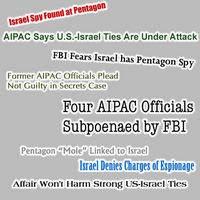 The excerpts below are taken from pages 30-35 of an 83-page working paper entitled "The Israel Lobby and U.S. Foreign Policy" and published by Harvard University's Kennedy School of Government in March 2006. Its authors are Professor John J. Mearsheimer, Department of Political Science, University of Chicago and Dean Stephen M. Walt, John F. Kennedy School of Government, Harvard University. The full text, including numerous endnotes omitted here, is available here. An edited and reworked version of the paper was published in the London Review of Books Vol. 28, No. 6 (March 23, 2006), and is available here
See also:Israel and the Iraq WarPressure from Israel and the [Israel—VFPD] Lobby was not the only factor behind the U.S. decision to attack Iraq in March 2003, but it was a critical element. Some Americans believe that this was a "war for oil," but there is hardly any direct evidence to support this claim. Instead, the war was motivated in good part by a desire to make Israel more secure. According to Philip Zelikow, a member of the President’s Foreign Intelligence Advisory Board (2001-2003), executive director of the 9/11 Commission, and now Counselor to Secretary of State Condoleezza Rice, the "real threat" from Iraq was not a threat to the United States. The "unstated threat" was the "threat against Israel," Zelikow told a University of Virginia audience in September 2002, noting further that "the American government doesn't want to lean too hard on it rhetorically, because it is not a popular sell."
On August 16, 2002, eleven days before Vice President Cheney kicked off the campaign for war with a hardline speech to the Veterans of Foreign Wars, the Washington Post reported that "Israel is urging U.S. officials not to delay a military strike against Iraq's Saddam Hussein." By this point, according to Sharon, strategic coordination between Israel and the U.S. had reached "unprecedented dimensions," and Israeli intelligence officials had given Washington a variety of alarming reports about Iraq's WMD programs. As one retired Israeli general later put it, "Israeli intelligence was a full partner to the picture presented by American and British intelligence regarding Iraq’s non-conventional capabilities."
Israeli leaders were deeply distressed when President Bush decided to seek U.N. Security Council authorization for war in September, and even more worried when Saddam agreed to let U.N. inspectors back into Iraq, because these developments seemed to reduce the likelihood of war. Foreign Minister Shimon Peres told reporters in September 2002 that "the campaign against Saddam Hussein is a must. Inspections and inspectors are good for decent people, but dishonest people can overcome easily inspections and inspectors."
... Or as Ha’aretz reported in February 2003: "The [Israeli] military and political leadership yearns for war in Iraq." But as [former Israeli Prime Minister] Netanyahu suggests, the desire for war was not confined to Israel's leaders. Apart from Kuwait, which Saddam conquered in 1990, Israel was the only country in the world where both the politicians and the public enthusiastically favored war. As journalist Gideon Levy observed at the time, "Israel is the only country in the West whose leaders support the war unreservedly and where no alternative opinion is voiced." In fact, Israelis were so gung-ho for war that their allies in America told them to damp down their hawkish rhetoric, lest it look like the war was for Israel.
The Lobby and the Iraq WarWithin the United States, the main driving force behind the Iraq war was a small band of neoconservatives, many with close ties to Israel's Likud Party. In addition, key leaders of the Lobby's major organizations lent their voices to the campaign for war. According to the Forward, "As President Bush attempted to sell the ... war in Iraq, America's most important Jewish organizations rallied as one to his defense. In statement after statement community leaders stressed the need to rid the world of Saddam Hussein and his weapons of mass destruction." The editorial goes on to say that "concern for Israel's safety rightfully factored into the deliberations of the main Jewish groups."
Although neoconservatives and other Lobby leaders were eager to invade Iraq, the broader American Jewish community was not. In fact, Samuel Freedman reported just after the war started that "a compilation of nationwide opinion polls by the Pew Research Center shows that Jews are less supportive of the Iraq war than the population at large, 52% to 62%." [The possibility that many respondents simply lied and that Jewish support for the war was much higher than the polls indicated should not be discounted. Above, the authors note, "Israelis were so gung-ho for war that their allies in America told them to damp down their hawkish rhetoric, lest it look like the war was for Israel." It is more than conceivable that American Jewish supporters of Israel consciously manipulated perception of their support, too.—VFPD] Thus, it would be wrong to blame the war in Iraq on "Jewish influence." Rather, the war was due in large part to the Lobby’s influence, especially the neoconservatives within it.
The neoconservatives were already determined to topple Saddam before Bush became President. They caused a stir in early 1998 by publishing two open letters to President Clinton calling for Saddam's removal from power. The signatories, many of whom had close ties to pro-Israel groups like JINSA or WINEP, and whose ranks included Elliot Abrams, John Bolton, Douglas Feith, William Kristol, Bernard Lewis, Donald Rumsfeld, Richard Perle and Paul Wolfowitz, had little trouble convincing the Clinton Administration to adopt the general goal of ousting Saddam. ... As important as the neoconservatives were for making the Iraq war happen, they needed help to achieve their aim.
That help arrived with 9/11. Specifically, the events of that fateful day led Bush and Cheney to reverse course and become strong proponents of a preventive war to topple Saddam. Neoconservatives in the Lobby—most notably Scooter Libby, Paul Wolfowitz, and Princeton historian Bernard Lewis—played especially critical roles in persuading the President and Vice-President to favor war. ...
A key part of this campaign [to win support for invading Iraq—VFPD] was the manipulation of intelligence information, so as to make Saddam look like an imminent threat. For example, Libby visited the CIA several times to pressure analysts to find evidence that would make the case for war, and he helped prepare a detailed briefing on the Iraq threat in early 2003 that was pushed on Colin Powell, then preparing his infamous briefing to the U.N. Security Council on the Iraqi threat. According to Bob Woodward, Powell "was appalled at what he considered overreaching and hyperbole. Libby was drawing only the worst conclusions from fragments and silky threads." Although Powell discarded Libby’s most outrageous claims, his U.N. presentation was still riddled with errors, as Powell now acknowledges.
The campaign to manipulate intelligence also involved two organizations that were created after 9/11 and reported directly to Undersecretary of Defense Douglas Feith. The Policy Counterterrorism Evaluation Group was tasked to find links between al Qaeda and Iraq that the intelligence community supposedly missed. Its two key members were Wurmser, a hard core neoconservative, and Michael Maloof, a Lebanese-American who had close ties with Perle. The Office of Special Plans was tasked with finding evidence that could be used to sell war with Iraq. It was headed by Abram Shulsky, a neoconservative with longstanding ties to Wolfowitz, and its ranks included recruits from pro-Israel think tanks.
Like virtually all the neoconservatives, Feith is deeply committed to Israel. He also has long-standing ties to the Likud Party. ... Wolfowitz is equally committed to Israel. The Forward once described him as "the most hawkishly pro-Israel voice in the Administration," and selected him in 2002 as the first among fifty notables who "have consciously pursued Jewish activism." ...
Finally, a brief word is in order about the neoconservatives' prewar support of Ahmed Chalabi, the unscrupulous Iraqi exile who headed the Iraqi National Congress (INC). They embraced Chalabi because he had worked to establish close ties with Jewish-American groups and had pledged to foster good relations with Israel once he gained power. This was precisely what pro-Israel proponents of regime change wanted to hear, so they backed Chalabi in return. Journalist Matthew Berger laid out the essence of the bargain in the Jewish Journal: "The INC saw improved relations as a way to tap Jewish influence in Washington and Jerusalem and to drum up increased support for its cause. For their part, the Jewish groups saw an opportunity to pave the way for better relations between Israel and Iraq, if and when the INC is involved in replacing Saddam Hussein’s regime."
Given the neoconservatives' devotion to Israel, their obsession with Iraq, and their influence in the Bush Administration, it is not surprising that many Americans suspected that the war was designed to further Israeli interests. For example, Barry Jacobs of the American Jewish Committee acknowledged in March 2005 that the belief that Israel and the neoconservatives conspired to get the United States into a war in Iraq was "pervasive" in the U.S. intelligence community. Yet few people would say so publicly, and most that did—including Senator Ernest Hollings (D-SC) and Representative James Moran (D-VA)—were condemned for raising the issue. Michael Kinsley put the point well in late 2002, when he wrote that "the lack of public discussion about the role of Israel ... is the proverbial elephant in the room: Everybody sees it, no one mentions it." The reason for this reluctance, he observed, was fear of being labeled an anti-Semite. Even so, there is little doubt that Israel and the Lobby were key factors in shaping the decision for war. Without the Lobby's efforts, the United States would have been far less likely to have gone to war in March 2003.
Dreams of Regional TransformationThe Iraq war was not supposed to be a costly quagmire. Rather, it was intended as the first step in a larger plan to reorder the Middle East. This ambitious strategy was a dramatic departure from previous U.S. policy, and the Lobby and Israel were critical driving forces behind this shift. This point was made clearly after the Iraq war began in a front-page story in the Wall Street Journal. The headline says it all: "President's Dream: Changing Not Just Regime but a Region: A Pro-U.S., Democratic Area is a Goal that Has Israeli and Neo Conservative Roots."
- 9/11 Commission Chairmen Admit Whitewashing the Cause of the Attacks
- The "JINSA Crowd" and the Iraq War
- "The Men From JINSA and CSP" by Jason West in The Nation
Labels: 9/11, Bush, Clintons, Iraq, Israel, Neoconservatives, War, Zionism
Sunday, August 13, 2006
9/11 Commission Chairmen Admit Whitewashing the Cause of the Attacks
As both the Bush administration and its client government in Israel, with their invasions of Arab states in Iraq and Lebanon, respectively, make the United States ever more hated in the Islamic world, a new book by the chairmen of the 9/11 commission admits that the commission whitewashed the root cause of the 9/11 attacks—that same interventionist U.S. foreign policy.
... Apparently, unidentified commissioners wanted to cover up the fact that U.S. support for Israel was one of the motivating factors behind al Qaeda's 9/11 attack. Although Hamilton, to his credit, argued for saying that the reasons al Qaeda committed the heinous strike were the U.S. military presence in the Middle East and American support for Israel, the panel watered down that frank conclusion to state that U.S. policy on the Israeli-Palestinian conflict and U.S. policy on Iraq are “dominant staples of popular commentary across the Arab and Muslim world.”
Some commissioners wanted to cover up the link between the 9/11 attack and U.S. support for Israel because this might imply that the United States should alter policy and lessen its support for Israeli actions. How right they were. The question is simple: if the vast bulk of Americans would be safer if U.S. politicians moderated their slavish support of Israel, designed to win the support of key pressure groups at home, wouldn’t it be a good idea to make this change in course? Average U.S. citizens might attenuate their support for Israel if the link between the 9/11 attacks and unquestioning U.S. favoritism for Israeli excesses were more widely known. Similarly, if American taxpayers knew that the expensive and unnecessary U.S. policy of intervening in the affairs of countries all over the world—including the U.S. military presence in the Middle East—made them less secure from terrorist attacks at home, pressure would likely build for an abrupt change to a more restrained U.S. foreign policy. ...
Labels: 9/11, Israel, Israel Lobby, United States


