Sunday, July 17, 2022
Cesare Beccaria on Gun Control
False is the idea of utility that sacrifices a thousand real advantages for one imaginary or trifling inconvenience; that would take fire from men because it burns, and water because one may drown in it; that has no remedy for evils, except destruction. The laws that forbid the carrying of arms are laws of such a nature. They disarm only those who are neither inclined nor determined to commit crimes. Can it be supposed that those who have the courage to violate the most sacred laws of humanity, the most important of the code, will respect the less important and arbitrary ones, which can be violated with ease and impunity, and which, if strictly obeyed, would put an end to personal liberty—so dear to men, so dear to the enlightened legislator—and subject innocent persons to all the vexations that the guilty alone ought to suffer? Such laws make things worse for the assaulted and better for the assailants; they serve rather to encourage than to prevent homicides, for an unarmed man may be attacked with greater confidence than an armed man. [Cramer's emphasis omitted].
Source: Clayton E. Cramer, Concealed Weapon Laws of the Early Republic: Dueling, Southern Violence, and Moral Reform (Greenwood, 1999) pp. 5-6 quoting Cesare Beccaria, On Crimes And Punishments, trans. by Henry Palolucci (New York: Bobbs-Merrill Co., 1963), 87-88.
Labels: civil liberties, crime, critical thinking, freedom, guns, quotations


Monday, January 11, 2021
Quotable: The Real Antagonist of Speech
It wasn't until my 30s that I began to understand free speech, that the real antagonist of speech is power. The only important question about a speech restriction is not who is being restricted but who gets to decide who is being restricted ...
Source: Former ACLU Executive Director Ira Glasser as quoted in an interview, "Would the ACLU Still Defend Nazis' Right To March in Skokie?", by Nick Gillespie, January, 2021.
Labels: civil liberties, freedom, politics, quotations
Friday, October 18, 2019
First, they came for the guns of the "neo-Nazis" ...
Police in Arlington, WA, recently seized the legally possessed firearms of Kaleb J. Cole, reportedly a "neo-Nazi" member of Atomwaffen. The weapons were seized pursuant to an Extreme Risk Protection Order (ERPO) issued by a King County judge at the request of the Seattle Police Department (SPD). Arlington, where Cole apparently lives, is in Snohomish County, WA. The long reach of the SPD, via RCW 7.94, across county lines is notable here.
Under Section 9 (see below) of the ERPO petition, "Violence and Threats", you may notice that it is indicated that Cole has "recently committed or threatened violence" and "shown ... a pattern of acts or threats of violence".

Yet, the SPD produces no conclusive evidence of any of that in its petition. The SPD's evidence consists of the decision by the Canadian government to exclude Cole along with two reports of an "Unknown suspect" placing Atomwaffen decals and two reports of people being offended by Cole engaging in protected First Amendment activities. The videos cited, which I have not seen, are offered in support of the allegation that Cole attended "ORGANIZED FIREARMS TRAINING/HATE CAMPS", neither of which are threats or acts of violence in any meaningful sense. Remarks in a KING 5 report are telling in regard to the lack of evidence of anything but thoughtcrimes here:
King County Prosecutor Dan Satterberg, whose deputy prosecutor Kim Wyatt argued the ERPO case before the judge, said the order to surrender guns is the right tool when law enforcement does not have enough evidence to file a criminal charge.
"In this case, the [FBI] joint terrorism task force had assessed Mr. Cole and said he was somebody who was doing more than thinking and talking about his extremist, violent beliefs, but that he was actually acting on it," Satterberg said.Yet, if he were "actually acting" on his beliefs in any criminal manner then he would be rightly subject to arrest. The KING 5 report also makes it clear that federal authorities, including the FBI and CBP, were instrumental in bringing this action forward.
The CBP report (Exhibit 3 of the ERPO petition) says: "COLE also stated that he discourages people (other members) from things that are illegal and he stated that his group is not interested in overthrowing the U.S. Government." The ERPO petition also included material about Atomwaffen from the disreputable ADL and SPLC.
If Cole and his associates were carrying out actual criminal activities such as harassment, assault, or homicide or conspiring to do so then I would be the first to say arrest and try them. What we, evidently, have here is a case of someone being deprived of their rights as guaranteed under the 1st, 2nd, 4th, and 14th Amendments to the US Constitution because of his objectionable ideas and his lawful activities in support of those ideas.
The rule of law and civil liberties are only as secure for members of any given majority as they are for a despised minority or individual. Unfortunately, this country has a long history of officials betraying those purported values when it is politically expedient or technically feasible.
In this case federal, state, county, and local authorities have all violated their oaths to uphold the U.S. Constitution and I am hoping civil libertarians will put aside their distaste for Cole's ideas long enough to mount a vigorous legal defense of the state and federal constitutions. It would be nice, too, to see some of the oath breakers—including, but not limited to, Seattle Police Chief Carmen Best, Seattle Police Sergeant Dorothy Kim, Seattle City Attorney Pete Holmes, Kim Wyatt, and Dan Satterberg—held accountable at the ballot box and/or in civil court.
Labels: censorship, civil liberties, freedom, government, guns, police, Seattle, surveillance, thoughtcrime
Tuesday, October 08, 2019
Orwell on "The Freedom of the Press"
... the chief danger to freedom of thought and speech at this moment is not the direct interference of the MOI [ministry of information—VFPD] or any official body. If publishers and editors exert themselves to keep certain topics out of print, it is not because they are frightened of prosecution but because they are frightened of public opinion. In this country intellectual cowardice is the worst enemy a writer or journalist has to face, and that fact does not seem to me to have had the discussion it deserves.Source: Orwell's Proposed Preface to Animal Farm. Animal Farm was first published in in England in 1945.
... The sinister fact about literary censorship in England is that it is largely voluntary.
Unpopular ideas can be silenced, and inconvenient facts kept dark, without the need for any official ban ... The British press is extremely centralised, and most of it is owned by wealthy men who have every motive to be dishonest on certain important topics. But the same kind of veiled censorship also operates in books and periodicals, as well as in plays, films and radio. At any given moment there is an orthodoxy, a body of ideas which it is assumed that all right-thinking people will accept without question ... Anyone who challenges the prevailing orthodoxy finds himself silenced with surprising effectiveness ...
At this moment what is demanded by the prevailing orthodoxy is an uncritical admiration of Soviet Russia. Everyone knows this, nearly everyone acts on it. Any serious criticism of the Soviet régime, any disclosure of facts which the Soviet government would prefer to keep hidden, is next door to unprintable. And this nation-wide conspiracy to flatter our ally takes place, curiously enough, against a background of genuine intellectual tolerance. For though you are not allowed to criticise the Soviet government, at least you are reasonably free to criticise our own ... [An American parallel would be the circumscribed nature of criticism of Israel in the US media—VFPD]
The servility with which the greater part of the English intelligentsia have swallowed and repeated Russian propaganda from 1941 onwards would be quite astounding if it were not that they have behaved similarly on several earlier occasions. On one controversial issue after another the Russian viewpoint has been accepted without examination and then publicised with complete disregard to historical truth or intellectual decency. To name only one instance, the BBC celebrated the twenty-fifth anniversary of the Red Army without mentioning Trotsky. This was about as accurate as commemorating the battle of Trafalgar without mentioning Nelson, but it evoked no protest from the English intelligentsia. In the internal struggles in the various occupied countries, the British press has in almost all cases sided with the faction favoured by the Russians and libelled the opposing faction, sometimes suppressing material evidence in order to do so ... Very similar things happened during the Spanish civil war. Then, too, the factions on the Republican side which the Russians were determined to crush were recklessly libelled in the English leftwing [sic] press, and any statement in their defence even in letter form, was refused publication. At present, not only is serious criticism of the USSR considered reprehensible, but even the fact of the existence of such criticism is kept secret in some cases ...
What is disquieting is that where the USSR and its policies are concerned one cannot expect intelligent criticism or even, in many cases, plain honesty from Liberal [sic — and throughout as typescript] writers and journalists who are under no direct pressure to falsify their opinions. Stalin is sacrosanct and certain aspects of his policy must not be seriously discussed. This rule has been almost universally observed since 1941, but it had operated, to a greater extent than is sometimes realised, for ten years earlier than that ... The English intelligentsia, or a great part of it, had developed a nationalistic loyalty towards the USSR, and in their hearts they felt that to cast any doubt on the wisdom of Stalin was a kind of blasphemy. Events in Russia and events elsewhere were to be judged by different standards. The endless executions in the purges of 1936-8 were applauded by life-long opponents of capital punishment, and it was considered equally proper to publicise famines when they happened in India and to conceal them when they happened in the Ukraine. And if this was true before the war, the intellectual atmosphere is certainly no better now.
But now to come back to this book [i.e. Animal Farm] of mine. The reaction towards it of most English intellectuals will be quite simple: 'It oughtn't to have been published.' Naturally, those reviewers who understand the art of denigration will not attack it on political grounds but on literary ones. They will say that it is a dull, silly book and a disgraceful waste of paper. This may well be true, but it is obviously not the whole of the story. One does not say that a book 'ought not to have been published' merely because it is a bad book. After all, acres of rubbish are printed daily and no one bothers. The English intelligentsia, or most of them, will object to this book because it traduces their Leader and (as they see it) does harm to the cause of progress. If it did the opposite they would have nothing to say against it, even if its literary faults were ten times as glaring as they are. The success of, for instance, the Left Book Club over a period of four or five years shows how willing they are to tolerate both scurrility and slipshod writing, provided that it tells them what they want to hear.
The issue involved here is quite a simple one: Is every opinion, however unpopular — however foolish, even — entitled to a hearing? Put it in that form and nearly any English intellectual will feel that he ought to say 'Yes'. But give it a concrete shape, and ask, 'How about an attack on Stalin? Is that entitled to a hearing?', and the answer more often than not will be 'No', In that case the current orthodoxy happens to be challenged, and so the principle of free speech lapses ... It is only, or at any rate it is chiefly, the literary and scientific intelligentsia, the very people who ought to be the guardians of liberty, who are beginning to despise it, in theory as well as in practice.
One of the peculiar phenomena of our time is the renegade Liberal. Over and above the familiar Marxist claim that 'bourgeois liberty' is an illusion, there is now a widespread tendency to argue that one can only defend democracy by totalitarian methods. [This calls to mind Karl Popper, the "totalitarian liberal"—VFPD] If one loves democracy, the argument runs, one must crush its enemies by no matter what means. And who are its enemies? It always appears that they are not only those who attack it openly and consciously, but those who 'objectively' endanger it by spreading mistaken doctrines. In other words, defending democracy involves destroying all independence of thought ...
These people don't see that if you encourage totalitarian methods, the time may come when they will be used against you instead of for you.
Labels: censorship, conspiracy, critical thinking, freedom, Karl Popper, media, Orwell, politics, quotations
Saturday, March 30, 2019
Facebook & Selective Censorship
 Enemies of freedom of thought and expression are hailing Facebook's recent reversal on banning "White nationalists" from its platform and from Instagram starting next week. Facebook's previous policy was as follows:
- Q: What is our stance on white supremacy, white nationalism and white separatism?
We don't allow praise, support and representation of white supremacy as an ideology. Eg. "White supremacy is the right thing"; "I am a white supremacist"; "Join the next White Supremacy rally!"
We allow praise, support and representation of white nationalism as an ideology. Eg. "White nationalism is the only way"; "I am a proud white nationalist"
We allow praise, support and representation of white separatism as an ideology. Eg. "White separatism is the perfect solution to America's problems"; "I am a white separatist". By the same token, we allow to call for the creation of white ethno-states (Eg. "The US should be a white-only nation")
Since then Facebook has been lobbied and attacked by the Humpty Dumpty brigade. Here's how the new policy arose according to Vice:
"We've had conversations with more than 20 members of civil society, academics, in some cases these were civil rights organizations, experts in race relations from around the world," Brian Fishman, policy director of counterterrorism at Facebook, told us in a phone call. "We decided that the overlap between white nationalism, [white] separatism, and white supremacy is so extensive we really can't make a meaningful distinction between them. And that's because the language and the rhetoric that is used and the ideology that it represents overlaps to a degree that it is not a meaningful distinction."Wow! "[M]ore than 20 members of civil society ..." That's surely representative of the full scope of views on the subjects of White nationalism and freedom of thought and expression. Of course, it is completely coincidental that Brian Fishman has been part of "regular consulting meetings" between Facebook execs and representatives of the Simon Wiesenthal Center's (SWC) Digital Terrorism and Hate Project, including Rabbi Abraham Cooper, SWC Associate Dean.

Also coincidental is that, apparently, only "White nationalism" will be banned by Facebook because no one ever died from violent Jewish nationalists (see here, here, and here) or violent Chinese nationalists or violent Black nationalists (see here, here, and here). On that subject The Deseret News reports:
As Motherboard [a Vice subdomain] reported, Facebook will still allow content relating to black separatist movements and the Basque separatist movement to be posted, due to experts' arguments that white separatism should be handled differently "because of the long history of white supremacism that has been used to subjugate and dehumanize people of color in the United States and around the world."To paraphrase Orwell, when it comes to Facebook Farm: All nationalisms are equal but some nationalisms are more equal than others. We'll see what happens when the new policy is implemented but as of today the Facebook page featured below was still live on Facebook:
However, Facebook does ban content centered on black nationalism, Motherboard reported. The Southern Poverty Law Center has characterized groups that espouse black nationalist ideology as hate groups, with the added proviso that "they should not be seen as equivalent to white supremacist groups — such as the Ku Klux Klan or neo-Nazis — in terms of their history of violence and terrorism."
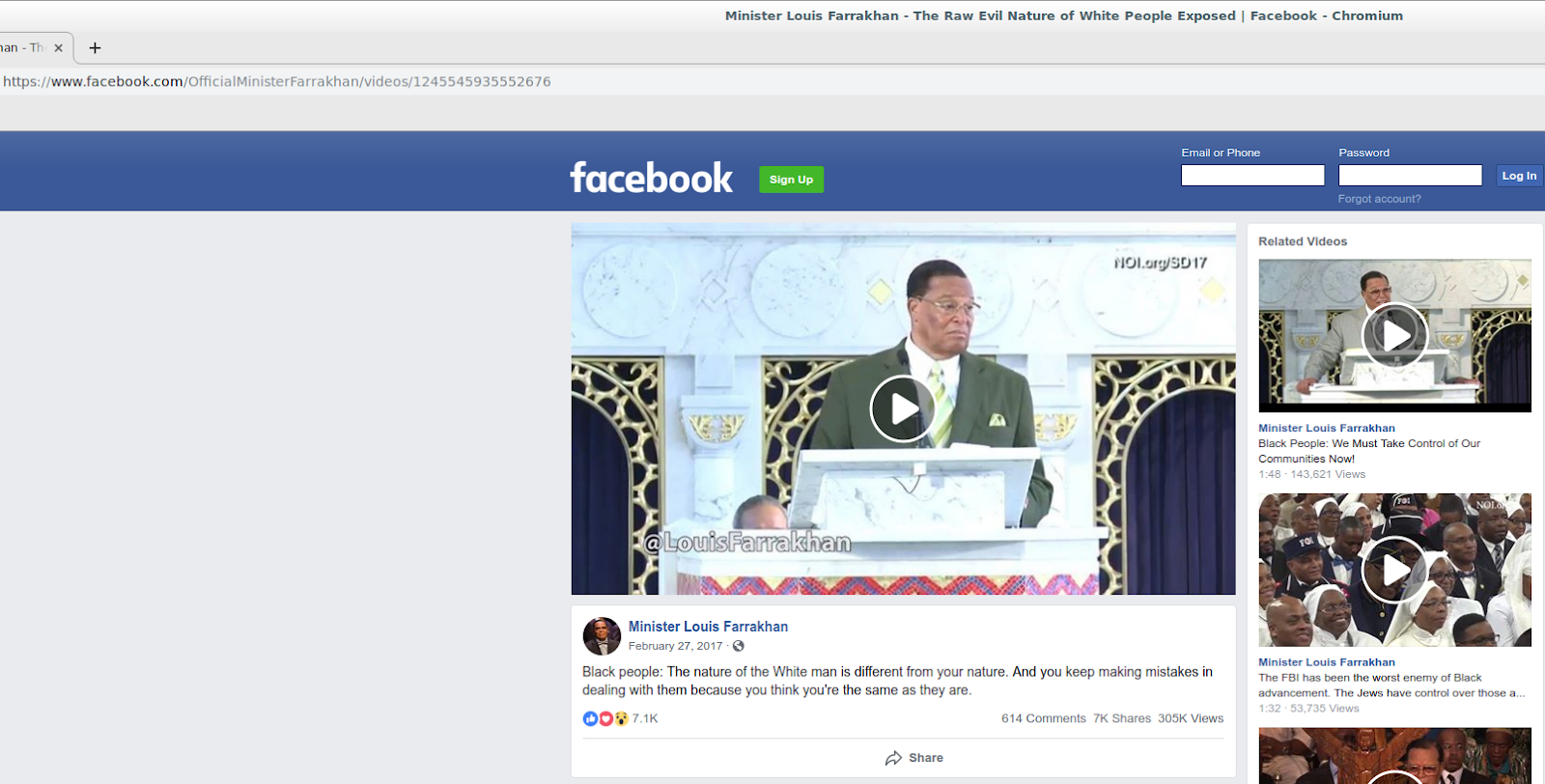
This seems to contradict the claim made in The Deseret News. You see, Louis Farrakhan is profiled as an "extremist", "antisemite", and a "Black Nationalist" by the SPLC and he is the head of the Nation of Islam (NOI), which is an "SPLC Designated Hate Group". The pictured video sub-page is entitled "Minister Louis Farrakhan - The Raw Evil Nature of White People Exposed" and Farrakhan's main page prominently features a link to the NOI main web site.
To be clear, I am no proponent of the SPLC and I don't support banning Farrakhan or the NOI from Facebook. Nor do I support banning White nationalists or supremacists. I do support banning people and entities advocating violence and related criminal activity although I don't think mere criminal advocacy or activity should be the threshold for censorship on Facebook.
For example, it was once a crime for Black people to, among other things, ride at the front of the bus or to dine in certain restaurants. Today, it is illegal, under Israeli law, for anyone anywhere in the world to advocate for a boycott of Israel; sedition is still, arguably, a crime in the United States; apostasy from Islam is punishable by death in some countries; and, a man in China was fined this year for using a VPN to access foreign web sites. Should Facebook censor speech reporting, supporting, or enabling those crimes?
While I have some sympathy with those who support regulating Facebook as a utility, I'm not fully convinced it would be a good idea. Moreover, I doubt that it will happen because that might open the door to treating Facebook as a common carrier and therefore intolerably impinge on the Left's ability to successfully pressure Facebook to censor crimethink.
In any case, my preferred approach to controversial speech is Millian:
But the peculiar evil of silencing the expression of an opinion is, that it is robbing the human race; posterity as well as the existing generation; those who dissent from the opinion, still more than those who hold it. If the opinion is right, they are deprived of the opportunity of exchanging error for truth: if wrong, they lose, what is almost as great a benefit, the clearer perception and livelier impression of truth, produced by its collision with error ...
Complete liberty of contradicting and disproving our opinion, is the very condition which justifies us in assuming its truth for purposes of action; and on no other terms can a being with human faculties have any rational assurance of being right ...
He who knows only his own side of the case, knows little of that. His reasons may be good, and no one may have been able to refute them. But if he is equally unable to refute the reasons on the opposite side; if he does not so much as know what they are, he has no ground for preferring either opinion.
Labels: censorship, freedom, J.S. Mill, media, Orwell, quotations, race, repression, technology, thoughtcrime, violence, White folks
Sunday, September 11, 2016
In Honor of Patriot Day
The true patriot … rejects the notion that patriotism means obedience to the state. Unquestioned loyalty to the state is especially demanded in times of war. Lack of support for a war policy is said to be unpatriotic. … Yet, it is dissent from government policies that defines the true patriot and champion of liberty ... we must not forget that the true patriot is the one who protests in spite of the consequences …
We are continually being reminded that 9/11 has changed everything.
Unfortunately, the policy that needed most to be changed, that is, our policy of foreign interventionism, has only been expanded …
The record since September 11th is dismal. Respect for liberty has rapidly deteriorated. Many of the new laws passed after 9/11 had, in fact, been proposed long before that attack. The political atmosphere after that attack simply made it more possible to pass such legislation. The fear generated by 9/11 became an opportunity for those seeking to promote the power of the state domestically, just as it served to falsely justify the long-planned invasion of Iraq …
Though opposition to totally unnecessary war should be the only moral position, the rhetoric is twisted to claim that patriots who oppose the war are not supporting the troops. The cliché 'Support the Troops' is incessantly used as a substitute for the unacceptable notion of supporting the policy, no matter how flawed it may be.
Unsound policy can never help the troops. Keeping the troops out of harm's way and out of wars unrelated to our national security is the only real way of protecting the troops. With this understanding, just who can claim the title of 'patriot'?
Before the war in the Middle East spreads and becomes a world conflict for which we will be held responsible, or the liberties of all Americans become so suppressed we can no longer resist, much has to be done. Time is short, but our course of action should be clear. Resistance to illegal and unconstitutional usurpation of our rights is required. Each of us must choose which course of action we should take: education, conventional political action, or even peaceful civil disobedience to bring about necessary changes.
But let it not be said that we did nothing …
Source: US Representative Ron Paul (R-Texas). "Patriotism." Congressional Record 153:84 (May 22, 2007; 110th US Congress) pp. H5609-H5612.
Labels: 9/11, freedom, military, patriotism, quotations, Ron Paul, terrorism, United States, War
Sunday, May 01, 2016
Quotable: The Military Threat to Liberty
A standing Army, however necessary it may be at some times, is always dangerous to the Liberties of the People. Soldiers are apt to consider themselves as a Body distinct from the rest of the Citizens. They have their Arms always in their hands. Their Rules and their Discipline is severe. They soon become attachd to their officers and disposd to yield implicit Obedience to their Commands. Such a Power should be watchd with a jealous Eye ... Men who have been long subject to military Laws and inured to military Customs and Habits, may lose the Spirit and Feeling of Citizens. And even Citizens, having been used to admire the Heroism which the Commanders of their own Army have displayd, and to look up to them as their Saviors may be prevaild upon to surrender to them those Rights for the protection of which against Invaders they had employd and paid them. We have seen too much of this Disposition among some of our Countrymen.
Source: Samuel Adams, "Founding Father" and American revolutionary, in his letter to James Warren (January 7, 1776) in the Warren-Adams Letters: Being Chiefly a Correspondence Among John Adams, Samuel Adams, and James Warren, Vol. 1, 1743-1777, (Massachusetts Historical Society, 1917) pp. 197-198.
Of all the enemies to public liberty war is, perhaps, the most to be dreaded ... War is the parent of armies; from these proceed debts and taxes; and armies, and debts, and taxes are the known instruments for bringing the many under the domination of the few. ... No nation could preserve its freedom in the midst of continual warfare.
Source: James Madison, "Father of the US Constitution" and 4th US President, from his pamphlet entitled Political Observations (April 20, 1795) in the Selected Writings of James Madison (Hackett, 2006) p. 236.
See also: "John Adams on the Military Threat"
Labels: freedom, history, James Madison, militarism, military, quotations, United States, US Founding Fathers, War
Sunday, October 11, 2015
Nothing But The Truth
This film is inspired by the Valerie Plame affair but it's not a retelling of that story. It is a sophisticated cinematic exploration of the clash between the imperatives of government and a free society.
See also: "L'affaire Plame" by Justin Raimondo on Antiwar.com.
Labels: civil liberties, film & television, freedom, politics, Valerie Plame, War
Saturday, September 12, 2015
Quotable: Freedom, Evil, & Utopia
... to take away a man's freedom of choice, even his freedom to make the wrong choice, is to manipulate him as though he were a puppet and not a person.
Source: Character of Canon Tom Tallis in Madeleine L'Engle's The Young Unicorns (Macmillan, 2008), p. 202.
... when evil declares itself in its absolute form, it declares itself as an angel of light.
Source: Tallis, p. 237.
... Utopia ... is always a heresy, no matter how nobly conceived.
Source: Tallis, p. 241.
Labels: art and literature, Christianity, freedom, Madeleine L'Engle, philosophy, quotations
Monday, August 17, 2015
Quotable: On Guardians
Laziness and cowardice are the reasons why such a large part of mankind gladly remain minors all their lives, long after nature has freed them from external guidance. They are the reasons why it is so easy for others to set themselves up as guardians. It is so comfortable to be a minor.
Source: Immanuel Kant, "An Answer to the Question: What is Enlightenment?" as quoted in The Enlightened Soldier: Scharnhorst and the Militarische Gesellschaft in Berlin, 1801-1805 (New York: Praeger, 1989) by Charles E. White, p. 1.
Labels: critical thinking, freedom, lazy thinking, philosophy, quotations, Scharnhorst
Tuesday, May 19, 2015
Happy Malcolm X Day
I believe that there will be a clash between those who want freedom, justice, and equality for everyone and those who want to continue the systems of exploitation. I believe that there will be that kind of clash, but I don't think that it will be based upon the color of the skin ...Source: Al-Hajj Malik El-Shabazz a.k.a. Malcolm X, Toronto, January 19, 1965.
Labels: freedom, Justice, Malcolm X, quotations, race, resistance
Saturday, July 13, 2013
White's "The Science Delusion"
It is very advisable to examine and dissect the men of science for once, since they for their part are quite accustomed to laying bold hands on everything in the world, even the most venerable things, and taking them to pieces. –Friedrich Nietzsche, epigraph to The Science Delusion.
Curtis White's latest non-fiction offering is The Science Delusion: Asking the Big Questions in a Culture of Easy Answers (Melville House, 2013). For those who wonder about such things, a self-described atheist, White is not critiquing science from a religious perspective. White's attack is grounded in the notion of classical Romanticism as a counterculture to a science or scientism that seeks to subsume or devalue non-scientific human enterprises such as art, religion, and philosophy.
White begins by taking a look at the "new atheists"--Dawkins, Hitchens, Rosenberg, and Harris—observing "that the story these writers have to tell is one that a very powerful part of our culture wants told and emphatically so" (p. 3). He develops the idea of science's "too-comfortable place in the broader ideology of social regimentation, economic exploitation, environmental destruction, and industrial militarism," declaring that "how the ideology of science meshes with the broader ideology of capitalism will be a consistent interest of my investigation here" (p. 11). In this vein, White wonders: "Where is Richard Dawkins's book on the almighty, self-correcting Market God? Or on the military-industrial complex that science and technology has made possible? But, then, it's not in science's interest to notice such things" (p. 55).
After taking on the new atheists, White goes after biology, neuroscience, and physics. Lawrence Krauss, Watson and Crick, Richard Feynman, Stephen Hawking, and Sebastian Seung, among others, fall under White's withering gaze. Along the way, he also brings to bear the arguments of others more attuned to Romanticism, citing for example, Friedrich Schiller: "Art's primary purpose as antagonist to the 'robot' is to 'model freedom.' 'Art models freedom' is Schiller's aesthetic mantra, and it is the Romantic aesthetic in full force. Do you want to know what it is like to be free? Then live in art. ... Art is a counter-discourse, it is a counterculture, or it's not art" (p. 69).
Contra reductive physicalism/materialism, White also cites physicist Arthur Eddington: "The stuff of the world is mind-stuff" (p. 174).. And James Jeans, also a physicist: "I incline to the idealistic theory that consciousness is fundamental, and that the material universe is derivative from consciousness, not consciousness from the material universe ... In general the universe seems to me to be nearer to a great thought than to a great machine" (p. 174).
In closing, here are two excerpts from White's final pages:
"We [Americans] are a culture in which self-evident lies, supported by stunning lapses in argument, are eagerly taken up by our most literate public, which is happy to call it 'fascinating' and 'provocative,' while also assuming it is our inevitable future" (p. 182).
"... Romanticism goes science one better: it also liberates us from the scam—the delusions—of science, of technology, and of the reign of the ever more efficient administration of life that has been the essential problem in the West for the last two centuries" (p. 192).
See also:
- Mark Kingwell, "Taking on scientism's big bullies: Hitchens, Dawkins and Pinker."The Globe and Mail. 14 June 2013.
- Pat Finn. "Romanticism for the 21st Century: Curtis White's 'The Science Delusion.' "Tottenville Review. Undated.
- Maggie Koerth-Baker. "The real problem with Curtis White's The Science Delusion." Boing Boing. 20 June 2013.
- Curtis White. "Ode to a Straw Man: What critics are getting wrong about my book." Slate. 12 July 2013.
Labels: art and literature, Curtis White, freedom, science, technology
Friday, May 24, 2013
Quotable: Cooperation
Source: Mohandas K. Gandhi as quoted in Gene Sharp, The Politics of Nonviolent Action. "Part 1. Power and Struggle." (Extending Horizons Books, 1973, 2006) p. 47.
Labels: freedom, Gandhi, poverty, quotations
Thursday, May 24, 2012
Quotable: Historians & Deconstruction

Most sources contain intentional messages. That is to say, they were produced by some person or persons for the purpose of conveying information to an audience. Oral, written, and visual sources can all contain intentional messages. ... Often, the meaning is open to debate ... Nevertheless it is clear that there are intentional messages ... We call the practice of seeking to understand the information or messages that the authors of the text wanted to convey to their audience reading with the grain. ...
However, texts also contain messages that their authors did not intend to convey to their audience. Often these messages are a set of assumptions. ... By definition, these assumptions are not explicitly stated in the text because they are assumed by the author to be universal truths that anyone (or at least the audience) would immediately recognize.
It is necessary, therefore, to read against the grain--or to deconstruct our sources--in order to gain access to the assumptions. The practice of deconstruction generally involves a series of steps. The first of these is to establish the origins, author, and other evidentiary issues about the text and to read it with the grain. It is especially important to know as much as possible about the author--his or her status in society, life experiences, political and cultural outlook, and so forth.This is because the assumptions we are looking for are usually generated communally and shared among a group. ...
The next step in deconstruction requires the researcher to search for assumptions and figurative language--metaphors, similes, stereotypes, and the like. Often, it is useful to look at a range of documents as a way of identifying language that is commonly used by many people in the same society or social group. At the same time, it is important to read the document closely to see where explanations end and assumptions begin--in other words, to search out the points that the author assumes need no explanation.
Source: Trevor R. Getz and Liz Clarke. Abina and the Important Men: A Graphic History (New York: Oxford UP,
2012) pp. 126-127.
Labels: Africa, art and literature, civil liberties, freedom, history, law, quotations, slavery
Sunday, May 13, 2012
Keynes on Hayek's "The Road to Serfdom"
Source: Nicholas Wapshott. Keynes Hayek: The Clash that Defined Modern Economics (New York: Norton & Co., 2011) p. 198.
I've posted this quote not as a blanket endorsement of Hayek's book but because I was surprised to read that Keynes actually had something good to say about it--shows you how little I know about Keynes, I suppose. I mainly agree with the Libertarian critique of the state. It's been a long time since I read The Road to Serfdom so I can't say if this is true of Hayek but what I generally find lacking in Libertarian rhetoric is an acknowledgement of and grappling with the real threat to liberty posed by private, as opposed to state, power. As if to confirm that it turns out that General Motors bankrolled the distribution of a cartoon version of the The Road to Serfdom, which was first published in Look in February 1945 (see video below).
See also:
- "The Road from Serfdom" by Thomas W. Hazlett on Reason.com
- "Why I Am Not a Conservative" by Friedrich Hayek on LewRockwell.com
Labels: economics, freedom, politics, quotations, video
Saturday, April 21, 2012
Quotable: The Man to Fear
David Atkins seems to be an honest Liberal, he unapologetically says Liberalism is "paternalistic" and an ideology that fully sanctions the use of violence in the name of the "weak and powerless". Of course, nearly everyone dresses up their use of violence in the garb of justice, freedom, or whatever.
Related to this is another contradiction peculiar to Liberal peace advocates—their unthinking embrace of tax-supported government progams in the name of equality, justice, etc. Liberals seldom seem to acknowledge that behind the tax collector is someone with a gun ready to put you behind bars if you don't pay up and to kill you if it comes to it. As Voltairine de Cleyre put it one hundred years ago: " ... even when the State does good things, it finally rests on a club, a gun, or a prison, for its power to carry them through."
Lost, too, is the lesson of Mohandas K. Gandhi: "The State represents violence in a concentrated and organized form. The individual has a soul, but as the State is a soulless machine, it can never be weaned from violence to which it owes its very existence." And as Paulo Freire wrote more recently: "Welfare programs ... ultimately serve the end of conquest. They act as an anesthetic, distracting the oppressed from the true causes of their problems and from the concrete solutions of these problems. "
American Liberals ought to embrace the political approach of Conservatives who don't want tax funds used to support abortion and apply that to their opposition of US foreign wars but that's unlikely to happen. If Liberals embraced that principle they would have to reject their paternalism and embrace of force as a means to their ends.
Any way, I digress. What set me to thinking about all this was something I read today in Samuel Noah Kramer's History Begins at Sumer: Thirty-Nine Firsts in Recorded History (U Penn Pr, 1981). At least 3,762 years ago, some Sumerian scribe wrote down this bit of wisdom:
You can have a lord, you can have a king,
But the man to fear is the tax collector!
Labels: abortion, anarchism, freedom, Gandhi, history, politics, quotations
Friday, January 13, 2012
Quotable: What Liberalism Is (or Why I'm Not a Liberal)
Liberalism is and has always been about intervention. ... Liberals understand that power corrupts, and absolute power corrupts absolutely. Left to their own devices, people with weapons and money will always try to exploit and dominate people without weapons and money unless they are stopped from doing so. It is not because we are taught to do so. It's just innate human nature. ...
When the government steps in to stop a corporation from dumping noxious chemicals into a stream, that is intervention at the point of a gun, by a superior force against a lesser force attempting to exploit the weak and powerless. When the government steps in to enforce desegregation in schools, that is intervention at the point of a gun, by a superior force against a lesser force attempting to exploit the weak and powerless.
When Abraham Lincoln and the North decided not to allow the nation of the Confederacy--and make no mistake, it was a separate nation with separate laws and an entirely separate culture--to secede from the Union, in large part because the North had an interest in ending slavery in the South and in striking down a competing agrarian economic system, that too was intervention by a superior force against a lesser force attempting to exploit the weak and powerless. To this day, many Southerners feel that their land is being occupied by an illegitimate and invading power, and theirs a Lost Cause that will rise again.
This is what liberalism is. It is unavoidably, inescapably paternalistic in nature. It is so because it understands the inevitable tendency of human beings to be truly awful to one another unless social and legal rules are put in place--yes, by force--to prevent them from doing otherwise.
Source: David Atkins. "No, Stoller and Sullivan: there is no liberal conflict over Ron Paul." January 03, 2012.
See also: "Quotable: The Man to Fear"
Labels: freedom, history, politics, quotations
Wednesday, August 17, 2011
Films: The Appeared & The Escapist
Rupert Wyatt's The Escapist is a clever British prison break film inspired by American author Ambrose Beirce's Civil War-era short story, An Occurrence at Owl Creek Bridge. The film carries a timely message about the nature of freedom and captivity. For good reason, the film won or was nominated for several awards in the UK and Ireland.
Labels: art and literature, film & television, freedom, history, video
Wednesday, January 27, 2010
Quotable: "I wish for freedom."
Source: Character of Andrew in "The Bicentennial Man" in Isaac Asimov's Robot Visions (New York: Roc, 1990) p. 256.
Labels: art and literature, freedom, quotations, robots
Thursday, December 18, 2008
Free Muntadhar al-Zaidi!
 Nothing gives the lie to the notion of "Iraqi democracy" like the fact that Muntadhar al-Zaidi-- wielder of two size 10 'weapons of mass humiliation'--is still in police custody in Iraq. He is charged with "attacking a head of state" and faces up to two to fifteen years in prison. Zaidi's employer, Iraqi television station Al-Baghdadia, demanded Zaidi's release "in line with the democracy and freedom of expression that the American authorities promised the Iraqi people." Meanwhile, on Thursday, the U.S. diplomats in Cairo asked the Egyptian minister of culture to close the Egyptian offices of Al-Baghdadia.
In lighter news, my high score after
Labels: Bush, freedom, Iraq, resistance