Sunday, June 07, 2015
Quotable: Jews, Christianity, & Porn
... Jewish involvement in the X-rated industry can be seen as a proverbial two fingers to the entire WASP establishment in America. Some porn stars viewed themselves as frontline fighters in the spiritual battle between Christian America and secular humanism. According to [Luke] Ford*, Jewish X-rated actors often brag about their 'joy in being anarchic, sexual gadflies to the puritanical beast'. Jewish involvement in porn, by this argument, is the result of an atavistic hatred of Christian authority: they are trying to weaken the dominant culture in America by moral subversion. ... Al Goldstein, the publisher of Screw, said (on lukeford.net), 'The only reason that Jews are in pornography is that we think that Christ sucks. Catholicism sucks. We don't believe in authoritarianism.' Pornography thus becomes a way of defiling Christian culture and, as it penetrates to the very heart of the American mainstream (and is no doubt consumed by those very same WASPs), its subversive character becomes more charged. ...
It is a case of the traditional revolutionary/radical drive of immigrant Jews in America being channelled into sexual rather than leftist politics. Just as Jews have been disproportionately represented in radical movements over the years, so they are also disproportionately represented in the porn industry.
* Elsewhere in the article Ford is referred to by the author as an "Orthodox Jew and porn gossipmonger".
Source: Nathan Abrams. "Triple-exthnics". Jewish Quarterly (Winter 2004). No. 196, p. 30.
 |
| Ron Jeremy as Jesus in the 2012 film Bloody Bloody Bible Camp. Nathan Abrams calls Jeremy "The doyen of the Hebrew studs ... one of America's biggest porn stars." Note: I have not seen the film and cannot confirm this image appears in it. |
Labels: Christianity, Hollywood, Jews, media, prostitution, quotations


Saturday, March 01, 2008
Trafficking of Korean Women in US

Below are the first few paragraphs from a new article by Kari Lydersen on Infoshop News.
Korean massage parlors are a common presence in most major U.S. cities – so much that those in the know refer to them with the acronym of KMPs. It is also widely known that these venues offer more than a massage – they function essentially as brothels, where South Korean women work as prostitutes controlled by a wide-reaching, shadowy and highly profitable network of traffickers and pimps.Read the rest of the article here.
Anti-trafficking, women's rights and immigrants rights advocates are increasingly focusing on this segment of trafficking and sexual exploitation in the United States. The Polaris Project has focused extensively on Korean massage parlors and trafficking of Korean women in California. In Chicago, a coalition of immigrants' rights, anti-domestic violence and ethnic groups are in the early stages of developing an outreach and advocacy structure for Korean women caught up in these situations.
Trafficking for sex work, domestic work and other types of labor is a poisonous manifestation of the increasingly global economy, where people in impoverished countries – especially women – fall prey to traffickers' false promises of a better life in another country or are even literally sold into slavery by family members or kidnappers. The U.S. government estimates that about 17,500 foreigners are trafficked into the U.S. annually, though some NGOs put the number much higher. Sex trafficking is considered to make up about 80 percent of cases, with trafficking for domestic, agricultural, food service and other types of labor making up the rest.
In general the pipeline of trafficked people flows from the most impoverished countries to wealthier ones within a region; for example from El Salvador to Mexico; or Romania to the Czech Republic; or Nepal to India. Then, either after going through those pipelines or directly from their points of origin, people are trafficked across continents to the wealthiest destinations: the U.S., Israel and parts of Western Europe.
South Korea ranks third as the point of origin for trafficking cases in the U.S., according to the National Immigrant Justice Center, behind Mexico and China and ahead of the Philippines and Thailand. Though exact numbers are impossible to come by, it is estimated at least 10,000 Korean women are doing sex work in the U.S.
See also:
- Opposing Prostitution As a Form of Male Violence: the Swedish Model
- Apologies & Global Dimming
- Glass Houses & 'Comfort Women'
Labels: Empire, gender, inequality, prostitution, United States, violence
Sunday, April 29, 2007
Glass Houses & 'Comfort Women'
 Thanks to an anonymous commenter to my "Apologies & Global Dimming" post for the tip on the April 2007 AP report: "Documents: U.S. troops used 'comfort women' after WWII."
Right: U.S. sailors gather in front of a Yasu-ura House "comfort station" in Yokosuka, south of Tokyo, in this undated image released by the Yokosuka City Council.
See also: Opposing Prostitution As a Form of Male Violence: the Swedish Model
Labels: prostitution, United States, violence
Saturday, April 28, 2007
Apologies & Global Dimming
 Japanese Prime Minister Shinzo Abe was in Washington last week. A focus of many of the news stories has been on the (in)sufficency of his country's apologies "for Japan's wartime exploitation of foreign women as military prostitutes." The US House of Representatives is working on a "resolution to demand another formal apology from Japan to the so-called comfort women."
The Chinese and Koreans have every right to pursue this matter but American politicians ought to shut their mouths until the US apologizes for using the nuclear weapons that killed 155,000 to 214,000 people, mostly Japanese civilians, in the cities of Hiroshima and Nagasaki. As Admiral William D. Leahy said:
It is my opinion that the use of this barbarous weapon at Hiroshima and Nagasaki was of no material assistance in our war against Japan. The Japanese were already defeated and ready to surrender because of the effective sea blockade and the successful bombing with conventional weapons.And where is the US apology for the prostitution that is to this day endemic at many overseas US military bases, including Okinawa, Japan? To learn more about the impact of such prostitution in the Philippines, see "Campaign Against The Return Of Military Prostitution."
While we're on the subject of apologies, it turns out that the droughts that triggered, but did not cause, the famines in sub-Saharan with their millions of victims in the 1970s and 80s may have been caused by the pollution of industrialized nations, mostly in Europe and North America. According to the PBS documentary film, Dimming the Sun (watch trailer here), the pollution probably resulted in a cooling effect that caused the African monsoon rains to fail.
Labels: Africa, famine, Japan, nuclear weapons, prostitution, United States, violence
Sunday, October 01, 2006
Opposing Prostitution As a Form of Male Violence: the Swedish Model
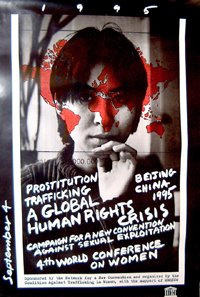 Right: Artist Mona Mark created this poster for the Coalition Against Trafficking in Women for the Fourth World Conference on Women, Beijing, 1995. Image source: Prostitution Research & Education.
From the old news department comes an article in the June-July 2005 issue of the American Friends Service Committee's Peacework Magazine. Below is an opening excerpt from "Opposing Prostitution As a Form of Male Violence: the Swedish Model" by Marie De Santis, director of the Women's Justice Center/Centro de Justicia Para Mujeres.
In the fog of clichés despairing that "prostitution will always be with us," one country's success stands out as a beacon lighting the way. In just five years Sweden has dramatically reduced the number of women in prostitution. In the capital city of Stockholm, the number of women in street prostitution has been reduced by two thirds, and the number of "johns" has been reduced by 80%. There are other major Swedish cities where street prostitution has all but disappeared. Gone too, for the most part, are the infamous Swedish brothels and massage parlors which proliferated during the last three decades of the twentieth century, when prostitution in Sweden was legal.Read the rest of the article here.
In addition, the number of foreign women now being trafficked into Sweden for sex work is almost nil. The Swedish government estimates that in the last few years only 200 to 400 women and girls have been annually sex trafficked into Sweden, a figure that's negligible compared to the 15,000 to 17,000 females yearly sex trafficked into neighboring Finland. No other country, nor any other social experiment, has come anywhere near Sweden's promising results.
By what complex formula has Sweden managed this feat? Amazingly, Sweden's strategy isn't complex at all. Its tenets, in fact, seem so simple and so firmly anchored in common sense as to immediately spark the question, "Why hasn't anyone tried this before?"
Sweden's Groundbreaking 1999 Legislation
In 1999, after years of research and study, Sweden passed legislation that a) criminalizes the buying of sex, and b) decriminalizes the selling of sex. The novel rationale behind this legislation is clearly stated in the government's literature on the law:
"In Sweden prostitution is regarded as an aspect of male violence against women and children. It is officially acknowledged as a form of exploitation of women and children and constitutes a significant social problem ... gender equality will remain unattainable so long as men buy, sell, and exploit women and children by prostituting them."
In addition to the two-pronged legal strategy, a third and essential element of Sweden's prostitution legislation provides for ample and comprehensive social service funds aimed at helping any prostitute who wants to get out, and additional funds to educate the public. As such, Sweden's unique strategy treats prostitution as a form of violence against women in which the men who exploit by buying sex are criminalized, the mostly female prostitutes are treated as victims who need help, and the public is educated in order to counteract the historical male bias that has long stultified thinking on prostitution. To securely anchor their view in firm legal ground, Sweden's prostitution legislation was passed as part and parcel of the country's 1999 omnibus violence against women legislation.
Labels: gender, prostitution, violence


