Monday, June 15, 2020
Popper & Tolerance
Almost thirteen years ago, I wrote a post, citing Chris Hedges, that mentioned Karl Popper and his contrived "paradox of tolerance". I also invoked Popper again last year in a post quoting George Orwell.
In note 4 to chapter 7 of The Open Society and Its Enemies (1945) Popper writes:
Less well known is the paradox of tolerance: Unlimited tolerance must lead to the disappearance of tolerance. If we extend unlimited tolerance even to those who are intolerant, if we are not prepared to defend a tolerant society against the onslaught of the intolerant, then the tolerant will be destroyed, and tolerance with them.—In this formulation, I do not imply, for instance, that we should always suppress the utterance of intolerant philosophies; as long as we can counter them by rational argument and keep them in check by public opinion, suppression would certainly be most unwise. But we should claim the right to suppress them if necessary even by force; for it may easily turn out that they are not prepared to meet us on the level of rational argument, but begin by denouncing all argument; they may forbid their followers to listen to rational argument, because it is deceptive, and teach them to answer arguments by the use of their fists or pistols. We should therefore claim, in the name of tolerance, the right not to tolerate the intolerant.Here is a graphic representation of Popper's ideas:


If you doubt whether Popper's "paradox of tolerance" enjoys any currency on the Left then please consider that a slightly longer version of the text quoted above appears as the epigraph to the first chapter, "Faith", of Chris Hedges' 2006 book American Fascists. Consider, too, that billionaire George Soros considers himself a protégé of Karl Popper and derived the name of his Open Society Foundations from Popper's book title. Then please have a look at these articles in The Washington Post, Patheos, Quartz, Kottke.org, Big Think, The New York Times, Salon, Open Culture, and Hornet, for example.
The problem with Popper's supposed paradox should be obvious but it, apparently, is not. To illustrate, here is what Popper should have said:
But we should claim the right to suppress them if necessary even by force if they or their followers advance their ideas by the use of their fists, pistols, or other means of actual criminal violence. But even then we must be clear that is not their ideas we suppress but their violence in furtherance of those ideas, which would be criminal even if stripped of any ideology whatsoever.In other words, the problem is not with "intolerant" ideas (Who gets to decide that?) but with violent, coercive actions that are used to promote those or any other ideas. I don't mean to say that society has to wait until the "intolerant" carry out actual violence but, at a minimum, there should be solid evidence of an actual, imminent attack. Thus, there is no paradox of tolerance.
What cannot be tolerated is not intolerance but criminal activity in support of "tolerance", "intolerance", or no ideology whatsoever. Ironically, as has been made abundantly clear in the last two weeks of looting, arson, shootings, assaults, theft, and vandalism in the George Floyd riots, many on the Left have a high tolerance for criminality in advance of a favored ideology. In this case the favored ideology is "anti-racism" i.e. the intolerance of alleged "racism".
Popper is not the only figure associated with the Left who advocated a constrained view of "tolerance". As cited in Sculos and Walsh, Herbert Marcuse wrote in a 1965 essay titled "Repressive Tolerance" (later published in A Critique of Pure Tolerance) that "a liberating tolerance:"
[W]ould include the withdrawal of toleration of speech and assembly from groups and movements which promote aggressive policies, armament, chauvinism, discrimination on the grounds of race and religion, or which oppose the extension of public services, social security, medical care, etc. Moreover, the restoration of freedom of thought may necessitate new and rigid restrictions on teachings and practices in the educational institutions which, by their very methods and concepts, serve to enclose the mind within the established universe of discourse and behavior—thereby precluding a priori a rational evaluation of the alternatives. And to the degree to which freedom of thought involves the struggle against inhumanity, restoration of such freedom would also imply intolerance toward scientific research in the interest of deadly “deterrents,” of abnormal human endurance under inhuman conditions, etc.It may be that Marcuse is more influential these days than Popper but they are two birds of a feather in the procrustean arguments they use to constrict and distort the idea of tolerance. My primary objections to Popper's and Marcuse's ideas are to their distortion of the idea of tolerance and their advocacy for the use of state power to enforce orthodoxy. On the latter point, if a church, company, political party, club, etc. wants to expel someone because they do or do not support same-sex marriage, for example, then that is nothing to be celebrated. However, it is a qualitatively far different thing than the governmental coercion Popper, Marcuse, and their acolytes advocate.
Here are a couple of other thoughtful critiques of the "paradox of tolerance":
See also: "The Ideological-Conflict Hypothesis: Intolerance Among Both Liberals and Conservatives" (2014) by Brandt et al. in Current Directions in Psychological Science.
Labels: censorship, Chris Hedges, crime, critical thinking, Karl Popper, Orwell, philosophy, politics, race, thoughtcrime, violence


Monday, June 08, 2020
MLK on Riots and Violence
 |
| Arson in Minneapolis on May 28, 2020 |
It is doubtful that there has been any time in American history when more Black people occupied positions of prominence in the media and power in politics. Even Demon Trump has the same percentage of Black cabinet members as Obama did in his first term.
In Minneapolis, the police chief and the state attorney general are both Black men. The city's representative in Congress is a Somali-American woman. There are apparently four Black members on the city council, one of whom is the son of the state attorney general.
So, how is it that the Minneapolis rioters are supposedly "unheard"? What are they saying and who isn't listening? More importantly, why is it that when pundits, politicians, and other propagandists quote King about the "language of the unheard" they seldom quote the text below from his 1964 Nobel Peace Prize speech?
Violence as a way of achieving racial justice is both impractical and immoral. I am not unmindful of the fact that violence often brings about momentary results. Nations have frequently won their independence in battle. But in spite of temporary victories, violence never brings permanent peace. It solves no social problem: it merely creates new and more complicated ones. Violence is impractical because it is a descending spiral ending in destruction for all. It is immoral because it seeks to humiliate the opponent rather than win his understanding: it seeks to annihilate rather than convert. Violence is immoral because it thrives on hatred rather than love. It destroys community and makes brotherhood impossible. It leaves society in monologue rather than dialogue. Violence ends up defeating itself. It creates bitterness in the survivors and brutality in the destroyers.In 1968, shortly before his death, King reiterated his position on the "language of the unheard" while "condemn[ing] riots", saying: "... I am still committed to militant, powerful, massive, non-violence as the most potent weapon in grappling with the [race] problem from a direct action point of view ... And I feel that we must always work with an effective, powerful weapon and method that brings about tangible results."
In a real sense nonviolence seeks to redeem the spiritual and moral lag that I spoke of earlier as the chief dilemma of modern man. It seeks to secure moral ends through moral means. Nonviolence is a powerful and just weapon. Indeed, it is a weapon unique in history, which cuts without wounding and ennobles the man who wields it.
I believe in this method because I think it is the only way to reestablish a broken community. It is the method which seeks to implement the just law by appealing to the conscience of the great decent majority who through blindness, fear, pride, and irrationality have allowed their consciences to sleep.
Labels: Black America, Christianity, crime, critical thinking, Ilhan Omar, Martin Luther King, nonviolence, Obama, police, quotations, race, Trump, violence
Saturday, March 30, 2019
Facebook & Selective Censorship
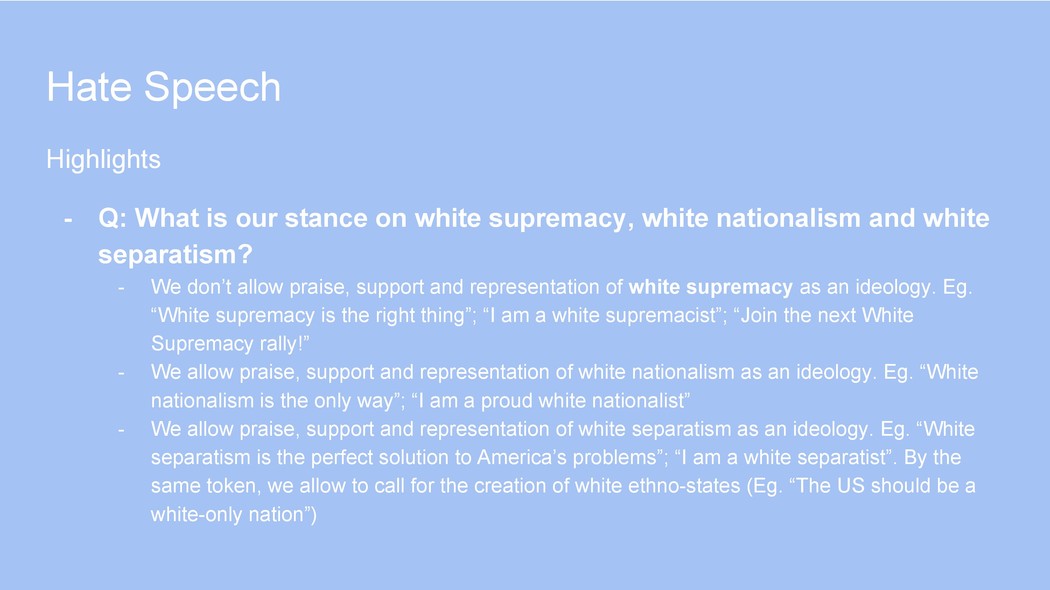
 Enemies of freedom of thought and expression are hailing Facebook's recent reversal on banning "White nationalists" from its platform and from Instagram starting next week. Facebook's previous policy was as follows:
- Q: What is our stance on white supremacy, white nationalism and white separatism?
We don't allow praise, support and representation of white supremacy as an ideology. Eg. "White supremacy is the right thing"; "I am a white supremacist"; "Join the next White Supremacy rally!"
We allow praise, support and representation of white nationalism as an ideology. Eg. "White nationalism is the only way"; "I am a proud white nationalist"
We allow praise, support and representation of white separatism as an ideology. Eg. "White separatism is the perfect solution to America's problems"; "I am a white separatist". By the same token, we allow to call for the creation of white ethno-states (Eg. "The US should be a white-only nation")
Since then Facebook has been lobbied and attacked by the Humpty Dumpty brigade. Here's how the new policy arose according to Vice:
"We've had conversations with more than 20 members of civil society, academics, in some cases these were civil rights organizations, experts in race relations from around the world," Brian Fishman, policy director of counterterrorism at Facebook, told us in a phone call. "We decided that the overlap between white nationalism, [white] separatism, and white supremacy is so extensive we really can't make a meaningful distinction between them. And that's because the language and the rhetoric that is used and the ideology that it represents overlaps to a degree that it is not a meaningful distinction."Wow! "[M]ore than 20 members of civil society ..." That's surely representative of the full scope of views on the subjects of White nationalism and freedom of thought and expression. Of course, it is completely coincidental that Brian Fishman has been part of "regular consulting meetings" between Facebook execs and representatives of the Simon Wiesenthal Center's (SWC) Digital Terrorism and Hate Project, including Rabbi Abraham Cooper, SWC Associate Dean.

Also coincidental is that, apparently, only "White nationalism" will be banned by Facebook because no one ever died from violent Jewish nationalists (see here, here, and here) or violent Chinese nationalists or violent Black nationalists (see here, here, and here). On that subject The Deseret News reports:
As Motherboard [a Vice subdomain] reported, Facebook will still allow content relating to black separatist movements and the Basque separatist movement to be posted, due to experts' arguments that white separatism should be handled differently "because of the long history of white supremacism that has been used to subjugate and dehumanize people of color in the United States and around the world."To paraphrase Orwell, when it comes to Facebook Farm: All nationalisms are equal but some nationalisms are more equal than others. We'll see what happens when the new policy is implemented but as of today the Facebook page featured below was still live on Facebook:
However, Facebook does ban content centered on black nationalism, Motherboard reported. The Southern Poverty Law Center has characterized groups that espouse black nationalist ideology as hate groups, with the added proviso that "they should not be seen as equivalent to white supremacist groups — such as the Ku Klux Klan or neo-Nazis — in terms of their history of violence and terrorism."
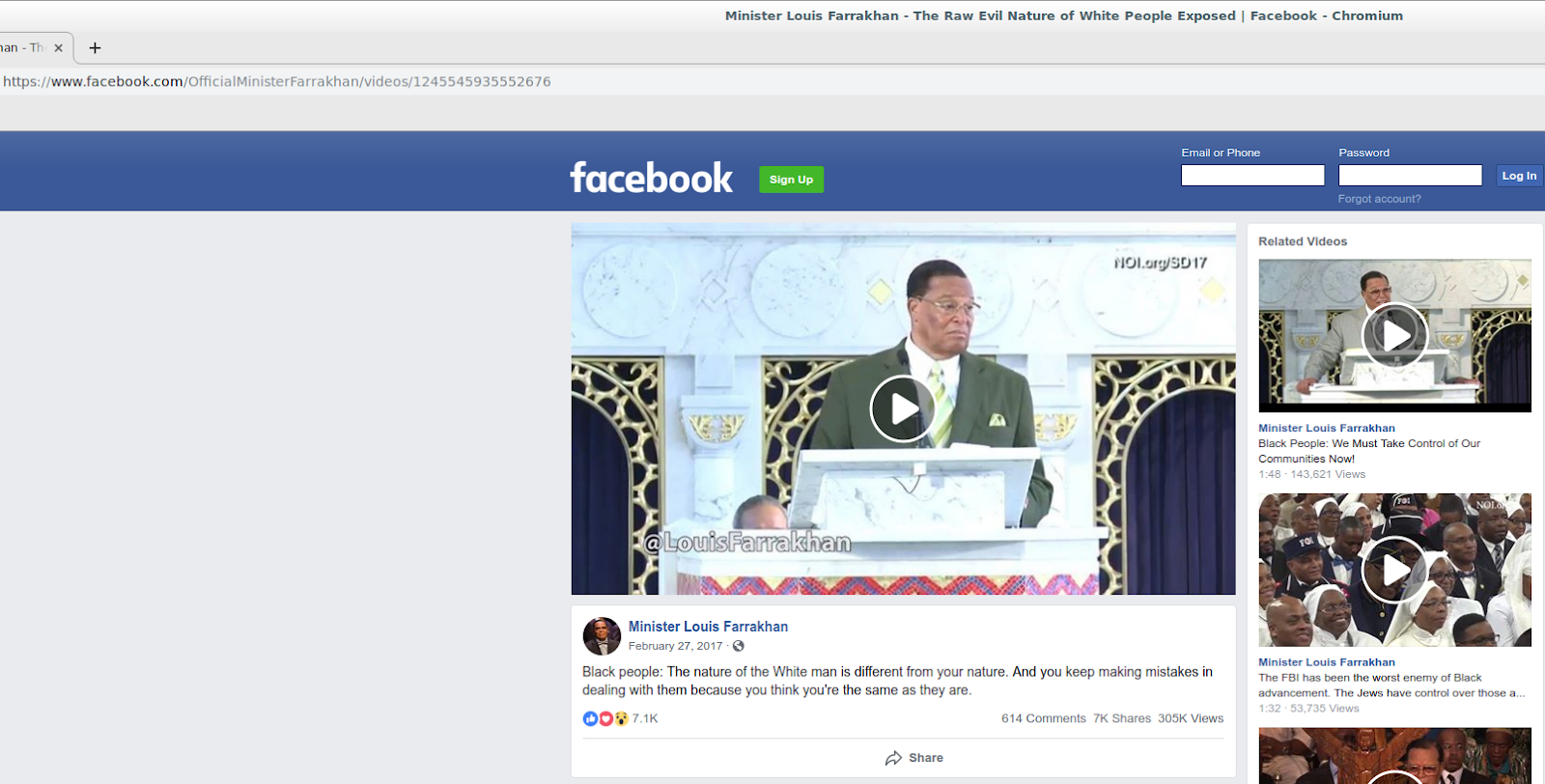
This seems to contradict the claim made in The Deseret News. You see, Louis Farrakhan is profiled as an "extremist", "antisemite", and a "Black Nationalist" by the SPLC and he is the head of the Nation of Islam (NOI), which is an "SPLC Designated Hate Group". The pictured video sub-page is entitled "Minister Louis Farrakhan - The Raw Evil Nature of White People Exposed" and Farrakhan's main page prominently features a link to the NOI main web site.
To be clear, I am no proponent of the SPLC and I don't support banning Farrakhan or the NOI from Facebook. Nor do I support banning White nationalists or supremacists. I do support banning people and entities advocating violence and related criminal activity although I don't think mere criminal advocacy or activity should be the threshold for censorship on Facebook.
For example, it was once a crime for Black people to, among other things, ride at the front of the bus or to dine in certain restaurants. Today, it is illegal, under Israeli law, for anyone anywhere in the world to advocate for a boycott of Israel; sedition is still, arguably, a crime in the United States; apostasy from Islam is punishable by death in some countries; and, a man in China was fined this year for using a VPN to access foreign web sites. Should Facebook censor speech reporting, supporting, or enabling those crimes?
While I have some sympathy with those who support regulating Facebook as a utility, I'm not fully convinced it would be a good idea. Moreover, I doubt that it will happen because that might open the door to treating Facebook as a common carrier and therefore intolerably impinge on the Left's ability to successfully pressure Facebook to censor crimethink.
In any case, my preferred approach to controversial speech is Millian:
But the peculiar evil of silencing the expression of an opinion is, that it is robbing the human race; posterity as well as the existing generation; those who dissent from the opinion, still more than those who hold it. If the opinion is right, they are deprived of the opportunity of exchanging error for truth: if wrong, they lose, what is almost as great a benefit, the clearer perception and livelier impression of truth, produced by its collision with error ...
Complete liberty of contradicting and disproving our opinion, is the very condition which justifies us in assuming its truth for purposes of action; and on no other terms can a being with human faculties have any rational assurance of being right ...
He who knows only his own side of the case, knows little of that. His reasons may be good, and no one may have been able to refute them. But if he is equally unable to refute the reasons on the opposite side; if he does not so much as know what they are, he has no ground for preferring either opinion.
Labels: censorship, freedom, J.S. Mill, media, Orwell, quotations, race, repression, technology, thoughtcrime, violence, White folks
Tuesday, March 27, 2018
No Outcry Over "Far Cry 5"

The game also calls to my mind the massacres at Ruby Ridge and Waco, along with the M.O.V.E. massacre. According to the game's creative director, Dan Hay, FC5 was partly inspired or influenced by the 2016 armed protest at the Malheur National Wildlife Refuge but mostly by his own insecurities:
"[That] brings us to the creative of the game," Hay said. "We are going to Montana. We are going to the frontier of Montana in present day. What we learned there is this concept of 'freedom, faith, and firearms.' People in that region, they don't want to be fucked with. We're applying that to Far Cry. We did that two-and-a-half years ago. But even today, this morning when I turned on the news, this concept of dissatisfaction, feeling like something is wrong, something is off. It brings me very much back to when I was a kid. I don't know that I feel safe."Hay's words seem to also echo Obama's notorious bitter clingers remark.
I realize that my limited engagement with the game is no substitute for having actually played it. My analysis here though is not really so much about the game itself as about the mainstream media response to public representations of FC5.
Thus, listening to the fawning NPR piece left me wondering how they would cover a mirror-image game where the first person shooter is a militia member or a deputy sheriff who is gunning down a caricature of the Left, say evil prominent Lefty gun controllers who are surrounded by armed guards and based in New York, for example. What about a game taking out protesters run violently amuck, based loosely on Black Lives Matter or Antifa?
Methinks Ari Shapiro et al. would not similarly overlook the dynamics of who was shooting whom and why in such a game. A gamer friend made a search and found no such parallel games to FC5 with contemporary center-Left villains so we needn't worry, I suppose.
See also:
08 April 2018 update: I've done a bit more reading of and about responses to FC5. Unsurprisingly, I'm not the first or only person to think about the ramifications of using an identifiable, albeit exaggerated, contemporary American political/cultural subgroup as the targets of an FPS game.
Last year, Chris Plante wrote in The Verge: "But Far Cry 5, should it commit to the direction the key art suggests, will be the biggest and most aggressive game to adjust the sights of the first-person shooter genre against people in the United States .... The game promises a conversation about ... why it became acceptable to murder virtual versions of one group of people, but not another." Unfortunately, I see very little evidence of the promised conversation taking place.
There have been complaints about why the "bad guys" aren't more clearly identifiable as members of the real "alt-Right" and other perceived nemeses of the Left. As Adi Robertson put it, writing more recently in The Verge: "many reviews have criticized Far Cry 5’s cult for not drawing on real Christian Fundamentalist or neo-Nazi ideology" (that would likely be the Left's insupportably expansive definition of neo-Nazi ideology).
Relatedly, some are also unhappy that the "good guys" aren't more clearly not conservatives. The two links below astutely critique in much greater detail some left-of center responses to FC5.
See also:
- "SJWs Complain That Far Cry 5 Isn’t Anti-Conservative, Anti-Christian Enough"
- "Gamespot Whines About Far Cry 5 Portraying Conservatives As Good Guys"
Labels: culture, gaming, guns, National Public Radio, politics, terrorism, United States, violence
Monday, June 13, 2016
Pink Pistols Statement on the Orlando Shootings
FOR IMMEDIATE RELEASE (Philadelphia, PA) June 12, 2016: Early Sunday, around 2AM Eastern Time, the Pulse nightclub in Orlando was attacked by an armed individual. Approximately 20 persons were killed and over double that wounded when the attacker, whom police have identified as Omar Mateen, a 29-year-old from Fort Pierce, FL, pushed his way into the club and opened fire on patrons. Weapons carried by Mateen are reported as an "assault-type" rifle, a handgun, and a suspected explosive device. UPDATE: Reports are that the death toll is around 50, with over 50 more wounded.
"It appears he was organized and well-prepared," said Orlando Police Chief John Mina at a news conference on Sunday. Additionally, Orange County Sheriff Jerry Demings said "This is an incident … that we certainly classify as a domestic terror incident." Authorities say the FBI is involved. Preliminary information reveals that Omar Mateen's family is from Afghanistan, though Omar may have been born in the United States. His family is reported to be distraught at the actions and loss of their son.
Gwendolyn Patton, First Speaker of the Pink Pistols, an international GLBT self-defense organization, warns people not to jump immediately to the assailant’s guns as the object of blame, but to concentrate instead on Mateen's violent acts. "The Pink Pistols gives condolences to all family and friends of those killed and injured at Pulse," began Patton. "This is exactly the kind of heinous act that justifies our existence. At such a time of tragedy, let us not reach for the low-hanging fruit of blaming the killer's guns. Let us stay focused on the fact that someone hated gay people so much they were ready to kill or injure so many. A human being did this. The human being's tools are unimportant when compared to the bleakness of that person's soul. I say again, GUNS did not do this. A human being did this, a dead human being. Our job now is not to demonize the man's tools, but to condemn his acts and work to prevent such acts in the future."
Patton's concerns are that knee-jerk gun-control efforts may make preventing future events harder rather than easier, as only the law-abiding potential victims will be affected by such laws. “It is difficult, if not impossible, to foresee such an event,” continues Patton, "But if they cannot be prevented, then they must be stopped as fast as someone tries to start them."
Some bars and other establishments that serve alcohol are difficult to protect because many states forbid the carrying of weapons where alcohol is served, but that just as one might have a designated driver who stays sober, one might have a designated carrier with a concealed-carry permit who goes armed and does not drink. "It's sad that we must consider such things, but when there are persons out there who mean us harm, we must find ways to protect ourselves within the law." Patton concludes.
The Pink Pistols is an international organization dedicated to the legal, safe, and responsible use of firearms for self-defense of the sexual-minority community. Chapters may be found across the United States and Canada. Though the Pink Pistols is for the GLBTQ community, it is not solely composed of the GLBTQ community, and all are welcome to join.
Contact:
Gwendolyn S. Patton
First Speaker, Pink Pistols International
firstspeaker@pinkpistols.org
http://www.pinkpistols.org
Ph: (610) 879-2364
See also:
- "LGBT Gun Rights Group Speaks Out After Orlando Shooting" by KTXL
- "In wake of Orlando, gays should arm themselves: Otherwise, in gun-free zones like the Pulse nightclub, we're sitting ducks to maniacs and terrorists" on NYDailyNews.com
Labels: crime, guns, LGBT, violence
Sunday, May 29, 2016
The only father who came looking ...
Labels: film & television, violence, War
Friday, January 08, 2016
Rewards for the Shahid/Martyr
There are many ways to deceive—one is the lie by omission. Critics of Islamic militants often use this tactic. One common example is to highlight suicide attacks and then to strip the acts of their larger context and ascribe purely or mostly carnal motives to the attackers.
One prime example of this is the "Martyrs rewarded with 72 Virgins" trope. The most effective lies often have a kernel of truth and that is the case here but the hadith at issue says rather more:
That the Messenger of Allah (ﷺ) said: "There are six things with Allah for the martyr. He is forgiven with the first flow of blood (he suffers), he is shown his place in Paradise, he is protected from punishment in the grave, secured from the greatest terror, the crown of dignity is placed upon his head - and its gems are better than the world and what is in it - he is married to seventy two wives along Al-Huril-'Ayn of Paradise, and he may intercede for seventy of his close relatives."Here's a different translation of that passage:
It was reported in the hadeeth of al-Miqdaam ibn Ma'di Karb that the Prophet (peace and blessings of Allaah be upon him) said:
"The martyr (shaheed) has seven blessings from Allaah: he is forgiven from the moment his blood is first shed; he will be shown his place in Paradise; he will be spared the trial of the grave; and he will be secure on the Day of the Greatest Terror (the Day of Judgement); there will be placed on his head a crown of dignity, one ruby of which is better than this world and all that is in it; he will be married to seventy-two of al-hoor al-'iyn; and he will be permitted to intercede for seventy of his relatives."In English, Al-Huril-'Ayn/al-hoor al-'iyn is the term usually transliterated as "houris" and translated as "virgins". At least two more things are worth pointing out: First, it's not transparently evident that the marriage depicted in Paradise is a physical one consummated sexually. By analogy, the New Testament describes the Church—the collective body of believers—as the virginal Bride of Christ (see e.g. 2 Corinthians 11:2 and Ephesians 5:22-32). Second, there is reason to believe that this alleged motivation is exaggerated or even fabricated.
To be clear, it may very well be that the 72 houris are widely understood by Muslims as a carnal reward for the shahid in Paradise. Muslims are no less capable than Jews or Christians of ignorance or dissimulation in defense of their faith. In any case, the Western media have generally chosen to decontextualize the (rather infrequent) act of the Muslim suicide bomber and to emphasize a salacious explanation to the detriment, in my opinion, of all except those want to add fuel to the fires of conflict. For a discussion of the larger context of suicide attacks I recommend Jacqueline Rose's "Deadly Embrace" in the London Review of Books.
Labels: Christianity, critical thinking, Islam, media, religion, resistance, violence
Saturday, May 30, 2015
Quotable: The Virus of Empire
42. To fight the Empire is to be infected by its derangement. This is a paradox; whoever defeats a segment of the Empire becomes the Empire; it proliferates like a virus, imposing its form on its enemies. Thereby it becomes its enemies.
Source: The Cryptica Scriptura of VALIS by Philip K. Dick (Bantam Books, 1981).
.jpg)
Labels: Empire, Philip K Dick, quotations, violence
Friday, January 25, 2013
Lessons of Athens, TN
I also learned about the inspiring story of the Battle of Athens from Ross' book. In 1946, WW II vets and other locals successfully took up arms against a corrupt, local Democratic Party regime in Athens, TN, the county seat of McMinn County.In a world where so many people are passive and disengaged from the major questions of political and social life, I expect I will always find righteous resistance to be inspirational. Yet, I am also keenly aware, that violent resistance is almost always a blind alley, which typically empowers not necessarily the kindest or most just among us but rather those who are adept at inflicting or orchestrating violence.
I was reminded of this recently while reading some of the post-Newtown massacre gun rights discussions. Unintended Consequences is, of course, an ardently pro-gun novel and it is therefore no coincidence that the story of the Battle of Athens appears on a lot of pro-gun web sites. While I was unsuccessful in verifying the provenance of an op-ed concerning the Athens revolt attributed to Eleanor Roosevelt, I did find an article in the New York Times (Jan. 12, 1947; p. 6) entitled "Athens, Tenn., Regime Set Up by GI's Falls." It reports:
The unofficial organization of the veterans is torn by dissension.
Four of the five leaders of the veterans movement declared in an open letter yesterday:
"We abolished one machine only to replace it with another and more powerful one in the making."
Labels: guns, nonviolence, politics, resistance, violence
Thursday, January 24, 2013
Seven Short Stories About Drones
Seven short stories about drones.* According to ProPublica, a "signature strike" is a drone attack targeting "apparent militants whose identities the U.S. doesn't know."
1. Mrs Dalloway said she would buy the flowers herself. Pity. A signature strike* leveled the florist's.
2. Call me Ishmael. I was a young man of military age. I was immolated at my wedding. My parents are inconsolable.
3. Stately, plump Buck Mulligan came from the stairhead, bearing a bowl of lather. A bomb whistled in. Blood on the walls. Fire from heaven.
4. I am an invisible man. My name is unknown. My loves are a mystery. But an unmanned aerial vehicle from a secret location has come for me.
5. Someone must have slandered Josef K., for one morning, without having done anything truly wrong, he was killed by a Predator drone.
6. Okonkwo was well known throughout the nine villages and even beyond. His torso was found, not his head.
7. Mother died today. The program saves American lives.
Everything we know so far about drone strikes: propublica.org/article/everything-we-know-so-far-about-drone-strikes
Here are the literary works referenced:
- Mrs. Dalloway by Virginia Woolf
- Moby-Dick by Herman Melville
- Ulysses by James Joyce
- Invisible Man by Ralph Ellison
- The Trial by Franz Kafka
- Things Fall Apart by Chinua Achebe
- The Stranger by Albert Camus
- "Here Are Seven (Very) Short Stories About Drones by Award-Winning Author Teju Cole" on Gawker.com
- "7 drone stories: Teju Cole creates literature from US assassination program (Video)" on Examiner.com
Labels: art and literature, drones, Herman Melville, quotations, technology, violence, War
Friday, January 18, 2013
Mass Killers & Gun-Free Zones

I found quite a few articles about the billboard pictured above. It appeared in Caldwell, ID last summer. None of the reports I saw allowed that the sign's creator might just have a point. Caldwell Mayor Garret Nancolas opined: "It's a private sign on private property and protected by the First Amendment, but this message crosses the line by politicizing the killing of innocent civilians in a movie theater." In other words, how dare you use your rights to say something that offends me.
No word on whether Mayor Nancolas is condemning Barack Obama, Joe Biden, Andrew Cuomo, etc. for "politicizing the killing of innocent civilians" in Newtown by using the tragedy to push through gun control measures. Although, to his credit, the Mayor did speak out over a National League of Cities "letter advocating a ban on certain weapons."
Labels: Biden, civil liberties, crime, critical thinking, guns, Obama, video, violence, War
Friday, January 04, 2013
Quotable: On Football
Source: George Will, International Herald Tribune. May 7, 1990 as qtd. in The Columbia Book of Quotations by Robert Andrews (Columbia UP, 1993) p. 341.
Labels: quotations, United States, violence
Monday, October 01, 2012
Executed Over Translating the Bible

In "civilized" Europe, not so long ago--relative to the broad scope of human history--professing Christians killed other professing Christians over translating the Bible into the vernacular or common language of the people and related doctrinal matters. You see in 1401, inspired by the proliferation of so-called Wycliffe Bibles, the English Parliament passed an act known as De heretico comburendo, Latin for "Regarding the heretic who is to be burnt".
Among other things, it made it unlawful to "make or write any book contrary to the catholic faith or determination of the Holy Church". The "determination" of "the Holy Church" being that, as far as the laity was concerned, the Bible should be in Latin only because "... Scripture was given only to, and could only be understood by, either the extremely learned. 'the doctors', or the clergy". So writes David Daniell in The Bible in English (Yale UP, 2003; p. 68).
As Daniell notes: "Heresy was soon to include reading not just owning even a scrap of Scripture not in Latin" (p. 68). Daniell, citing Nicholas Watson, further writes: "the capacity of the English language was rejected; the lower classes were refused [English] texts; limitations were imposed on what it was 'necessary' to know; and the role of clergy as guardians of truth and controllers of its communications was emphasised" (p. 110).
De heretico comburendo was enforced well into the 1500s and, "between 1553 and 1558 ... about 300 men and women were burned alive" (p. 263) under the law. Perhaps the best known victim of the vernacular-Bible-as-heresy principle was English Bible translator William Tyndale, who was executed in October 1536 in Belgium.
Labels: Christianity, religion, thoughtcrime, violence
Friday, January 13, 2012
Some Lessons of "Unintended Consequences"
One of the opening vignettes in the novel is the 1932 Battle of Anacostia Flats, i.e. the US Army's assault during the Great Depression on an encampment of impoverished WW I veterans seeking early payment of the bonus promised them for their wartime service. The author returns to this repeatedly in his chronicling of US government assaults on American citizens.
The book left me with a better appreciation of how some conservative, gun-rights advocates view the episode and I also learned that Jim Crow was banned from the encampment though in 1932, Washington, DC was a Jim Crow stronghold. Ross erroneously attributes an article entitled "The Bonuseers [sic] Ban Jim Crow" to the New York Times. It turns out the article was by Roy Wilkins and was published in the NAACP's house magazine The Crisis in October, 1932.
Wilkins' article is quoted in The Bonus Army: An American Epic by Paul Dickson and Thomas B. Allen (Bloomsbury, 2006) on p. 118:
[At Camp Marks in Anacostia] I found black toes and white toes sticking out side by side from a ramshackle town of pup tents, packing crates and tar-paper shacks. Black men and white men, veterans of the segregated army that had fought in World War I, lined up equally, perspired in sick bays, side by side. For years, the U.S. Army had argued that General Jim Crow was its proper commander, but the Bonus marchers gave lie to the notion that Black and white soldiers--ex-soldiers in their case--couldn't live together.I had either never known or else forgotten about this aspect of the Bonus Army's occupation. I also learned about the inspiring story of the Battle of Athens from Ross' book. In 1946, WW II vets and other locals successfully took up arms against a corrupt, local Democratic Party regime in Athens, TN, the county seat of McMinn County.
Ross' righteous anger about the ambush at Ruby Ridge and the Waco Massacre is refreshing. I remember many of my Liberal and Lefty friends being non-plussed about these two atrocities at the time. Unintended Consequences reveals that infamous FBI sniper Lon Horiuchi was at the scene of both crimes. Other government atrocities featured in the book include the Ken Ballew raid and the MOVE massacre. No government officials were ever held criminally or civilly responsible for any of these crimes.
From Ross' book, I learned of an interesting 1982 report on "The Right to Keep and Bear Arms" from the US Senate's Subcommittee on the Constitution. Here are two paragraphs from the report's "History: Second amendment right to 'keep and bear arms' ":
That the National Guard is not the "Militia" referred to in the second amendment is even clearer today. Congress has organized the National Guard under its power to "raise and support armies" and not its power to "Provide for the organizing, arming and disciplining the Militia". This Congress chose to do in the interests of organizing reserve military units which were not limited in deployment by the strictures of our power over the constitutional militia, which can be called forth only "to execute the laws of the Union, suppress insurrections and repel invasions." The modern National Guard was specifically intended to avoid status as the constitutional militia, a distinction recognized by 10 U.S.C. Sec. 311(a).You can read more selections from the report here.
The conclusion is thus inescapable that the history, concept, and wording of the second amendment to the Constitution of the United States, as well as its interpretation by every major commentator and court in the first half century after its ratification, indicates that what is protected is an individual right of a private citizen to own and carry firearms in a peaceful manner.
Ross makes the point in the book that early gun control laws were enacted to keep guns out of the hands of free Blacks. A surprising fact mentioned in the book is that Vermont has always permitted the open and concealed carrying of handguns without requiring a permit.
I'll close with two thoughts. One of the ironies of the books is that several of its characters train law enforcement officers in firearms usage and marksmanship as a means to get around gun control laws. The book has conflicted views on law enforcement personnel. Another irony is that the book's author and characters have a blind spot a mile wide. While they can see domestic government repression quite clearly, there is no clear acknowledgment that US government violence against foreigners is unjust and dwarfs domestic repression. Likewise, there is no evident appreciation in Unintended Consequences for the dialectical relationship between the killing of foreigners and the killing of Americans.
Labels: art and literature, civil liberties, guns, police repression, terrorism, violence
Sunday, January 08, 2012
The Last Words of Otto Zehm
Labels: crime, police repression, video, violence
Monday, March 02, 2009
Analyzing Darfur's Conflict of Definitions--Interview With Professor Mahmood Mamdani
Analyzing Darfur's Conflict of Definitions
Interview With Professor Mahmood Mamdani
By Isma’il Kushkush
IOL Correspondent — Sudan
"How you define the [Darfur] problem shapes the solution," says a world renowned Africa specialist in an interview with IslamOnline.net.
Professor Mahmood Mamdani of Columbia University, US believes that defining the conflict as Arab against African is inaccurate and says much more about the potency of race in the West rather than the relevance of the notion in Darfur. He believes that estimates of 400,000 dead in Darfur are inflated, irresponsible and unrealistic.
Mamdani, who was named as one of the top 100 public intellectuals in the world by the US magazine Foreign Affairs in 2008, is from Uganda, and is the current chair of the Council for the Development of Social Science Research in Africa (CODESRIA), Dakar, Senegal.
He is the author of numerous books and articles, including the book Citizen and Subject: Contemporary Africa and the Legacy of Late Colonialism. His upcoming book, Saviors and Survivors: Darfur, politics and the War on Terror will be published in English by Pantheon (Random House, New York) on March 17, 2009 and by Verso (London) a month later.
Following is the full interview conducted by IOL correspondent in Khartoum, Sudan, Isma'il Kushkush.
IslamOnline.net (IOL): The conflict in Darfur is often described in the media and by activists as a war pitting "black Africans" against "Arabs". How accurate do you think this description is?
Prof. Mahmood Mamdani: Even if you take the terms for granted, the majority of the "Arabs" in Darfur — the southern Rozayqat [Arab clans] — are not involved in the conflict. If you narrow the focus to those who are involved in the conflict, which is the northern Rozayqat, the Fur, the Masaleet, and the Zaghawah, then you realize that the distinction which best captures the difference between them is that the northern Rozayqat are those tribes in Darfur who received no [tribal] homeland, no "dar", in the colonial dispensation, because the colonial dispensation did not give a tribal homeland to those who were fully nomadic and were thus without settled villages. At the same time, the colonial dispensation gave the largest homelands to peasant tribes with settled villages... Please continue reading the full answer for this question here
Media Usage of African vs. Arab
IOL: Why do you think that activists and the media, especially the Western, define the conflict in Darfur in such a simplified manner: African vs. Arab?
Mamdani: Well, I think it is political. You can make sense of it not by focusing on those they are defining, but on their audience. Whereas the former live in Darfur, their audience is in the West. They understand that the Western audience would be quick to grasp a racialized distinction and would be easy to mobilize around it. It says much more about the potency of the history of race in the West rather than the relevance of the notion of race in Darfur.
A "Genocide"?
IOL: The conflict in Darfur is described in some corners as "genocide", while others reject that term and use "civil war". Can you comment on the usage of the term "genocide"; is it accurate to describe conflict in Darfur as "genocide"?
Mamdani: If you read the two international reports on Darfur, one from the UN Commission on Darfur and the other from the International Criminal Court (ICC), you will find no great disagreement over how many people have died. The real disagreement is on what to call it. The UN Commission says that this is a "counter-insurgency". They say the killings took place as a consequence of an effort to militarily defeat an insurgency. The ICC says no, this is evidence of a larger intention to kill the groups in question, the Fur, the Masaleet, and the Zaghawah.
How do you prove it? The claim is not made on the basis of those that have actually been killed; the claim is that they would be killed if the conflict went on because that is the intention of the perpetrators. From this point of view, the only way to arrest the killing is to arrest the political leadership of Sudan, and not to urge the two sides to negotiate. The UN Commission was arguing the reverse; that all efforts should be invested in negotiations and in stopping the conflict. The ICC seems to be arguing the opposite; that negotiations would only appease and give time to those who are bent on genocide. It seems to me that the ICC is responding not to what is going on in Darfur but to a particular constituency in the West.
"Genocide" vs. "Counter-insurgency"
IOL: Why do you think the term "genocide" has been used to describe the conflict in Darfur but not in Congo or Iraq despite the similarities in the conflicts that pit the "state" against an "insurgency"?
Mamdani: The conflicts in Congo and Iraq are different; the scale of killings is much higher. In Congo it is said to be four to five million. In Iraq it is said to have exceeded a million. So from that point of view, these conflicts are much worse than that in Darfur. The conflict in Iraq arises from an occupation and resistance to an occupation. The conflict in Darfur started as a civil war between tribes in Darfur, 1987 and 1989, and the government was not involved at all. The government became involved, first in 1995 and then 2003, but it is still not an occupation, it is an internal conflict.
So why would what's happening in Darfur be described as "genocide" while the numbers involved are less than in Iraq and when the conflict began as a civil war between tribes internal to Darfur and only then developed into an insurgency against the central government, followed by a counter-insurgency in response to that insurgency? Why?
The answer is basically that in international law "counter-insurgency" is considered a legitimate response by a government to an "insurgency"; "genocide" is not. Only if you call Darfur "genocide" you can justify an external intervention in Darfur. If you call it "counter-insurgency", intervention becomes an "invasion" of Darfur. That's the reason.
"Dead" vs. "Killed" Controversy
IOL: The number of "dead" in Darfur has been an issue of controversy. Can you comment on the studies made on this topic and is there a distinction between the terms "dead" and "killed" in Darfur?
Mamdani: We are fortunate that there was actually a review of all the major studies estimating the mortality in Darfur. The review was in 2006 by the Government Accountability Office (GAO) which is an audit agency of the US government. The GAO was asked to review six different studies of mortality in Darfur, including a study sponsored by the US state department estimating nearly 400,000 dead over eighteen months in 2003-2004, at the high end, and at the low end a study by the World Health Organization (WHO) estimating 70,000 dead over roughly the same period.
The WHO study made a distinction between those "dead" and those "killed". It said that roughly 80% of these 70,000 had died from malnutrition, dysentery, from the effects of drought and desertification, and 20% from violence.
The GAO got together with and asked the American Academy of Sciences (AAS) to nominate a team of twelve experts. These experts went over the six studies, and they concluded that the high end studies were totally unreliable in terms of methodology, in terms of projection. Their findings are on the website www.gao.gov. These were sent to the US State Department — which agreed with the GAO in writing — and to Congress, and then to the media, which basically ignored it. I find it quite amazing that it did not have any impact on the public debate in the United States or in the West. The public debate continued to be dominated by the Save Darfur Coalition and its totally inflated, irresponsible, and unrealistic estimates of 400,000 dead. The problem is that this is a very politicized movement which has had no effective counter-response.
Contrast in Numbers of Dead
IOL: Whatever the real numbers of dead in Darfur are, no one can deny a tragedy has occurred. But why do you think there is a contrast in the numbers of dead used by activist groups, the media, and even governments?
Mamdani: I think the answer is two fold: One, there is a legitimate debate. Let's say, take the WHO figures, 70,000 died. 20,000 roughly died from violence, 50,000 roughly died from non-violent causes, mainly children dying from dysentery, things like that. Now the debate is this: One group says those who died from violence are the only ones who died from the conflict. The other groups say: Not really. Many of those who died from non-violent causes like dysentery really died from indirect effects of the conflict because the conflict stopped supplies from coming in. From this point of view, those who could have been rescued died, they died of dysentery, but really, had it not been because of the conflict, they would have been saved. That is a legitimate debate. It is a debate that appears in all cases like in the case of the American Indians who died in the Indian genocide you will find many died from diseases, like smallpox, which they did not have to die from. That is a legitimate debate.
There is a second debate that is not legitimate, which is entirely political. The best example is the Save Darfur Coalition and their figures of 400,000. Here you find two things: One you find an extrapolation which is completely unjustifiable and unwarranted. The GAO showed that they [Save Darfur Coalition] extrapolated from deaths in refugee camps in Chad without taking into account any local variations.
They also extrapolate from death rates from 2003, 2004, when the conflict was at its highest, by assuming that the same rate continued in 2005, 2006, 2007, and 2008. This is how the UN got its figure of 300,000 [last year] when Holmes, the undersecretary for Humanitarian Affairs said: "It was 200,000 in 2005 therefore it must be 300,000 now". "Therefore", meaning, if the same rate continues which is patently absurd, because the UN's own people on the ground showed that the mortality rates — not just deaths from killings — dropped low in Darfur starting January 2005. It was less than 200 per month, in other words, less than it would take to call Darfur an "emergency". So this kind of presumption, that nothing has changed, and therefore you just extrapolate from pre-existing rates, is totally unjustifiable.
Also unjustifiable is the Save Darfur Coalition's refusal to acknowledge that people are also dying from another cause, drought and desertification. So instead of a debate on how many of those could have been saved had there been no conflict, there is simply silence. This too is a deliberate denial to acknowledge a developed catalogued by the UN's own agency.
"Right" vs. "Wrong" to Avoid Political Complexity
IOL: The conflict in Darfur is portrayed sometimes as a "moral issue"; one that pits "right" against "wrong" as opposed to a "political issue" with its various complications. Can you comment on that, and why do think it is portrayed as such?
Mamdani: It is very important how you define the conflict. In retrospect, one can see that none of those who were involved in this conflict when it began in 1987-1989 as a civil war — the northern Rozayqat one side, the Fur, the Masaleet, and the Zaghawah on the other side — really had control over the issues that triggered the conflict. The issues were no doubt complex.
The really long term issues stemmed from how the British redesigned the hakura [land] system that came out of the Sultanate of Darfur. It eliminated individual ownership and re-divided all the land as "tribal land" with larger hakuras for peasant tribes, smaller ones for semi-nomadic tribes with cattle and no hakuras for fully nomadic tribes with camels. That was one issue. The second trigger was ecological, the expanding desert, pushing the tribes in the north down south, leading to the conflict around Jebal Marra. In 1995, the government tried to solve this conflict by giving land to tribes without hakura, but they should have realized that since all the land in Darfur was already divided up, to do it by taking lands from tribes with hakura would restart the conflict, as indeed happened.
In 2003/2004 when the insurgency began, the government responded to it with a purely security framework with no regards for the issues that had led to this conflict with no attempt to solve the basic problem. Because the rebel movements are anchored in those tribes with hakuras, they are not raising the question of land; the question that pushed the hakura-less tribes into the conflict. The government is simply looking at the security question and the issues being raised by the rebels which is the marginalization of Darfur, but not looking at the issues internal to Darfur which created the conflict in the first place. So, the government has a very narrow vision. The government does not seem to have a Darfur vision. It is evident that Darfur is marginal. There don't seem to be people with a Darfur vision in the government.
Those outside of Sudan, the Save Darfur movement in the US, are looking at it from their own vantage point which is not simply a global vantage point or a West-centered one, but worse, it's the vantage point of the most reactionary circles in the US, those waging the "war on terror". They are painting this conflict not as a conflict over questions of land, not a conflict over questions of law and order, an insurgency/counter-insurgency — which is how the Government of Sudan is seeing it —, but as a conflict between "Arab" and "African"; they've racialized the conflict completely. They are partly responsible for the conflict being racialized. Consider the fact that it is a much more racialized conflict now than it was five years ago.
When the Save Darfur movement claims that this violence is African versus Arab its explanation is not historical or political. Its explanation basically is that the Arabs are "race-intoxicated" and they are just trying to wipe out the Africans. The Save Darfur movement does not educate the people they mobilize about the history of Darfur. It does not educate them about what issues drive the conflict. So they know nothing about the politics of Darfur, the history of Darfur, the history of the conflict. All they know is that Darfur is a place where "Arabs" are trying to eliminate "Africans". That's all. Darfur is a place where "evil lives", so they have completely "moralized" the conflict and presented it as a struggle against evil. This evil is thus portrayed as ahistorical, or trans-historical, living outside of history — except that evil is said to live in this place called Darfur and Sudan.
The conclusion means of course that you have to eliminate this "evil". There is no settlement to a conflict like that. You can't settle it, you can't negotiate, there is only one way to have peace and which is to eliminate the evil. So ironically they are trying to create that which they say they are combating.
Darfur's Terminology: Of Importance?
IOL: We've discussed the issue of terminology in the Darfur conflict: "genocide" vs. "counter-insurgency"; "African" vs. "Arab"; "killed" vs. "died"; "moral issue" vs. "political issue". Some would argue that it really does not make a difference if we make these distinctions. How important is it to have a correct understanding of these terms to reach a solution for the Darfur conflict?
Mamdani: How you define the problem shapes the solution. If you define it as a "war of liberation", you have a different attitude to it. If you define it as "terror", you have a different attitude to it. If you define the person as a "terrorist" or as a "liberator" you have totally opposite attitudes to that person. If you define "violence" as "self-defense" or as "aggression" you have a different attitude to that violence. If you explain the issues behind the violence you are more likely to address the issues to stop the violence. But if you portray the violence as "senseless" without any reason, with no issues, with no backgrounds, then you are likely to think that the only way to stop the violence is to target those involved in it.
So "definition" is crucial. "Definition" tells you what the problem is. And in a way, the entire debate rightly should be about what the problem is. Every doctor knows that diagnosis is at the heart of medicine; not prescription. Wrong diagnosis, wrong prescription, and the patient will die. The heart of medicine lies in the analysis.
Isma’il Kamal Kushkush is a Sudanese-American freelance writer currently based in Khartoum, Sudan.
Labels: Africa, critical thinking, Darfur, Sudan, violence, War
Monday, January 05, 2009
"We love death": Projecting the American Culture of Death onto Islam
 Do a Google search on the phrase "we love death" and you will get more than 37,000 hits, many of them describing a purportedly essential feature of Islam. But consider that it is primarily Christian nations that have the world's largest nuclear and conventional arsenals. Further, the predominantly Christian United States has likely been responsible for the violent and other premature deaths of more people than any other country in the last sixty years--including half-a-million children under the age of five in Iraq during the 1990s.
In the last seven years, the predominantly Christian US has invaded and occupied two predominantly Muslim countries: Afghanistan and Iraq at the cost of more than a million dead Afghanis and Iraqis. Over the last sixty years, the predominantly Christian US has been the most important backer of Israel which displaced the predominantly Muslim Palestinian people and continues to visit murder and mayhem upon them. The Christian President-elect Barack Obama has spoken openly about attacking another predominantly Muslim country, Pakistan.
In "The Spirit of Disobedience," Curtis White eloquently ties these threads together:
In the end, evangelical Christianity conspires with technical and economic rationalism. In the end, they both require a commitment to "duty" that masks unspeakable violence and injustice. In the end, the Muslim whose legs are being reduced to pulp by his American tormentor doesn't care if he's being murdered because he is despised by Christians or because he is an impediment to economic rationality. He understands far better than we do how the two become one at the end of the torturer's rod. The Predator missile, product of American scientific ingenuity, that homes in on his head is both self-righteously and arrogantly evangelical and meanly pragmatic. It is the empire that the rest of the world reads in George Bush's smirk. As John Ruskin understood 150 years ago, "The only question (determined mostly by fraud in peace, and force in war) is, Who is to die, and how?"So, just who is it that demonstrably loves death, even if it is not articulated clearly? An American and/or Christian culture of death is abundantly evident. But what got me thinking about this subject was part of a post on the ZionistsOut blog about the head of the Jewish Federation of Greater Ann Arbor. It says:
If we live in a "culture of death," as Pope John Paul II put it, it is a culture that is made possible by the advocates of both Reason and Revelation. In the opposition of Reason to Revelation, death cannot lose. Ours is a culture in which death has taken refuge in a legality that is supported by both reasonable liberals and Christian conservatives. Our exploitation of humans as "workers" is legal and somehow, weird and perverse though it may seem, generally acknowledged as part of our heritage of freedom, and virtually the entire political spectrum falls over itself to praise it. When Wal-Mart pays its employees impoverishing wages without adequate health or retirement benefits, we justify it out of respect for Wal-Mart's "freedom," its "reasonable" need to make itself "competitive," and because what it does is legal. As George Whalin, president of Retail Management Consultants, put it, "They don't have a responsibility to society to pay a higher wage than the law says you have to pay." Similarly, our use of the most fantastically destructive military power is also legal and also somehow a part of our heritage of "protecting freedom," no matter how obscene and destructive its excesses. The grotesque violence of video games and Hollywood movies, doing God knows what to the "individual morality" of teenagers, is legal and somehow now a protected part of our freedom of expression. Even, as the more thoughtful anti-abortionists complain with some justice, the legality of abortion at times covers over an attitude toward human life that subjects life to the low logic of efficiency and convenience. The idea of abortion as a minor "medical procedure" becomes Orwellian in its intense determination not to "know what we do." Or, perhaps most destructively, the legality of property rights condemns nature itself to annihilation even as we call it the freedom to pursue personal happiness and prosperity through the ownership of private property. This legality formalizes and empowers our famous "unalienable right" to property (especially that most peculiar form of private property known as the corporation), the exercise of which will profoundly alienate those on whom this right is inflicted: workers, children, foreign enemies, and animals. In its most extreme and universal form, our constitutional rights are reducible to the right not to have to love our neighbor. The irony is that the more energetically we pursue our individual, socially isolated right to "life, liberty and the pursuit of happiness," the deader the social and natural worlds become.
The new JFGAA Executive Director is David Shtulman, a dual US-Israeli citizen, Israeli Occupation Forces (IOF) veteran, and, in all likelihood, a current IOF reservist. ... in his weekly shabbat message--wittily entitled "The New Year Enters with a Bang!"--Herr Shtulman refers to the Israeli attacks as an "Israeli counter-attack on Hamas."One other example of a Muslim claiming a love of death is, perhaps, more credible than the claims attributed to al-Qaeda in 2004. A 2001 story by the Telegraph (UK) quotes a veteran Afghan fighter:
Shtulman next pulls a predictable role reversal of the Judaic culture of death with the unsourced claim: "Hamas has often responded with the mantra, 'We will win because we love death and Israel loves life.' " If Hamas uses this "mantra" frequently then it is pretty strange that it is not attributed to Hamas in the New York Times even once. In fact, in searches using two different databases, the phrase "we love death" turns up in the NYT archives only three times between 1851 and the present. The "mantra" never made it onto the news pages of the NYT.
In two instances, it appears in editorials by Jewish neoconservative pundit David Brooks. In March 2004, Brooks attributed it to Al Qaeda and by September of that year he had expanded it to the "fringes of the Muslim world." The third instance, was just five days before Brooks' second invocation of the "mantra." At the invitation of the NYT "Op-Ed page," in his proposed "conclusion to President Bush's [2004 RNC] address," former Bush I speech writer Daniel McGroarty attributed the phrase "to the statement the terrorists released to claim responsibility for the carnage ... in Madrid."
Terrorism: A Documentary and Reference Guide by Burns and Peterson (Greenwood, 2005), which includes Hamas, has only one documented reference to terrorists loving death and that is a statement attributed to "al-Qaeda in Europe" in connection with the Madrid bombings. It says: "You love life and we love death." There are two problems, though.
First, this is one of at least two statements claiming responsibility for the 2004 Madrid bombings. The apparently first alleged claim of responsibility by al-Qaeda does not say anything about loving death. It was discredited by the pro-Israel group, MEMRI. More importantly, a "two-year investigation into the attacks has found no evidence that al-Qa'ida helped plan, finance or carry out the bombings, or even knew about them in advance," which would indicate that both of the claims of responsibility are fabrications.
It is plausible that Shtulman's claim began as an Israeli false flag operation to smear Islam (see also the "Gil Affair" and "Israeli Psyops Against EU and US"). If that is the case, then it is awfully helpful to have someone to discredit the competing claim of responsibility. In this case the guy doing the discrediting, author of the MEMRI analysis, was Yigal Carmon, an IOF Colonel who served at least twenty years (1968-88) in the Israeli intelligence service. In sum, there is nothing credible linking Shtulman's "mantra" to Hamas. But since when have supporters of Israel ever cared about the truth?
Maulana Inyadullah, who began fighting the Soviet invasion in 1982 at the age of 16, declared that his fellow Afghans relish the prospect of an American attack.But only an idiot or a liar would read this as a broad cultural embrace of death or a statement of theological principle. Rather, it is not a desire to die but an express willingness to do so, if need be, in the service of home and hearth with a good dose of braggadocio mixed in for good measure.
"War is our best hobby. The sound of guns firing is like music for us. We cannot live without war. We have no other way except jihad," he said. ...
Mr Inyadullah, 35, said: "The Americans would be easier to defeat than the Russians. The Americans lead lavish lives and they are afraid of death. We are not afraid of death. The Americans love Pepsi Cola, we love death."
A willingness to die is similarly expected of American combat troops. And if Americans put greater stress on killing the enemy then, perhaps, it is simply because they ruthlessly put a premium on killing others and because the commanders know overcoming the normal human aversion to kill is the more difficult task unless, perhaps, you live in America where we are programmed to kill.
The willingness to sacrifice oneself, even in battle, is more humane and noble than the willingness to kill. As Jesus Christ said, "No one has greater love than this, to lay down one's life for one's friends." But this is an ethos that Christianity turned against centuries ago when it joined with the Roman Empire--the very empire that carried out the death sentence of Jesus. The "Constantinian moment" marks the key point in the transformation of the cross from a symbol of love, self-sacrifice, and hope into a symbol of death, empire, and greed. In the wake of this transformation came forced conversions, the Crusades, the Inquisition and the like. Whatever lip service they may pay to the older, nobler meanings, it is clear that for most Americans (and their victims) the deeper, lived reality is that the cross is a symbol of death and devout American Christians are largely "guilty bystanders," if not active participants, in the crimes of empire.
See also:
- "Judaism's Culture of Death"
- "Ralph Peters on Pax Americana & American Culture"
- "The 'General Eisenhower Warned Us' Hoax"
- Women Leaders in Muslim & Christian States
Labels: abortion, Christianity, critical thinking, Curtis White, Empire, Hollywood, Islam, Islamophobia, United States, violence
Wednesday, December 31, 2008
Bendib: More Surgical Strikes in Gaza

Saturday, December 27, 2008
Israel Drops More Than 100 Tons of Bombs on Gaza
 Gaza and the American city of Detroit both have a total land area of 139 square miles. Earlier today, the BBC reported that according to the Israeli government, the forces of the Jewish state--backed by the crucial diplomatic, military, and economic power of the US--have dropped more than 100 tons of bombs on Gaza in the last 24 hours. Ehud Barak, one of the cowards who runs Israel had the nerve to call the aerial bombing of one of the most densely populated, most poorly defended places in the world a "fight."
See the BBC's 2:28 min. video clip, "Massive Israeli air raids on Gaza" here. Click here for a collection of photos of the carnage. Here are a few excerpts from the BBC text report:
Israeli [American-made] F-16 bombers have pounded key targets across the Gaza Strip, killing at least 225 people, local medics say.
Most of those killed were policemen in the Hamas militant movement, which controls Gaza, but women and children also died, the Gaza officials said.
About 700 others were wounded, as missiles struck security compounds and militant bases, the officials added.
Israeli PM Ehud Olmert said the operation "may take some time"- but he pledged to avoid a humanitarian crisis.
"It's not going to last a few days,'' he said in a televised statement, flanked by Israeli Defence Minister Ehud Barak and Foreign Minister Tzipi Livni.
Israel said it was responding to an escalation in rocket attacks from Gaza and would bomb "as long as necessary".
They were the heaviest Israeli attacks on Gaza for decades. More air raids were launched as night fell.
Staff at the main hospital in Gaza say operating rooms are overflowing, it is running out of medicine, and there are not enough surgeons to cope.
The raids came days after a truce with Hamas expired.
Israeli Defence Minister Ehud Barak said "there is a time for calm and a time for fighting, and now the time has come to fight". ...
US Secretary of State Condoleezza Rice accused Hamas of having triggered the new bout of violence.
"The United States is deeply concerned about the escalating violence in Gaza," she said in a statement.
"We strongly condemn the repeated rocket and mortar attacks against Israel and hold Hamas responsible for breaking the ceasefire and for the renewal of violence there. The ceasefire must be restored immediately and fully respected." ...
Labels: Israel, Jews, Palestine, video, violence, Zionism