Sunday, July 17, 2022
Indians in Ireland—Take III
In "Indians at home – Indians in Cornwall, Indians in Wales, Indians in Ireland" I wrote about how European settler-colonialism, particularly by the English, was first inflicted upon other European peoples in Europe well before it was exported to other continents. This should be obvious to anyone with more than a passing knowledge of European history. Alas, it appears this is not the case.
Below is an interesting quote that speaks once more to this subject. Of course, I do not endorse Leyburn's lessons allegedly "learned from hard experience".
This use of the Scots-Irish as shock troops in the New World was quite similar to how the English government had used Scots settlers in Ulster against the Irish:They lived on land in both regions that had often been forcibly taken from the natives. ... When the natives, whether Irish or Indian, refused to accept either the legality or the settlement, preferring rather to fight back by whatever means they could devise, the settlers fought equally hard to retain the homes and farms they had made by their own labor. They learned from hard experience that one must fight for what one has; that turning the other cheek does not guarantee property rights; in short, that might makes right, at least in the matter of life and land ownership.
Source: Clayton E. Cramer, Concealed Weapon Laws of the Early Republic: Dueling, Southern Violence, and Moral Reform (Greenwood, 1999) pp. 30-31 quoting James G. Leyburn, The Scotch-Irish, 147-148.
Labels: Empire, history, identity, Indians, Ireland, quotations, United States, White folks


Monday, May 06, 2019
People of Color?

Sunday, November 29, 2015
Thinking About Left-Right Convergence
Fortunately, not everyone on the Left is as short-sighted as the leaders of VFP. Last spring Yes! magazine ran an interesting article entitled "Can the Left and Right Unite to End Corporate Rule? An Interview with Ralph Nader and Daniel McCarthy". It may be too little, too late but it is a hopeful sign nevertheless. Below are a two excerpts from the interview.
Ralph Nader: Well, liberalism and conservatism, in various ways, have been hijacked by corporatism.
Liberalism in the 18th and 19th centuries was the classic philosophy aimed at restraining arbitrary government power—then often exercised by kings and emperors. Civil liberties were the foundation of freedom of speech and due process of law, which became part of our Constitution.
Fast forward, you now have corporate liberals— like the Clintons—and you have the corporatists who call themselves conservatives throughout Congress. They're all pushing corporate welfare and bailouts for banks.
What we're trying to do here is go back to fundamental principles and un-hijack conservatism and liberalism. When we do that, we see that there's a convergence of support on a lot of major issues.
McCarthy: Yeah, the two parties and the bipartisan elite have had their own kind of convergence on a strategy for dominating the country, both in government and in big business.
Americans of all ideological stripes have been feeling a great deal of alienation, resentment, and anger. But it's very difficult to talk about the actual structure of government and of the economy and to explain how it is that people have been effectively disenfranchised and manipulated. It’s much easier on both the left and the right to focus on cultural issues, where you can have scapegoats and think that those are the central issues, and to ignore these more structural problems.
I think the left's embrace of identity politics in the 1960s and '70s was disastrous for the working class. It was very bad for the labor union movement, it was very bad for any number of economic issues. Which is not to say that there wasn’t a place for the civil rights movement. Of course there was. But identity-based politics went from being a necessary thing to being something that started to preclude some of the economic and other policy efforts that needed to be undertaken.
And similarly on the right. It's not just a matter of a cynical manipulation of the public by going for hot-button issues. There really was a sense among many ordinary people in the 1960s that something had gone culturally wrong in the country. Crime rates were going up, promiscuity was going up. There were changes that people found weird or disorienting. Whether or not they were right or wrong, they were unfamiliar and new, and therefore alarming.
This set of emotional complexes was turned into the so-called culture war, to the detriment of anything that would reform our economy, our self-government, or our foreign policy. Those sort of complex issues have been thrown by the wayside in favor of identity politics.
Labels: anti-war movement, Clintons, identity, politics, Ralph Nader, United States, Veterans for Peace
Monday, October 26, 2015
Two Takes on Modeling
The Children Come First
The ABC News video below tells the story of Bianca and Nick, the transgender parents of two young children. As an article in the Mirror Online explains: " 'We have the parts so we will use them,' she says. 'If we could change them we would, and they would be the other way around – but we cannot afford it and the children come first.' "
Labels: gender, human reproduction, identity, LGBT, video
Saturday, June 20, 2015
Adolph Reed, Jr. on the Dolezal Affair
Years ago I was honored to unexpectedly be asked to share a speaker's platform with Adolph Reed, Jr. at a labor conference. I had admired his writing for some time. While I don't fully endorse all of his positions, I still think he has one of the most compelling approaches to class and race in American discourse and sheds more light than heat (and, believe me, he puts out a lot of heat) on the Rachel Dolezal affair. Below are a few excerpts from his "From Jenner to Dolezal: One Trans Good, the Other Not So Much".
By far the most intellectually and politically interesting thing about
the recent "exposé" of Spokane, WA, NAACP activist Rachel Dolezal’s
racial status is the conundrum it has posed for racial identitarians who
are also committed to defense of transgender identity. ... Their contention is that one kind of claim to an
identity at odds with culturally constructed understandings of the
identity appropriate to one’s biology is okay but that the other is not ...
This brings me to the most important point that this affair throws into relief. It has outed the essentialism on which those identitarian discourses rest ... The essentialism cuts in odd ways in this saga. Sometimes race is real in a way that sex is not – you’re black only if you meet the biological criteria (whatever they’re supposed to be) for blackness.
There is a guild-protective agenda underlying racial identitarians’ outrage about Dolezal that is also quite revealing ... The charge is what those making it want to be true; they assume it’s true because they understand black racial classification as a form of capital.
... the Dolezal issue has captured such attention only because it rankles the sensibilities of those who essentialize race ...
... race politics is ... the politics of the left-wing of neoliberalism.
... the more aggressively and openly capitalist class power destroys and marketizes every shred of social protection working people of all races, genders, and sexual orientations have fought for and won over the last century, the louder and more insistent are the demands from the identitarian left that we focus our attention on statistical disparities and episodic outrages that "prove" that the crucial injustices in the society should be understood in the language of ascriptive identity.
The fundamental contradiction that has impelled the debate and required the flight into often idiotic sophistry is that racial identitarians assume, even if they give catechistic lip service ... to the catchphrase that "race is a social construction," that race is a thing, an essence that lives within us.
The transrace/transgender comparison makes clear the conceptual emptiness of the essentializing discourses, and the opportunist politics, that undergird identitarian ideologies. There is no coherent, principled defense of the stance that transgender identity is legitimate but transracial is not, at least not one that would satisfy basic rules of argument. The debate also throws into relief the reality that a notion of social justice that hinges on claims to entitlement based on extra-societal, ascriptive identities is neoliberalism’s critical self-consciousness. In insisting on the political priority of such fictive, naturalized populations identitarianism meshes well with neoliberal naturalization of the structures that reproduce inequality.
Reed concludes his article by saying: "It may be that one of Rachel Dolezal’s most important contributions to the struggle for social justice may turn out to be having catalyzed, not intentionally to be sure, a discussion that may help us move beyond the identitarian dead end." I really hope that's true but, sadly, I see very little evidence of it.
Labels: Adolph Reed Jr., class, gender, identity, quotations, race, Rachel Dolezal
Monday, June 15, 2015
Rachel Dolezal, Passing, & White Self-Hatred
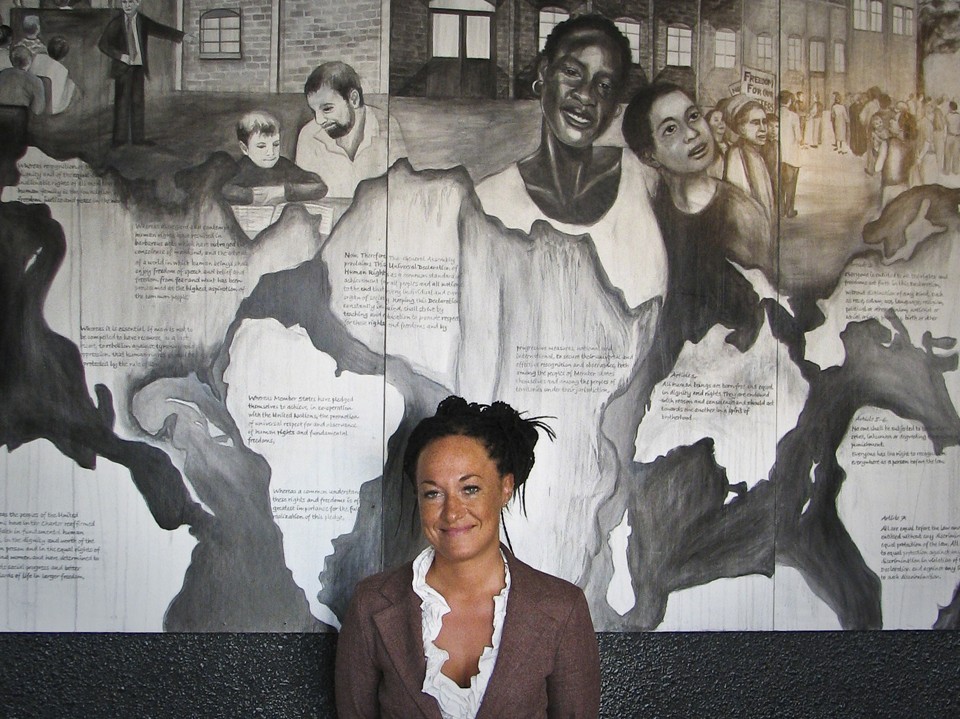 |
On June 11, 2015, the Coeur d' Alene Press broke the story that the head of the Spokane chapter of the NAACP, Rachel Dolezal, had woven a web of lies in order to falsely present herself as a Black woman. In a testament to the highly charged and contested nature of modern racial discourse the story has since "Gone viral" and international.
The phenomenon of so-called light-skinned Black people "passing as White" has long been a source of curiosity to me. If someone has so much non-African ancestry that they appear to the casual observer as White and they have/have adopted "White" cultural values and behaviors—whatever those may be—then who is to say they are not White? Do we take the White racist's and/or the Black racist's word for this?
Of course, it is true that the "one-drop rule" was a creation of White people made for enforcing slavery and later Jim Crow but now it seems just as many, if not more, Black people accept it (see, e.g. a recent Atlanta Blackstar photo gallery with the contradictory title "9 Black Celebrities Who Rejected The One Drop Rule" and especially the photo captions for Devyn (#2) and Zoe Saldana (#5)). It is in no small part because many Black people embrace the one-drop rule or some version of it that Rachel Dolezal was able to "pass as Black," apparently, for years.
This Black and White madness over racial identity leads to other bizarre outcomes. So, on The Atlantic we have Baz Dreisinger, author of Near Black: White-to-Black Passing in American Culture, telling an interviewer: "The earliest cases [of Whites passing for Black] that I look at are from the slave era. There are cases of white people who are kidnapped and sold into slavery, and which therefore are cases of involuntary passing." While on Slate, Jamelle Bouie writes:
Of course there were also black Americans who could pass but chose to stay in the black community. Walter Francis White led the national staff of the NAACP for nearly a quarter-century, from 1931 to 1955. The child of formerly enslaved people, White looked, well, white. And yet he chose blackness. "I am a Negro," he wrote in his autobiography A Man Called White. "My skin is white, my eyes are blue, my hair is blond. The traits of my race are nowhere visible upon me."White is Bouie's example of a Black American who stayed Black. Bouie nowhere admits the possibility, if not fact, that the obviously European traits of White's race were quite visible upon him. Instead, implicitly, slavery is equated with Blackness (because there was no such thing as White slaves in the antebellum South, right?) and the one-drop rule is affirmed.
So why did Rachel Dolezal decide to deceive people about her identity? If anyone knows for sure, and that's not clear, it would be Rachel Dolezal herself. However, there are some interesting possibilities to consider. First, as Baz Dreisinger claims: "Anytime you're talking about the cultural domain, it certainly can be advantageous to pass as black." Dolezal is a talented artist whose work seemingly has mostly African-American themes. So there's that.
Second, and this is the one I find more compelling, there's the possibility that Dolezal is a victim of self-hatred for being White. As David Smedley, a Howard University associate professor, who was Dolezal's Master of Fine Arts thesis adviser told the Washington Post:
" 'White' people who have inherited a privileged place in society seemingly have just two choices: stay ignorant, accept and continue to justify the delusion that America is and always has been great and democratic; or do some research and then feel the heavy guilt and shame upon discovering the ugly truth about the systemic unfairnesses that their ancestors perpetuated.One need not accept Prof. Smedley's beliefs lock, stock, and barrel to see that there's more than a grain of truth to what he says about the choices White people are presented with in terms of how they see themselves. More evidence for this perspective comes from Dolezal's adopted Black brother, Ezra Dolezal. According to CNN:
"Neither of these are healthy, and I suspect that this isn't the last time we will see another white person chose to switch sides."
Dolezal's time at predominantly black Howard University may have been a major turning point in her transformation, her adopted brother said.
"When she applied they thought she was a black student," he said. "When she came there, they saw she was white and she wasn't treated that well, especially by people that worked there. She probably started developing this kind of dislike for being white and dislike for white people. She used to tell [her Black adopted brother] Izaiah ... that all white people are racists. She might have developed some self-hatred."Rachel Dolezal unsuccessfully "sued Howard for discrimination in 2002, the year she graduated from the historically black college with a Master of Fine Arts degree." If her brother is correct, then Rachel Dolezal would not be the first person to internalize perceived and/or actual discrimination and bias as self-hatred. In the case of White people like Dolezal there is also the poisonous concept of trans-generational collective guilt for the past sins—real or imagined—of others.
If the story of Rachel Dolezal is a case of self-hatred then one can hope that she will examine the lies and distortions that led her to this point and reject and combat them. She doesn't need the people who she may have thought needed or wanted her to be Black and there are probably far more Black and other people than she imagined who would have embraced her openly as an artist and humans rights activist who is White.
I want to shift now to the comparisons of Rachel Dolezal to Caitlyn Jenner. As Nick Gillespie writes: "... what conservatives dig most about Dolezal is that she is a punchline regarding not racial misrepresentation but gender identity. Hence, conservative folks are using Dolezal's unmasking to yet again mock Caitlyn Jenner, the 1976 Olympic decathlon champion and reality TV star formerly known as Bruce." I agree but I also think it overstates the case to say that "There is no comparison between transgender people and Rachel Dolezal", as does the title to a Guardian article by Meredith Talusan.
Talusan, who is transgender, claims:
The fundamental difference between Dolezal's actions and trans people's is that her decision to identify as black was an active choice, whereas transgender people's decision to transition is almost always involuntary. Transitioning is the product of a fundamental aspect of our humanity – gender – being foisted upon us over and over again from the time of our birth in a manner inconsistent with our own experience of our genders. Doctors don't announce our race or color when we are born; they announce our gender. People who are alienated from their presumed gender and define themselves according to another gender have existed since earliest recorded history; race is a medieval European invention. Thus, Dolezal identified as black, but I am a woman, and other trans people are the gender they feel themselves to be.I wonder how fully Dolezal experiences/ed her decision to pass as Black as voluntary. And "our race or color" is frequently determined when we are born by our parents or a bureaucrat via a birth certificate. Talusan's insistence that she is different from Dolezal because "I am a woman" strikes me as a case of protesting too much. Mind you, I'm not disputing her claim to being a woman, it's her vehemence in the service of criticizing another that I find troubling.
I suppose I am more, though not fully, in agreement with Camille Gear Rich, who, in "Rachel Dolezal has a right to be black", writes: "The central issue that separates Jenner's and Dolezal's choices is deception. Jenner chose carefully how and when she would disclose herself as actually female." In Dolezal's case I think the problem with the deception is that it was active rather than passive and she hitched that deception to her status as a Black community leader.
If Bruce Jenner had long ago ceased to have been a recognizable celebrity would Caitlyn Jenner then have any blanket obligation to out herself as transgender to anyone? No, but I think she would have an ethical obligation not to deliberately mislead people into thinking she'd had a girlhood or the lived social and biological experience of a typical natal female, except when her safety or well-being was at stake. To be clear, in light of the violence and discrimination faced by transgender people when I speak of deliberate deception I'm talking about steps akin to what Dolezal did—inventing a fake father, presenting her adopted siblings as her own children, and, possibly, falsifying hate crimes.
Camille Gear Rich writes: "People allow Caitlyn Jenner to change because she has some biological basis for believing she is female. But is this all identity is? Are we prepared to accept the implications of this view?" She raises a good point but I would go further, I've never been fully convinced by the science suggesting that biology is behind transgender (or LGB) identity.
Mostly, the studies I've read (admittedly quite a few years ago now) fail to address the question of causality: Are you transgender because your biology is different from a non-trans person's or is your biology different because you're transgender? Often, due to small sample sizes and ambiguous findings, they also fail to convincingly show that there actually is a biological difference. In any case, while I'm willing to go wherever the evidence leads, I also think it should be kept in mind that biological explanations are potentially dangerous.
See also:
- "Adolph Reed, Jr. on the Dolezal Affair" on the Dissident Veteran For Peace blog
- "Pike County, OH: As Black as We Wish to Be" by State of the Re:Union
- Gulliver as Slave Trader: Racism Reviled by Jonathan Swift
- Quotable: Fraud, Gunpowder, A Soldier on the Dissident Veteran For Peace blog
- "The Bad-White Body" in Performing Whiteness: Postmodern Re/Constructions in the Cinema
Labels: Black America, gender, identity, LGBT, race, Rachel Dolezal, science, slavery, White folks
Saturday, February 14, 2015
Go Patriots!? Go Seahawks!?

Tuesday, July 05, 2011
Beads & Shells
In any case, I wanted to provide some examples of just what some early Europeans made and wore long before the Romans expanded their empire and drastically changed life in previously non-Roman areas. First, an etymological note: According to Lois Sherr Dubin, writing in The History of Beads: From 100,000 B.C. to the Present (New York: Abrams, 2009), "The word bead is derived from the Anglo-Saxon bidden ('to pray') and bede ('prayer')" (p. 79).
The first example is a shell necklace from an archaeological site near Dolní Věstonice in the present-day Czech Republic. According to Palmer et al. (Unearthing the Past: The Great Archaeological Discoveries that Have Changed History, 2009), the artifacts at this Gravettian site date from 27,000 to 24, 000 BC.

Next up is a Magdalenian necklace of dentalium shell and bear, lion, fox and deer teeth from Rocher de la Peine, Les Eyzies (Dordogne), France. It dates from about 10,050 BC.

Below is an ibex head necklace with a bison head clasp made around 11,000-10,000 BC from ibex bone (see Dubin p. 27). It was excavated from a Paleolithic site of the Magdalenian culture in the Labastide commune in the French Pyrenees.

The shale beads pictured below are part of a cache of over 700 beads found at Nab's Head, Pembrokeshire, Wales. The beads date from about 10,500 years ago.

The next two images are not of beads, shells, or feathers but they do give a sense of life in pre-Roman Europe. Pictured below is an interior portion of the Gundestrap Cauldron, found in a peat bog in Himmerland, Denmark in 1891. The cauldron is generally believed to have been created in the 2nd or 1st century BC. The central, antlered figure, holding a snake and a torc, is the Celtic god Cernunnos.

The final image is an artist's rendition of the ancient (ca. 200 BC) fort of Castell Henllys in present-day Pembrokeshire, Wales.

See also: "Prehistoric Stonehenge visitors came from the Mediterranean and the Alps" on Heritage-Key.com
Labels: history, identity, White folks
Thursday, June 30, 2011
I'm part White but ...

See also: "American Indians: Some Stereotypes & Realities"
Labels: identity, Indians, Paul Chaat Smith, race, White folks
Quotable: "a riot of vastly different cultures"
Five hundred years ago we were Seneca and Cree and Hopi and Kiowa, as different from each other as Norwegians are from Italians, or Egyptians from Zulus. ...
America pre-Columbus was a riot of vastly different cultures, which occasionally fought each other, no doubt sometimes viciously and for stupid reasons. If some Indian societies were ecological utopias with that perfect, elusive blend of democracy and individual freedom, some also practiced slavery, both before and after contact. Yet the amazing variety of human civilization that existed five centuries ago has been replaced by one image above all: the Plains Indians of the mid-nineteenth century. Most Indians weren't anything like the Sioux or the Comanche, either the real ones or the Hollywood invention. The true story is simply too messy and complicated. And too threatening. The myth of noble savages, completely unable to cope with modern times, goes down much more easily. No matter that Indian societies consistently valued technology and when useful made it their own. The glory days of the Comanches, for example, were built on European imports of horses and guns. ...
I suggest that a powerful antidote to the manufactured past now being created for us is the secret history of Indians in the twentieth century. Geronimo really did have a Cadillac and used to drive it to church, where he'd sign autographs. Quanah Parker, the legendary leader of the Comanches, became a successful businessman after the war. He was part owner of a railroad, and endorsed farming and Jesus. At the same time he was leader in the Native American Church and advocated the use of peyote. One of the most instructive lives is that of Black Elk, one of our greatest heroes and most revered spiritual leaders. His astonishing life included a stint in Buffalo Bill's Wild West show and surviving the Wounded Knee massacre. An impresario-anthropologist named John Neihardt wrote of his fantastic visions in Black Elk Speaks. ...
I found it fascinating that despite hearing about Black Elk for many years, I had no idea he spent most of his life as a Catholic. I learned that many believe that Black Elk and white assistants sat down and invented practically a new religion, explicitly designed to blend teachings of Christianity and Lakota spiritualism. At the time he was working as a catechist for the Roman Catholic Church of Nebraska. Essentially he was a lay priest. I also learned he had a first name, and that it was Nick. ... Do any of these facts about Nick Black Elk invalidate his contribution to the Lakota people, or his spiritual teachings? I think that to say they do is to say the invented, impossibly wise sages are preferable to the people who actually lived. Nick Black Elk, an extra in Buffalo Bill's Wild West show, a paid employee of the Catholic Church, only becomes more interesting, not less, and his accomplishments even more remarkable. Those who would have it otherwise cherish the myth more than the genuine struggles of real human beings.
Source: Paul Chaat Smith in Everything You Know about Indians Is Wrong (Minneapolis, Univ of Minnesota Pr., 2009) pp. 19-22.
See also: "A Brief History of Native Stereotyping" on the Blue Corn Comics site.
Labels: Black Elk, Hollywood, identity, Indians, Paul Chaat Smith, quotations, religion
Saturday, June 18, 2011
Quotable: Descendants of Tribes
Source: John Trudell, Lakota activist/poet in Reel Injun (Rezolution Pictures & the National Film Board of Canada, 2009)
See also:
- Indians at home – Indians in Cornwall, Indians in Wales, Indians in Ireland
- Skins & Fighting for Uncle Scum
- Quotable: "We believe in America"
- The "lower class" as Indians (and vice versa)
- Beads & Shells
Labels: art and literature, Empire, Hollywood, identity, Indians, White folks
Monday, January 17, 2011
Human Meat
"They're made out of meat."
"Meat?"
"Meat. They're made out of meat."
"Meat?"
"There's no doubt about it. We picked up several from different parts of the planet, took them aboard our recon vessels, and probed them all the way through. They're completely meat."
"That's impossible. What about the radio signals? The messages to the stars?"
"They use the radio waves to talk, but the signals don't come from them. The signals come from machines."
"So who made the machines? That's who we want to contact."
"They made the machines. That's what I'm trying to tell you. Meat made the machines."
"That's ridiculous. How can meat make a machine? You're asking me to believe in sentient meat."
"I'm not asking you, I'm telling you. These creatures are the only sentient race in that sector and they're made out of meat."
"Maybe they're like the orfolei. You know, a carbon-based intelligence that goes through a meat stage."
"Nope. They're born meat and they die meat. We studied them for several of their life spans, which didn't take long. Do you have any idea what's the life span of meat?"
"Spare me. Okay, maybe they're only part meat. You know, like the weddilei. A meat head with an electron plasma brain inside."
"Nope. We thought of that, since they do have meat heads, like the weddilei. But I told you, we probed them. They're meat all the way through."
"No brain?"
"Oh, there's a brain all right. It's just that the brain is made out of meat! That's what I've been trying to tell you."
"So ... what does the thinking?"
"You're not understanding, are you? You're refusing to deal with what I'm telling you. The brain does the thinking. The meat."
"Thinking meat! You're asking me to believe in thinking meat!"
"Yes, thinking meat! Conscious meat! Loving meat. Dreaming meat. The meat is the whole deal! Are you beginning to get the picture or do I have to start all over?"
"Omigod. You're serious then. They're made out of meat."
"Thank you. Finally. Yes. They are indeed made out of meat. And they've been trying to get in touch with us for almost a hundred of their years."
"Omigod. So what does this meat have in mind?"
"First it wants to talk to us. Then I imagine it wants to explore the Universe, contact other sentiences, swap ideas and information. The usual."
"We're supposed to talk to meat."
"That's the idea. That's the message they're sending out by radio. 'Hello. Anyone out there. Anybody home.' That sort of thing."
"They actually do talk, then. They use words, ideas, concepts?"
"Oh, yes. Except they do it with meat."
"I thought you just told me they used radio."
"They do, but what do you think is on the radio? Meat sounds. You know how when you slap or flap meat, it makes a noise? They talk by flapping their meat at each other. They can even sing by squirting air through their meat."
"Omigod. Singing meat. This is altogether too much. So what do you advise?"
"Officially or unofficially?"
"Both."
"Officially, we are required to contact, welcome and log in any and all sentient races or multibeings in this quadrant of the Universe, without prejudice, fear or favor. Unofficially, I advise that we erase the records and forget the whole thing."
"I was hoping you would say that."
"It seems harsh, but there is a limit. Do we really want to make contact with meat?"
"I agree one hundred percent. What's there to say? 'Hello, meat. How's it going?' But will this work? How many planets are we dealing with here?"
"Just one. They can travel to other planets in special meat containers, but they can't live on them. And being meat, they can only travel through C space. Which limits them to the speed of light and makes the possibility of their ever making contact pretty slim. Infinitesimal, in fact."
"So we just pretend there's no one home in the Universe."
"That's it."
"Cruel. But you said it yourself, who wants to meet meat? And the ones who have been aboard our vessels, the ones you probed? You're sure they won't remember?"
"They'll be considered crackpots if they do. We went into their heads and smoothed out their meat so that we're just a dream to them."
"A dream to meat! How strangely appropriate, that we should be meat's dream."
"And we marked the entire sector unoccupied."
"Good. Agreed, officially and unofficially. Case closed. Any others? Anyone interesting on that side of the galaxy?"
"Yes, a rather shy but sweet hydrogen core cluster intelligence in a class nine star in G445 zone. Was in contact two galactic rotations ago, wants to be friendly again."
"They always come around."
"And why not? Imagine how unbearably, how unutterably cold the Universe would be if one were all alone ..."
Labels: art and literature, identity
Friday, August 06, 2010
"Diversity" Means No Protestant Christians on US Supreme Court
Yesterday, the US Senate confirmed Barack Obama's nomination of Elena Kagan to the US Supreme Court. The Voice of America's story on the confirmation includes this paragraph:
Democratic Senator Ben Cardin of Maryland said, "And when Elena Kagan is confirmed, she will, for the first time in America's history, be the third woman out of nine on the Supreme Court of the United States. I think that is going to give us more common sense justice in this nation, and certainly one that reflects the diversity of our country."What Cardin neglected to mention is that there are now no Protestant Christian Justices on the Court and when Kagan is sworn-in tomorrow there will be six Roman Catholics and three Jews on the Court. How is that for "diversity"? As ABC News reported last May, "At least one Protestant justice has served at all times since the Supreme Court was established in 1789." But not any more.
Although about 50% of Americans identify as Protestant Christians, they will not be represented on the US Supreme Court. Roman Catholics, who comprise about 25% of the US population, will be over-represented by a factor of 2.7, while Jews, who comprise about 1.2% of the US population, will be overrepresented by a factor of 27.8. (All percentages in this paragraph are from the 2008 American Religious Identification Survey, which is a data source for the Census Bureau's Statistical Abstract of the United States).
In light of the apparent historical over-representation of Protestants on the Court, perhaps, a fair case could be made that they should be now under-represented for a while. However, there's a big difference between having half of the country's population under-represented and not having it represented at all. If one upholds the principle of representative government then you can't be indifferent to a complete lack of representation for the largest population segment.
The fields of critical race, class, and gender theory all tell us that personal identity and cultural background matter in influencing how we view the world and function in institutional settings. Diversity was supposed to help address and counteract biases created by minority exclusion and under-representation but somewhere along the way it seems that it was decided that representing majorities or pluralities didn't matter so much.
In April, before Kagan was nominated retired Supreme Court Justice Sandra Day O'Connor, an Episcopalian, said "I think that religion should not be the basis for an appointment, but if that were the case, one would expect somewhere in the nine to see a Protestant or two." But that expectation has been dashed. Why is that? Could it have something to do with the fact that Barack Obama was hailed in some quarters as the "first Jewish president"? What about the fact that Jews, such as Ben Cardin quoted above, are over-represented in the US Senate by a factor of at least 11?
See also:
- "Elena Kagan and the Supreme Court: A Barnyard Smell in Chicago, Harvard and Washington" by James Petras
- "Elena Kagan: Jewish Ethnic Networking Eases the Path of a Liberal/Leftist to the Supreme Court" by Kevin MacDonald
- "Ambition and orthodoxy (Kagan's hero is also Dershowitz's)" by Philip Weiss
Labels: Christianity, diversity, identity, Jews, law, Obama, Supreme Court, United States
Sunday, March 28, 2010
American Indians: Some Stereotypes & Realities
STEREOTYPE
"My grandmother was an Indian".
REALITY
Thousands of Americans "wannabe" Indians, but they are not.
Indians are all full bloods.
REALITY
The majority of Indians are of mixed heritage.
All Indians have an "Indian name".
REALITY
Most Indians have only a Euro-American name.
A minority of Indians also have "Indian names."
Most Indians know the histories, languages and cultural aspects of
their own tribe and of other tribes.
REALITY
Few Indians know all cultural aspects of their own tribes, much
less those of other tribes.
Source: Devon A. Mihesuah, American Indians: Stereotypes & Realities, (Atlanta: Clarity Pr., 1996).
Labels: critical thinking, identity, Indians
Wednesday, November 25, 2009
Wounded Knee and Indian and "Buffalo" Soldiers
The Indian scouts at Wounded Knee, like the Indian police at Grand river and Pine Ridge, were brave and loyal, as has been the almost universal rule with Indians when enlisted in the government service, even when called on, as were these, to serve against their own tribe and relatives. The prairie Indian is a born soldier, with all the soldier's pride of loyalty to duty, and may be trusted implicitly after he has once consented to enter the service. The scouts at Wounded Knee were Sioux, with Philip Wells as interpreter. Other Sioux scouts were ranging the country between the agency and the hostile camp in the Bad Lands, and acted as mediators in the peace negotiations which led to the final surrender. Fifty Cheyenne and about as many Crow scouts were also employed in the same section of country. Throughout the entire campaign the Indian scouts and police were faithful and received the warmest commendation of their officers. ...
On January 5 there was another encounter on Wounded Knee creek. A small detachment which had been sent out to meet a supply train coming into the agency found the wagons drawn up in a square to resist an attack made by a band of about 50 Indians. The soldiers joined forces with the teamsters, and by firing from behind the protection of the wagons succeeded in driving off the Indians and killing a number of their horses. The hostiles were reinforced, however, and a hard skirmish was kept up for several hours until more troops arrived from the agency about dark, having been sent in answer to a courier who managed to elude the attacking party. The troops charged on a gallop and the Indians retreated, having lost several killed and wounded, besides a number of their horses. (Colby, 7.)Chorus:
Amid all these warlike alarms the gentle muse Calliope hovered over the field and inspired W. H. Prather, a colored private of troop I of the Ninth cavalry, to the production of the ballad given below, one of the few good specimens of American ballad poetry, and worthy of equal place with "Captain Lovewell's Fight," "Old Quebec," or anything that originated in the late rebellion. It became a favorite among the troops in camp and with the scattered frontiersmen of Dakota and Nebraska, being sung to a simple air with vigor and expression and a particularly rousing chorus, and is probably by this time a classic of the barracks. It is here reproduced verbatim from the printed slip published for distribution among the soldiers during the campaign.
A GHOST-DANCE BALLAD
THE INDIAN GHOST DANCE AND WAR
The Red Skins left their Agency, the Soldiers left their Post,
All on the strength of an Indian tale about Messiah's ghost
Got up by savage chieftains to lead their tribes astray;
But Uncle Sam wouldn't have it so, for he ain't built that way.
They swore that this Messiah came to them in visions sleep,
And promised to restore their game and Buffalos a heap,
So they must start a big ghost dance, then all would join their band,
And may be so we lead the way into the great Bad Land.
They claimed the shirt Messiah gave, no bullet could go through,Chorus: They claimed the shirt, etc.
But when the Soldiers fired at them they saw this was not true.
The Medicine man supplied them with their great Messiah's grace,
And he, too, pulled his freight and swore the 7th hard to face.
About their tents the Soldiers stood, awaiting one and all,
That they might hear the trumpet clear when sounding General call
Or Boots and Saddles in a rush, that each and every man
Might mount in haste, ride soon and fast to stop this devilish band
But Generals great like Miles and Brooke don't do things up that way,
For they know an Indian like a book, and let him have his sway
Until they think him far enough and then to John they'll say,
"You had better stop your fooling or we'll bring our guns to play."
The 9th marched out with splendid cheer the Bad Lands to explo'e--Chorus: They claimed the shirt, etc.
With Col. Henry at their head they never fear the foe;
So on they rode from Xmas eve 'till dawn of Xmas day ;
The Red Skins heard the 9th was near and fled in great dismay;
The 7th is of courage bold both officers and men,
But bad luck seems to follow them and twice has took them in;
They came in contact with Big Foot's warriors in their fierce might
This chief made sure he had a chance of vantage in the fight.
A fight took place, 'twas hand to hand, unwarned by trumpetChorus: They claimed the shirt, etc.
While the Sioux were dropping man by man--the 7th killed them all,
And to that regiment be said "Ye noble braves, well done,
Although you lost some gallant men a glorious fight you've won."
The 8th was there, the sixth rode miles to swell that great command
And waited orders night and day to round up Short Bull's band.
The Infantry marched up in mass the Cavalry's support,
And while the latter rounded up, the former held the fort.
E battery of the 1st stood by and did their duty well,Chorus: They claimed the shirt, etc.
For every time the Hotchkiss barked they say a hostile fell.
Some Indian soldiers chipped in too and helped to quell the fray,
And now the campaign's ended and the soldiers marched away.
So all have done their share, you see, whether it was thick or thin,
And all helped break the ghost dance up and drive the hostiles in.
The settlers in that region now can breathe with better grace;
They only ask and pray to God to make John hold his base.
See also:(W. H. Prather, I, 9th Cavalry).
Labels: Empire, history, identity, Indians, United States
Tuesday, November 17, 2009
The "lower class" as Indians (and vice versa)
In an 1897 article Myron Eels compared Indians to the "lower class of whites." He wrote:
I should say of the greatest part of those under forty-five years of age, that if they had white skins, talked the English language,--and if a part of them had abandoned their belief in their medicine men,--as some have not done,--if they travelled in boats instead of canoes, if their women wore hats or bonnets on their heads, if they were neater, they would be called civilized, at least as much so as the lower class of whites.I got this quote from Indians in the Making: Ethnic Relations and Indian Identities around Puget Sound by Alexandra Harmon (Univ. of California Press, 1998) pp. 122-3. For Harmon, this illustrates how much "Indians remained aliens" and, certainly, that is so but I can't help but notice, too, just how little, to Eels' mind, separates Indians from the "the lower class of whites." One wonders about the gulf that separates them from upper class Whites like Eels.
Labels: class, history, identity, Indians, race, United States, White folks
Friday, October 02, 2009
Quotable: "We believe in America"
Source: Swil Kanim (Lummi) in A-Y-P: Indigenous Voices Reply, a film by Anna Laura Hoover (Aleut) and part of a larger exhibit by the same name.
A few days before viewing the film I asked a friend, who is also an enrolled member of the Flathead tribe, why he thought so many Indians served in the US military his response was "Survival."
In discussing the matter with another friend, I observed that high rates of military service in the conquering armies are an apparent characteristic of many conquered peoples such as White Southerners and Filipinos in the US military and the Gurkha and Scottish regiments in the British Army. The French Foreign Legion has also attracted large numbers of soldiers from French colonies. Going back further, many Roman Legions were also populated by non-Romans. Serving in a conquering army is a way of demonstrating (and being rewarded for) military prowess, valor, and loyalty to the dominant society and, yes, it can also be a survival tactic.
See also: "Skins & Fighting for Uncle Scum"
Labels: Empire, identity, Indians, quotations, United States
Sunday, July 05, 2009
Who's "Manly" Now? (Sung to the Tune of Connie Francis' Rendition of "Who's Sorry Now")
In any case, I provide forthwith some anecdotal evidence that the special operations forces may have an even higher proportion of closeted transwomen in their ranks than the rest of the military. First up: The obituary of Rebecca Lynn Cross, "A former Special Forces medic and combat veteran, Cross underwent sexual reassignment surgery in Thailand last year." Next is the video clip below about a former US Army Special Forces Colonel who also transitioned to living as a woman. I can't end without saying that the ALCU's exploitation of Diane Schroer's case strikes me as a sort of imposture, too. They are cloaking the struggle for transgender rights in the garb of patriotism and the dishonorable, mythical 'war on terrorism.' It's really kind of disgusting.
Labels: gender, identity, LGBT, militarism, video
Tuesday, April 21, 2009
Three Images from Chris Jordan
The last two images are from "Barbie Dolls," comprised of 32,000 Barbies, equal to the number of elective breast-augmentation surgeries performed monthly in the U.S. in 2006. To see more images and read an interview with Jordan go to "Chris Jordan photographs our culture of excess in hopes of changing it."


Labels: art and literature, environment, gender, identity, repression, United States


