Sunday, October 03, 2021
Black Lives Don't Matter to BLM, Media, & Academia
If Black lives really mattered to BLM, the media, and academia then they would tell the truth about the Black homicide rate instead of promoting specious, unfounded narratives about racism and police brutality. I was reminded of this once more while listening to an almost hour-long program on National Prevarication Radio (NPR) yesterday.
The show was Freakonomics Radio and the episode was "What Are the Police for, Anyway?" I actually agree that the US has a murder and incarceration problem. I also support an end to the War on Drugs and evidence-based police reforms that are effective at increasing the safety of both officers and the communities they serve.
Unfortunately, BLM, most of the media, and most academics don't care about facts. They are driven by false narratives that sow division and enhance their careers and the power of politicians and business elites.
Here's an illustrative excerpt from the radio show transcript:
Black Americans are five times more likely to be arrested than white Americans. On a per-capita basis, Blacks are also much more likely to be fatally shot by the police. There has of course been a racial reckoning around policing latelyAnyone with even a modicum of common sense, let alone statistical education, realizes that on "a per-capita basis" is a wholly inadequate way to analyze police shootings by demographic group.
PROTESTORS: Hey, hey! Ho, ho! These racist cops have got to go!
Highlighted by the police murder [sic] of George Floyd. According to a recent Gallup poll, just 51 percent of U.S. adults have either 'a great deal' or 'quite a lot' of confidence in the police.
According to the Washington Post 2015-2021 police shootings database, 95.5% of the people shot and killed by police in the US are males and yet they make up slightly less than half of the US population. Thus, on a per capita basis, men are far more likely to be shot and killed by police but no one screams about systemic police misandry. An honest, sensible person looks at that discrepancy and say, yes, but males commit proportionality far more violent crimes than females.
In fact, year after year, Blacks commit around 50% of the murders in the US and most of their victims are Black. Anyone who thinks this fact bears no relation to outcomes of police encounters with Black people is profoundly stupid, profoundly dishonest, or both. Cops of all colors may not be able to cite the precise statistics but they know by experience that, ceteris paribus, Black people they encounter are far more likely to be a threat to police and others than people of any other race. (That doesn't mean police should not regard everyone as putatively law-abiding individuals, most Black people are not violent criminals and they deserve to be treated respectfully unless objective circumstances dictate otherwise.)
Moreover, FBI data (Zip file) reveals that Black criminals upped their game in 2020.* In 56.6% of cases where the race of the "murder offender" is known that offender is Black; the comparable figure for Whites is 40.6%.† Academics have long known that Black Americans have a criminal violence problem that dwarfs that in all other communities but, by and large, they haven't had the courage or integrity to vocalize that and hold the media and activists accountable in discussions of police conduct.
For instance, in 2013, Siegel et al. published an article on the predictors of firearm homicide rates in arguably, the premier US public health journal, but they buried the lede. They claimed "ours is the most up-to-date and comprehensive analysis of the relationship between firearm ownership and gun-related homicide rates among the 50 states."
In their final statistical analysis they found that the strongest predictor of "gun-related homicide" rate was a racial factor. In their tables 2 and 3 they reported: "For each 1 percentage point increase in proportion of Black population, firearm homicide rate increased by 5.2%" and "For each 1-SD [standard deviation] increase in proportion of black population, firearm homicide rate increased by 82.8". The comparable firearm homicide rate increases associated with an "increase in proportion of household gun ownership" were 0.9% and 12.9%.
There is no discussion whatsoever of the relationship between proportion of Black and firearm homicide rate in the body of their paper, which was titled "The Relationship Between Gun Ownership and Firearm Homicide Rates in the United States, 1981–2010". Now, if you really cared about reducing homicides wouldn't you foreground the strongest predictor found in your analysis? Needless to say this finding, as far as I can tell, has never been reported in any mainstream media outlet. In the only coverage I could find of the study anywhere was in Science Daily and they didn't report on any predictor but household gun ownership.
Notes
* See "Expanded Homicide Data Table 3, Murder Offenders by Age, Sex, Race, and Ethnicity, 2020".
† 8,142 ÷ (20,982 - 6,592) = 0.5658 = 56.6%; 5,844 ÷ (20,982 - 6,592) = 0.4061 = 40.6%
Labels: Black America, crime, George Floyd, guns, media, National Public Radio, police, race, science


Sunday, October 11, 2020
Quotable: The Overwhelming Target of Interracial Violence
Facts don't matter to the academic victimology narrative. Far from destroying the black body, whites are the overwhelming target of interracial violence. Between 2012 and 2015, blacks committed 85.5 percent of all black-white interracial violent victimizations (excluding interracial homicide, which is also disproportionately black-on-white). That works out to 540,360 felonious assaults on whites. Whites committed 14.4 percent of all interracial violent victimization, or 91,470 felonious assaults on blacks. Blacks are less than 13 percent of the national population.
Source: Heather Mac Donald. "Darkness Falls: The collapse of the rule of law across the country, intensified by Antifa radicals, is terrifying". City Journal. May 31, 2020.
Labels: Black America, crime, politics, quotations, race, White folks
Friday, September 04, 2020
Echoes of Insight
There is another class of coloured people who make a business of keeping the troubles, the wrongs, and the hardships of the Negro race before the public. Having learned that they are able to make a living out of their troubles, they have grown into the settled habit of advertising their wrongs -- partly because they want sympathy and partly because it pays. Some of these people do not want the Negro to lose his grievances, because they [do] not want to lose their jobs.
A story told me by a coloured man in South Carolina will illustrate how people sometimes get into situations where they do not like to part with their grievances. In a certain community there was a coloured doctor of the old school, who knew little about modern ideas of medicine, but who in some way had gained the confidence of the people and had made considerable money by his own peculiar methods of treatment. In this community there was an old lady who happened to be pretty well provided with this world's goods and who thought that she had a cancer. For twenty years she had enjoyed the luxury of having this old doctor treat her for that cancer. As the old doctor became -- thanks to the cancer and to other practice -- pretty well-to-do, he decided to send one of his boys to a medical college. After graduating from the medical school, the young man returned home, and his father took a vacation. During this time the old lady who was afflicted with the "cancer" called in the young man, who treated her; within a few weeks the cancer (or what was supposed to be the cancer) disappeared, and the old lady declared herself well.
When the father of the boy returned and found the patient on her feet and perfectly well, he was outraged. He called the young man before him and said: "My son, I find that you have cured that cancer case of mine. Now, son, let me tell you something. I educated you on that cancer. I put you through high school, through college, and finally through the medical school on that cancer. And now you, with your new ideas of practising medicine, have come here and cured that cancer. Let me tell you, son, you have started all wrong. How do you expect to make a living practising medicine in that way?"
I am afraid that there is a certain class of race-problem solvers who don't want the patient to get well, because as long as the disease holds out they have not only an easy means of making a living, but also an easy medium through which to make themselves prominent before the public.
Source: Booker T. Washington. My Larger Education; Being Chapters from My Experience (Doubleday, Page & Co., 1911). pp. 118-120. Washington was born into slavery in Franklin County, VA some time during or about the year 1856.
###
People who expected the election of President Barack Obama to lead to racial healing and a post-racial society failed to take account of the political reality that racial healing and a post-racial society would, at a minimum, reduce black voter turnout.
Black votes matter to many politicians -- more so than black lives. That is why such politicians must try to keep black voters fearful, angry and resentful. Racial harmony would be a political disaster for such politicians.
Racial polarization makes both the black population and the white population worse off, but it makes politicians who depend on black votes better off.
Source: Thomas Sowell. "Black Votes Matter." Rasmussen Reports. July 26, 2016.
Labels: Biden, Black America, Obama, politics, quotations, race, slavery, Thomas Sowell, voting
Monday, August 17, 2020
Biden-Harris, Rustin, & Reparations

And don't get any ideas about a discount if one of your ancestors died fighting against slavery during the Civil War. The study's authors have that covered, too:
... some reparations opponents point to the federal government's expenditures in blood and treasure to end slavery through the Civil War as a form of reparations already rendered. This argument suffers from two major problems. First, ending an injustice is not the same as making reparations for its enduring effects. Second, more than 200,000 Black soldiers, including slaves and free, fought and died disproportionately to earn the freedom of the enslaved. The moral credit for this self-liberation goes to them, not to the federal government that had permitted their enslavement for so long.
With Joe Biden and Kamala Harris poised to possibly begin relocating to 1600 Pennsylvania Ave. and 1 Observatory Circle, respectively, next January it's worth thinking a bit more about reparations.
Apparently, Biden's chronologically impaired thinking has, shall we say, quickly evolved on the issue. He reportedly said in 1975: "I don't feel responsible for the sins of my father and grandfather. I feel responsible for what the situation is today, for the sins of my own generation. And I'll be damned if I feel responsible to pay for what happened 300 [sic] years ago."
In a 2019 presidential debate Biden gave a muddled response when asked: "What responsibility do you think that Americans need to take to repair the legacy of slavery in our country?" However, by February of this year Biden was on board with a proposal by Cory Booker (he of not inconsiderable, say 45%, European ancestry) "to study reparations and make a judgment whether or not what they should be and what they should do". Then Biden publicly stated about two months ago that he is in favor of "slavery reparations".
Kamala Harris, the privileged daughter of not one but two PhD possessing immigrant parents, co-sponsored Booker's legislation. She also reportedly supports reparations when she's not hiding in the "study it" column.
It's worth pointing out that the idea of slavery reparations is not new. I do not intend here to go all the way back to 1865 and Special Field Orders, No. 15. Given its limited scope and purpose, it is debatable that the order was intended as reparations for slavery. No, my goal is much more modest and I wish only to go back about five decades.
In 1969, James Forman of the Black Economic Development Conference (and formerly of the Student Nonviolent Coordinating Committee) "interrupted services at New York City's Riverside Church to demand $500 million in reparations from white churches to make up for injustices African Americans had suffered over the centuries." These demands were in accord with the BEDC's "Black Manifesto".
Civil-rights organizations rejected the idea, which the NAACP's assistant director called "an illogical, diversionary and paltry way out for guilt-ridden whites." Bayard Rustin, who organized the 1963 March on Washington and was one of Martin Luther King's closest advisers, was another vocal skeptic of blacks cashing in on the tribulations of long-gone forebears. "The idea of reparations is a ridiculous idea," Rustin said. "If my great-grandfather picked cotton for 50 years, then he may deserve some money, but he's dead and gone and nobody owes me anything."
Rustin, profiled in this blog in 2006, called the demand for reparations "preposterous" and accused Forman of "hustling, begging." Rustin continued: "Furthermore, I don't believe that any black man in this country wants to be given a thing—just the opportunity to work, to work and take care of his family." Times have changed, Bayard.
Labels: Bayard Rustin, Biden, Black America, class, economics, history, Obama, politics, race, slavery, White folks
Monday, June 08, 2020
MLK on Riots and Violence
 |
| Arson in Minneapolis on May 28, 2020 |
It is doubtful that there has been any time in American history when more Black people occupied positions of prominence in the media and power in politics. Even Demon Trump has the same percentage of Black cabinet members as Obama did in his first term.
In Minneapolis, the police chief and the state attorney general are both Black men. The city's representative in Congress is a Somali-American woman. There are apparently four Black members on the city council, one of whom is the son of the state attorney general.
So, how is it that the Minneapolis rioters are supposedly "unheard"? What are they saying and who isn't listening? More importantly, why is it that when pundits, politicians, and other propagandists quote King about the "language of the unheard" they seldom quote the text below from his 1964 Nobel Peace Prize speech?
Violence as a way of achieving racial justice is both impractical and immoral. I am not unmindful of the fact that violence often brings about momentary results. Nations have frequently won their independence in battle. But in spite of temporary victories, violence never brings permanent peace. It solves no social problem: it merely creates new and more complicated ones. Violence is impractical because it is a descending spiral ending in destruction for all. It is immoral because it seeks to humiliate the opponent rather than win his understanding: it seeks to annihilate rather than convert. Violence is immoral because it thrives on hatred rather than love. It destroys community and makes brotherhood impossible. It leaves society in monologue rather than dialogue. Violence ends up defeating itself. It creates bitterness in the survivors and brutality in the destroyers.In 1968, shortly before his death, King reiterated his position on the "language of the unheard" while "condemn[ing] riots", saying: "... I am still committed to militant, powerful, massive, non-violence as the most potent weapon in grappling with the [race] problem from a direct action point of view ... And I feel that we must always work with an effective, powerful weapon and method that brings about tangible results."
In a real sense nonviolence seeks to redeem the spiritual and moral lag that I spoke of earlier as the chief dilemma of modern man. It seeks to secure moral ends through moral means. Nonviolence is a powerful and just weapon. Indeed, it is a weapon unique in history, which cuts without wounding and ennobles the man who wields it.
I believe in this method because I think it is the only way to reestablish a broken community. It is the method which seeks to implement the just law by appealing to the conscience of the great decent majority who through blindness, fear, pride, and irrationality have allowed their consciences to sleep.
Labels: Black America, Christianity, crime, critical thinking, Ilhan Omar, Martin Luther King, nonviolence, Obama, police, quotations, race, Trump, violence
Monday, June 15, 2015
Rachel Dolezal, Passing, & White Self-Hatred
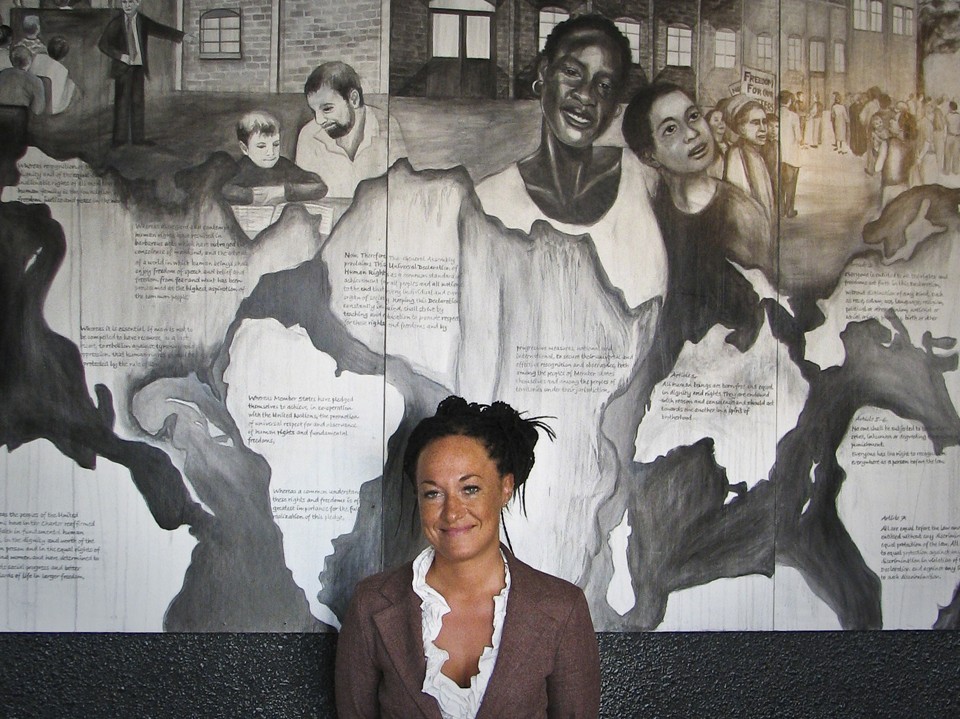 |
On June 11, 2015, the Coeur d' Alene Press broke the story that the head of the Spokane chapter of the NAACP, Rachel Dolezal, had woven a web of lies in order to falsely present herself as a Black woman. In a testament to the highly charged and contested nature of modern racial discourse the story has since "Gone viral" and international.
The phenomenon of so-called light-skinned Black people "passing as White" has long been a source of curiosity to me. If someone has so much non-African ancestry that they appear to the casual observer as White and they have/have adopted "White" cultural values and behaviors—whatever those may be—then who is to say they are not White? Do we take the White racist's and/or the Black racist's word for this?
Of course, it is true that the "one-drop rule" was a creation of White people made for enforcing slavery and later Jim Crow but now it seems just as many, if not more, Black people accept it (see, e.g. a recent Atlanta Blackstar photo gallery with the contradictory title "9 Black Celebrities Who Rejected The One Drop Rule" and especially the photo captions for Devyn (#2) and Zoe Saldana (#5)). It is in no small part because many Black people embrace the one-drop rule or some version of it that Rachel Dolezal was able to "pass as Black," apparently, for years.
This Black and White madness over racial identity leads to other bizarre outcomes. So, on The Atlantic we have Baz Dreisinger, author of Near Black: White-to-Black Passing in American Culture, telling an interviewer: "The earliest cases [of Whites passing for Black] that I look at are from the slave era. There are cases of white people who are kidnapped and sold into slavery, and which therefore are cases of involuntary passing." While on Slate, Jamelle Bouie writes:
Of course there were also black Americans who could pass but chose to stay in the black community. Walter Francis White led the national staff of the NAACP for nearly a quarter-century, from 1931 to 1955. The child of formerly enslaved people, White looked, well, white. And yet he chose blackness. "I am a Negro," he wrote in his autobiography A Man Called White. "My skin is white, my eyes are blue, my hair is blond. The traits of my race are nowhere visible upon me."White is Bouie's example of a Black American who stayed Black. Bouie nowhere admits the possibility, if not fact, that the obviously European traits of White's race were quite visible upon him. Instead, implicitly, slavery is equated with Blackness (because there was no such thing as White slaves in the antebellum South, right?) and the one-drop rule is affirmed.
So why did Rachel Dolezal decide to deceive people about her identity? If anyone knows for sure, and that's not clear, it would be Rachel Dolezal herself. However, there are some interesting possibilities to consider. First, as Baz Dreisinger claims: "Anytime you're talking about the cultural domain, it certainly can be advantageous to pass as black." Dolezal is a talented artist whose work seemingly has mostly African-American themes. So there's that.
Second, and this is the one I find more compelling, there's the possibility that Dolezal is a victim of self-hatred for being White. As David Smedley, a Howard University associate professor, who was Dolezal's Master of Fine Arts thesis adviser told the Washington Post:
" 'White' people who have inherited a privileged place in society seemingly have just two choices: stay ignorant, accept and continue to justify the delusion that America is and always has been great and democratic; or do some research and then feel the heavy guilt and shame upon discovering the ugly truth about the systemic unfairnesses that their ancestors perpetuated.One need not accept Prof. Smedley's beliefs lock, stock, and barrel to see that there's more than a grain of truth to what he says about the choices White people are presented with in terms of how they see themselves. More evidence for this perspective comes from Dolezal's adopted Black brother, Ezra Dolezal. According to CNN:
"Neither of these are healthy, and I suspect that this isn't the last time we will see another white person chose to switch sides."
Dolezal's time at predominantly black Howard University may have been a major turning point in her transformation, her adopted brother said.
"When she applied they thought she was a black student," he said. "When she came there, they saw she was white and she wasn't treated that well, especially by people that worked there. She probably started developing this kind of dislike for being white and dislike for white people. She used to tell [her Black adopted brother] Izaiah ... that all white people are racists. She might have developed some self-hatred."Rachel Dolezal unsuccessfully "sued Howard for discrimination in 2002, the year she graduated from the historically black college with a Master of Fine Arts degree." If her brother is correct, then Rachel Dolezal would not be the first person to internalize perceived and/or actual discrimination and bias as self-hatred. In the case of White people like Dolezal there is also the poisonous concept of trans-generational collective guilt for the past sins—real or imagined—of others.
If the story of Rachel Dolezal is a case of self-hatred then one can hope that she will examine the lies and distortions that led her to this point and reject and combat them. She doesn't need the people who she may have thought needed or wanted her to be Black and there are probably far more Black and other people than she imagined who would have embraced her openly as an artist and humans rights activist who is White.
I want to shift now to the comparisons of Rachel Dolezal to Caitlyn Jenner. As Nick Gillespie writes: "... what conservatives dig most about Dolezal is that she is a punchline regarding not racial misrepresentation but gender identity. Hence, conservative folks are using Dolezal's unmasking to yet again mock Caitlyn Jenner, the 1976 Olympic decathlon champion and reality TV star formerly known as Bruce." I agree but I also think it overstates the case to say that "There is no comparison between transgender people and Rachel Dolezal", as does the title to a Guardian article by Meredith Talusan.
Talusan, who is transgender, claims:
The fundamental difference between Dolezal's actions and trans people's is that her decision to identify as black was an active choice, whereas transgender people's decision to transition is almost always involuntary. Transitioning is the product of a fundamental aspect of our humanity – gender – being foisted upon us over and over again from the time of our birth in a manner inconsistent with our own experience of our genders. Doctors don't announce our race or color when we are born; they announce our gender. People who are alienated from their presumed gender and define themselves according to another gender have existed since earliest recorded history; race is a medieval European invention. Thus, Dolezal identified as black, but I am a woman, and other trans people are the gender they feel themselves to be.I wonder how fully Dolezal experiences/ed her decision to pass as Black as voluntary. And "our race or color" is frequently determined when we are born by our parents or a bureaucrat via a birth certificate. Talusan's insistence that she is different from Dolezal because "I am a woman" strikes me as a case of protesting too much. Mind you, I'm not disputing her claim to being a woman, it's her vehemence in the service of criticizing another that I find troubling.
I suppose I am more, though not fully, in agreement with Camille Gear Rich, who, in "Rachel Dolezal has a right to be black", writes: "The central issue that separates Jenner's and Dolezal's choices is deception. Jenner chose carefully how and when she would disclose herself as actually female." In Dolezal's case I think the problem with the deception is that it was active rather than passive and she hitched that deception to her status as a Black community leader.
If Bruce Jenner had long ago ceased to have been a recognizable celebrity would Caitlyn Jenner then have any blanket obligation to out herself as transgender to anyone? No, but I think she would have an ethical obligation not to deliberately mislead people into thinking she'd had a girlhood or the lived social and biological experience of a typical natal female, except when her safety or well-being was at stake. To be clear, in light of the violence and discrimination faced by transgender people when I speak of deliberate deception I'm talking about steps akin to what Dolezal did—inventing a fake father, presenting her adopted siblings as her own children, and, possibly, falsifying hate crimes.
Camille Gear Rich writes: "People allow Caitlyn Jenner to change because she has some biological basis for believing she is female. But is this all identity is? Are we prepared to accept the implications of this view?" She raises a good point but I would go further, I've never been fully convinced by the science suggesting that biology is behind transgender (or LGB) identity.
Mostly, the studies I've read (admittedly quite a few years ago now) fail to address the question of causality: Are you transgender because your biology is different from a non-trans person's or is your biology different because you're transgender? Often, due to small sample sizes and ambiguous findings, they also fail to convincingly show that there actually is a biological difference. In any case, while I'm willing to go wherever the evidence leads, I also think it should be kept in mind that biological explanations are potentially dangerous.
See also:
- "Adolph Reed, Jr. on the Dolezal Affair" on the Dissident Veteran For Peace blog
- "Pike County, OH: As Black as We Wish to Be" by State of the Re:Union
- Gulliver as Slave Trader: Racism Reviled by Jonathan Swift
- Quotable: Fraud, Gunpowder, A Soldier on the Dissident Veteran For Peace blog
- "The Bad-White Body" in Performing Whiteness: Postmodern Re/Constructions in the Cinema
Labels: Black America, gender, identity, LGBT, race, Rachel Dolezal, science, slavery, White folks
Thursday, May 28, 2015
The Race Hammer
Thus, "With the killing of Freddie Gray and the Baltimore Uprising we are 'back to the future': Jim and Jane Crow white supremacy is a poltergeist that continues to haunt the American body politic in the 21st century." This claim is meant to be taken seriously despite the fact that the events in question took place in a city where both the mayor and police chief are Black. And despite the fact that three of the four police officers charged, by the Black prosecutor, with felonies in the death of Freddie Gray are also Black. And despite the fact that all of this occured in a country that for the last six-and-a-half years has been governed by a Black president and a Black attorney general.
White supremacism sure is some powerful stuff. Undoubtedly, it is also to blame for the latest outrageous shooting deaths in Baltimore—Jennifer Jeffrey-Browne and her 7-year-old son, Kester "Tony" Browne —which have, apparently, elicited no massive public protests. Seemingly, Black lives matter much more when a police officer is involved in their end.
So, what explains such idiocy? It's easy, really. You take all the Black people in positions of power and reduce them to tokens. It goes kind of like this: "The symbolic progress along the color line is substantial. The American people elected a black man as president." See? The election of a Black man as the POTUS is not substantive but "symbolic".
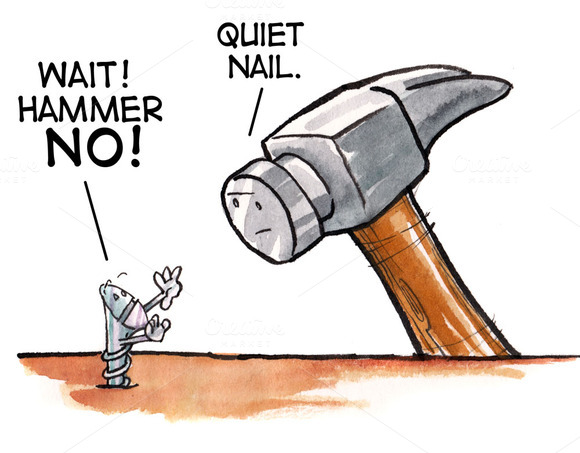
Never for one minute lend any credence to the idea that Black leaders may be people who have internalized the values of the Domination System, a system which in fact has purged itself of White supremacism. Never for one minute seriously consider that in their roles they are every bit as powerful/powerless as their White predecessors/counterparts. This is what you do when the race hammer is the only tool in your critical thinking box.
Labels: Black America, crime, critical thinking, Obama, politics, race, United States
Saturday, May 23, 2015
"We Real Cool" by Gwendolyn Brooks
Friday, April 17, 2009
Quick Comments on Three Movies
The Family That Preys is a recent offering by Tyler Perry, who has created and dominates a film niche that caters primarily to Black audiences. Perry's films feature predominantly Black casts and include some of the big names in Hollywood. TFTP included Alfre Woodard, Kathy Bates, and Sanaa Lathan. If you want insight into the values and dreams/illusions of much of the Black American middle-class then watch Perry's films.
Boy A is a compelling adaptation of a novel of the same name. The novel and film are British and the film provides a striking contrast to what is known as an "American ending" in cinema. A typically American ending is a happy ending with no loose ends. It tends to minimally, if at all, engage the intellect and the imagination. An American or Hollywood ending encourages passivity in the viewer as the sweet, but ultimately poisonous, syrup is spoon-fed to you. The best of the non-American endings (and American films can have such endings) provide no neat resolution and, thus, engage viewers intellectually and imaginatively.
Perhaps nothing illustrates the insidious nature of the "American ending" as well as the remarks of Dan Glickman. At a major film industry convention last month Glickman, the Motion Picture Association of America Chairman and CEO, told his audience:
... the fact that in the dark ... in the theater ... we are on ... and if only for a few hours on a Saturday afternoon, nice guys finish first ... underdogs have their day…and whether it's autobots versus decepticons ... Harry versus Voldemort ... humans versus cyborgs ... or guinea pigs versus billionaires ... the good guys carry the day ... and the little guy can take on the system and win. In the global cinema, this is known as the American ending--the happy ending.Few people know better than Dan Glickman just how heavily the deck is stacked against the underdog and in favor of the billionaires in real American life. Thus, the surfeit of vicarious victories in reel American life.
In 1998, as Secretary of Agriculture in the Clinton administration, Glickman defended a $600 million federal ethanol subsidy saying: "Political theory is really the rationalization of economic interests." The chief beneficiary of the subsidy was corporate agro-monster Archer Daniels Midland. Among other things, in 1996, ADM agreed to pay a $100 million fine for illegally manipulating the price of lysine. Of course, none of this deterred Congress or Glickman and the rest of the Clinton administration from giving hundreds of millions of tax dollars to ADM.
Labels: art and literature, Black America, Clintons, Hollywood, Jews, media, politics, United States
Wednesday, June 25, 2008
Malcolm X on Africa, Zionism, Islam
AL-MUSLIMOON: Africa seems to have captured most of your attention and eager concern. Why? And now that you have visited almost every part of it, where do you think Islam actually stands? And what, in your opinion, could be done to save it from both the brainlessness of many, or rather most of those who are considered to be the champions of its cause, and from the malicious, resourceful alliance of Zionism, atheism, and religious fanaticism against Islam?See also: Malcolm X on Zionism---Reprinted From the Egyptian Gazette
MALCOLM X: I regard Africa as my fatherland. I am primarily interested in seeing it become completely free of outside political and economic influence that has dominated and exploited it. Africa, because of its strategic position, faces a real crisis. The colonial vultures have no intention of giving it up without a fight. Their chief weapon is still "divide and conquer." In East Africa there is a strong anti-Asian feeling being nourished among the Africans. In West Africa there is a strong anti-Arab feeling. Where there are Arabs or Asians there is a strong anti-Muslim feeling.
These hostilities are not initiated by the above-mentioned people who are involved. They have nothing to benefit from fighting among themselves at this point. Those who benefit most are the former colonial masters who have now supplanted the hated colonialism and imperialism with Zionism. The Zionists have outstripped all other interest groups in the present struggle for our mother continent. They use such a benevolent, philanthropic approach that it is quite difficult for their victims to see through their schemes. Zionism is even more dangerous than communism because it is made more acceptable and is thus more destructively effective.
Since the Arab image is almost inseparable from the image of Islam, the Arab world has a multiple responsibility that it must live up to. Since Islam is a religion of brotherhood and unity those who take the lead in expounding this religion are duty-bound to set the highest example of brotherhood and unity. It is imperative that Cairo and Mecca (the Supreme Council of Islamic Affairs and the Muslim World League) have a religious "summit" conference and show a greater degree of concern and responsibility for the present plight of the Muslim world, or other forces will rise up in this present generation of young, forward-thinking Muslims and the "power centers" will be taken from the hands of those that they are now in and placed elsewhere. Allah can easily do this.
Labels: Black America, Malcolm X, Zionism
Sunday, March 02, 2008
Free the Angola 3

Wednesday, February 06, 2008
Barack Obama: The War in Iraq and the Jewish Vote
Moveon, you may recall, is a front group for the liberal wing of the corporate war party--the Democrats--and was founded by a pair of California software millionaires specifically to defend Bill Clinton against impeachment proceedings. The pity isn't so much that Clinton wasn't convicted as that he wasn't impeached and convicted for, among other things, the Waco massacre, the deaths of half-a-million Iraqi children, and the Antiterrorism and Effective Death Penalty Act of 1996. Any way, below is a long excerpt from Frank's article--subtitled "Why there is no 'hope' for 'change.' " Following that is a consideration of Jewish attitudes on Obama.
... Obama's best quality at this point seems to be the fact that he's not a Clinton. When it comes to foreign policy, however, he may as well be, which makes MoveOn's shallow approval of his candidacy all the more hypocritical.Regarding Barack Obama, Jews are, unsurprisingly, asking that perennial question: Is he good for the Jews? In the last two weeks, the Jewish Daily Forward has run at least three articles on Obama. One of the most interesting is an unsigned editorial entitled "Fear Factor" (1/30/08). Here are a couple of excerpts (emphasis added):
After Obama won his senatorial race in 2004 he quickly abandoned the antiwar rhetoric he had touted along the campaign trail. While remaining critical of the White House and the lies that pushed us toward war, Obama still maintained that U.S. military should remain in Iraq until the job was completed.
"Given the enormous stakes in Iraq, I believe that those of us who are involved in shaping our national security policies should do what we believe is right, not merely what is politically expedient," Obama proclaimed in a speech to the Chicago Council on Foreign Relations in late November 2005.
Later in that same speech, he said, "In sum, we have to focus, methodically and without partisanship, on those steps that will: one, stabilize Iraq, avoid all out civil war, and give the factions within Iraq the space they need to forge a political settlement; two, contain and ultimately extinguish the insurgency in Iraq; and three, bring our troops safely home."
Obama continues to favor a "phased redeployment" of our troops as well as "benchmarks" for the Iraqi government, but promises to not "fully withdraw" – hence why the Illinois senator has supported the majority of Bush administration's pork-engorged appropriation bills that are draining the U.S. Treasury. Obama wants to keep cadres of troops throughout Iraq with others all other the region to strike if necessary.
So where would President Obama send the troops he's redeployed? A good guess might be Iran.
As Obama told the Chicago Tribune on Sept. 26, 2004, "[T]he big question is going to be, if Iran is resistant to these pressures [to stop its nuclear program], including economic sanctions, which I hope will be imposed if they do not cooperate, at what point … if any, are we going to take military action?"
He added that "launching some missile strikes into Iran is not the optimal position for us to be in" given the ongoing war in Iraq. "On the other hand, having a radical Muslim theocracy in possession of nuclear weapons is worse." Obama went on to argue that military strikes on Pakistan should not be ruled out if "violent Islamic extremists" were to "take over."
Iran is a "genuine threat" to the United States and Israel, Obama later expressed at a forum sponsored by AIPAC on March 12, 2007, in Washington, D.C. At the event Obama reiterated that he would not rule out the use of force in disarming Iran, a position he shares with rival Hillary Clinton.
Earlier that same month, on March 2, 2007, Obama spoke at an AIPAC Policy Forum in Chicago, where he succinctly laid out his position on how he would deal with the Middle East, promising not to alter America's lopsided relationship with Israel. "[W]e must preserve our total commitment to our unique defense relationship with Israel by fully funding military assistance and continuing work on the Arrow and related missile defense programs," he said. "This would help Israel maintain its military edge and deter and repel attacks from as far as Tehran and as close as Gaza." ...
When the dust settles, the uproar over Barack Obama's religious beliefs will have taught us little about the candidate and his loyalties that we don't already know. If we look closely, however, we can learn a great deal about American Jews and their anxieties. More pointedly, we can penetrate the mystery of the power of the so-called Jewish lobby.It is this writer's experience that "Moderate and liberal Jews" are every bit as quick as conservative Jews to falsely accuse people of "antisemitism." Below is an excerpt from "As Campaign Surges, Obama Working to Quell Jewish Fears," another recent (1/30/08) Barack Obama article in the Forward ( emphasis added).
As most Americans have heard by now, rumors flying around the Internet suggest that the Illinois senator is secretly a radical Muslim. It’s rumored that he took his oath of office on a Quran, that he was educated in a Saudi-funded Muslim academy in Indonesia, that he’s some sort of Manchurian candidate plotting to take the reins of government and launch a jihad. It sounds almost comically implausible, but some people — too many, it seems — take it as fact. The Obama campaign vigorously denies the whole thing as a tissue of lies from beginning to end. ...
Most surprising, a parade of Jewish politicians and organizational leaders, the elite of what’s called the Jewish lobby, has spoken out aggressively to reject the rumors and defend Obama — but it hasn’t helped much. Early indications are that Jewish voters will spurn Obama in numbers large enough to hurt him. And all the efforts of the vaunted Jewish establishment haven’t convinced them otherwise.
That's the secret of Jewish lobbying success: It's not about the professional influence-peddlers and fundraisers. It's about frightened, angry Jews, thousands of them, determined to stop anyone they suspect is against them. Once they get going, no one can talk them out of it. They feel powerless and vulnerable before enemies great and small, and they have the clout to do something about it. And they don't always check the details before hitting the barricades. ...
Published reports and word-of-mouth from New York to Miami suggest that considerable numbers of Jewish voters will not back Obama, because they're not sure he's not their enemy. The rumors may be true or false, they reason; Obama may or may not be a secret Muslim radical. But why risk it? If there's any danger of antisemitism, the thinking goes, you err on the side of caution. You don’t take chances.
One prominent Orthodox activist, founder of a pro-Israel PAC and a former president of the Union of Orthodox Jewish Congregations, bluntly told a local weekly last week that he wouldn't vote for Obama and couldn't imagine anything that would change his mind. A news report on the controversy, published on the English-language Web site of the Israeli daily Yediot Aharonot, drew dozens of online comments from readers who insisted that Obama must be a secret Islamist, regardless of what anyone says. Some, secure in their anonymity, argued that he must be a Jew-basher because most African Americans are.
... Consistently, liberals have failed to appreciate the conservatives’ secret weapon.
Accusations of antisemitism take on a life of their own. Once the A-word is in play, the defenses go up, and they don't come down until it's proved that there's no danger. Moderate and liberal Jews who don't share the conservatives' agenda will give the benefit of doubt to the accusers. Thus the Jewish hawks have the final say, and the burden is on the candidate to avoid falling afoul of them.
... Immediately prior to accepting the endorsement of Senator Edward Kennedy on Monday afternoon in Washington, Obama conducted a conference call with Jewish reporters in an effort to dispel concerns on a number of issues, including his approach to the Israeli-Palestinian conflict and the views of his longtime pastor. ...See also:
In recent weeks, even as the organized Jewish community has publicly combated a series of scurrilous personal falsehoods, more delicate questions about his views on the Middle East have animated Jewish leaders, spilling on to the pages of newspapers and into discussions among voters. Despite repeated efforts to reach out to the community — including the recent mobilization of some of his prominent Jewish supporters, such as Lee Rosenberg, a board member of the American Israel Public Affairs Committee — doubters have continued to make noise.
"The concern in the back of my mind is, "Is he going to be the next Jimmy Carter?'" said one prominent Jewish Democrat who spoke with Forward on the eve of the primary in New Hampshire, as he was grappling with the seeming implosion of the Clinton campaign. Emphasizing that he planned to support whoever became the party's eventual nominee, the Democrat said he was uneasy about Obama’s emphasis of dialogue with Iran.
Spurred by the same concern, last week the former Israeli ambassador to Washington, Danny Ayalon, raised his voice in The Jerusalem Post, in an article titled "Who Are You, Barack Obama?"
Such comments have frustrated Obama aides, who complain that the candidate has repeatedly clarified the various issues about his personal connections as well as his policy positions, but that these efforts seem to gain little traction against the power of rumor and innuendo. Nevertheless, those efforts were made once again in this week’s conference call.
During the call, Obama argued that a magazine affiliated with his pastor's Chicago congregation, the Trinity United Church of Christ, had "made an error in judgment" by awarding a prize to Nation of Islam leader Louis Farrakhan in November 2007.
"I have always denounced the abhorrent antisemitic views of Louis Farrakhan," Obama said. He noted that he had spoken out against antisemitism in the black community for decades, including during a recent appearance at Atlanta’s Ebenezer Baptist Church on Martin Luther King Day.
He also reiterated many of his longstanding pro-Israel positions, including the need for Hamas to recognize Israel's right to exist as a precondition for talks, and his rejection of a literal Palestinian right of return. Asked about the peace process, Obama said the Palestinians had the responsibility to tamp down on violence before Israel made substantial concessions.
Palestinian leaders have to "get a hold of their security apparatus, to be able to crack down on terrorist activity, to root out the corruption," he said. "Until the Israelis have some confidence that whatever is negotiated will actually be followed through on, I think it’s going to be difficult."
When asked about his previous statements emphasizing the need for diplomatic engagement with Tehran, the senator first reaffirmed his understanding of the threats posed by the Iranians.
"Iran's possession of nuclear weapons would not only be a threat to U.S. interests and destabilizing to the region but would also be an extraordinary threat to Israel," he said, noting Iranian President Mahmoud Ahmadinejad's Holocaust denial and his expressed wish that Israel did not exist. But Obama said that incentives, along with deterrence, are needed to deal with the regime.
"I also think we should be presenting carrots," he said. "The key is to give Iranians incentives to behave differently." The unwillingness to talk, he said, "empowered extremists like Ahmadinejad."
These remarks came on the heels of other steps taken to underscore his support for Israel in the past week. On January 23, the senator sent a letter to Zalmay Khalilzad, the U.S. ambassador to the United Nations, calling upon him to ensure that any response to the recent unrest in the Gaza strip will not be biased against Israel. ...
- "Internal Memo Takes On Obama's Mideast Approach" in the Jewish Daily Forward (1/23/08)
- "Ali Abunimah discusses US presidential candidates on Democracy Now!" in the Electronic Intifada (1/25/08)
- "Clinton, Giuliani Top Survey of Jewish Voters" in the Jewish Daily Forward (12/12/07)
- The Obama Campaign's Israel Fact Sheet(PDF)
Labels: Black America, Clintons, Iraq, Israel, Obama, politics, United States, voting, War
Tuesday, February 05, 2008
Black American Anti-Zionism II
Malcolm X on Zionism---Reprinted From the Egyptian Gazette
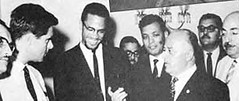
Photo caption: Malcolm X with early leaders of the Palestine Liberation Organization (PLO) in 1964. Malcolm was a staunch critic of zionism as a political philosophy. Originally uploaded by Pan-African News Wire File Photos
Zionist Logic -- Malcolm X on Zionism
Malcolm X (Omowale Malcolm X Shabazz)
Taken from The Egyptian Gazette -- Sept. 17, 1964
The Zionist armies that now occupy Palestine claim their ancient Jewish prophets predicted that in the "last days of this world" their own God would raise them up a "messiah" who would lead them to their promised land, and they would set up their own "divine" government in this newly-gained land, this "divine" government would enable them to "rule all other nations with a rod of iron."
If the Israeli Zionists believe their present occupation of Arab Palestine is the fulfillment of predictions made by their Jewish prophets, then they also religiously believe that Israel must fulfill its "divine" mission to rule all other nations with a rod of irons, which only means a different form of iron-like rule, more firmly entrenched even, than that of the former European Colonial Powers.
These Israeli Zionists religiously believe their Jewish God has chosen them to replace the outdated European colonialism with a new form of colonialism, so well disguised that it will enable them to deceive the African masses into submitting willingly to their "divine" authority and guidance, without the African masses being aware that they are still colonized.
CAMOUFLAGE
The Israeli Zionists are convinced they have successfully camouflaged their new kind of colonialism. Their colonialism appears to be more "benevolent," more "philanthropic," a system with which they rule simply by getting their potential victims to accept their friendly offers of economic "aid," and other tempting gifts, that they dangle in front of the newly-independent African nations, whose economies are experiencing great difficulties. During the 19th century, when the masses here in Africa were largely illiterate it was easy for European imperialists to rule them with "force and fear," but in this present era of enlightenment the African masses are awakening, and it is impossible to hold them in check now with the antiquated methods of the 19th century.
The imperialists, therefore, have been compelled to devise new methods. Since they can no longer force or frighten the masses into submission, they must devise modern methods that will enable them to manouevre the African masses into willing submission.
The modern 20th century weapon of neo-imperialism is "dollarism." The Zionists have mastered the science of dollarism: the ability to come posing as a friend and benefactor, bearing gifts and all other forms of economic aid and offers of technical assistance. Thus, the power and influence of Zionist Israel in many of the newly
"independent" African nations has fast-become even more unshakeable than that of the 18th century European colonialists... and this new kind of Zionist colonialism differs only in form and method, but never in motive or objective.
At the close of the 19th century when European imperialists wisely foresaw that the awakening masses of Africa would not submit to their old method of ruling through force and fears, these ever-scheming imperialists had to create a "new weapon," and to find a "new base" for that weapon.
DOLLARISM
The number one weapon of 20th century imperialism is zionist dollarism, and one of the main bases for this weapon is Zionist Israel. The ever-scheming European imperialists wisely placed Israel where she could geographically divide the Arab world, infiltrate and sow the seed of dissension among African leaders and also divide the Africans against the Asians.
Zionist Israel's occupation of Arab Palestine has forced the Arab world to waste billions of precious dollars on armaments, making it impossible for these newly independent Arab nations to concentrate on strengthening the economies of their countries and elevate the living standard of their people.
And the continued low standard of living in the Arab world has been skillfully used by the Zionist propagandists to make it appear to the Africans that the Arab leaders are not intellectually or technically qualified to lift the living standard of their people ... thus, indirectly "enducing" Africans to turn away from the Arabs and towards the Israelis for teachers and technical assistance.
"They cripple the bird's wing, and then condemn it for not flying as fast as they."
The imperialists always make themselves look good, but it is only because they are competing against economically crippled newly independent countries whose economies are actually crippled by the Zionist-capitalist conspiracy. They can't stand against fair competition, thus they dread Gamal Abdul Nasser's call for African-Arab Unity under Socialism.
MESSIAH?
If the "religious" claim of the Zionists is true that they were to be led to the promised land by their messiah, and Israel's present occupation of Arab Palestine is the fulfillment of that prophesy: where is their messiah whom their prophets said would get the credit for leading them there? It was Ralph Bunche who "negotiated" the Zionists into possession of Occupied Palestine! Is Ralph Bunche the messiah of Zionism? If Ralph Bunche is not their messiah, and their messsiah has not yet come, then what are they doing in Palestine ahead of their messiah?
Did the Zionists have the legal or moral right to invade Arab Palestine, uproot its Arab citizens from their homes and seize all Arab property for themselves just based on the "religious" claim that their forefathers lived there thousands of years ago? Only a thousand years ago the Moors lived in Spain. Would this give the Moors of today the legal and moral right to invade the Iberian Peninsula, drive out its Spanish citizens, and then set up a new Moroccan nation ... where Spain used to be, as the European zionists have done to our Arab brothers and sisters in Palestine?...
In short the Zionist argument to justify Israel's present occupation of Arab Palestine has no intelligent or legal basis in history ... not even in their own religion. Where is their Messiah?
See also: "Black American Anti-Zionism: From Boggs to Badu"
Labels: Black America, Malcolm X, Palestine, resistance, Zionism
Sunday, February 03, 2008
Black American Anti-Zionism: From Boggs to Badu
Erykah Badu got the attention of the Associated Press last week when she reportedly "said she identifies with Palestinian hip-hop and expressed support for Louis Farrakhan before a crowd of Israeli fans and journalists Thursday." The short piece goes on to say:
The singer, who couldn't name any Israeli hip-hop artists, said she identified best with the Palestinians and their hip-hop scene, saying they are part of her "tribe" of hip-hop.Ha'aretz and the Jerusalem Post both republished the AP story and their readers left lots of interesting comments here and here. One hopes that Badu got the permission of Palestinians to perform in Israel as the Jewish apartheid state is currently under a cultural and economic boycott.
"They use (hip-hop) as a form of liberation, as a form of pre-resistance, as a form of therapy," she said.
In any case, the AP report reminded me of the November 1, 1970, "Appeal by Black Americans Against United States Support of the Zionist Government of Israel", published in the New York Times (p. 172) by the Committee of Black Americans for Truth About the Middle East. The statement was signed by a number of Detroit activists, including Grace and James Boggs and the Reverend Albert B. Cleage Jr., founder of the Shrine of the Black Madonna. Among other things, the appeal expressed "complete solidarity with our Palestinian brothers and sisters", denounced "King Hussein's slaughter of Palestinian refugees and freedom-fighters", noted the alliance of apartheid South Africa and Israel, and quoted Yassir Arafat as follows: "Our political vision for a free Palestine is a democratic, secular, non-racial state where all Palestinians--Christians, Jews, and Muslims--will have equal rights."

Props to no snow here for alerting me to the Erykah Badu story, via criticalbloggers.org, and to Stop Raping Palestine for clueing me into the "Appeal by Black Americans ..."
I liked Badu's 1997 Baduizm but haven't really followed her music since then but I really like the video for "Honey" from the New Amerikah album. The two vids below are both from the Palestinian hip hop group, DAM.
See also:
Labels: apartheid, Black America, Erykah Badu, Israel, music, Palestine, resistance, video
Thursday, October 26, 2006
Bayard Rustin—Giant with Feet of Clay
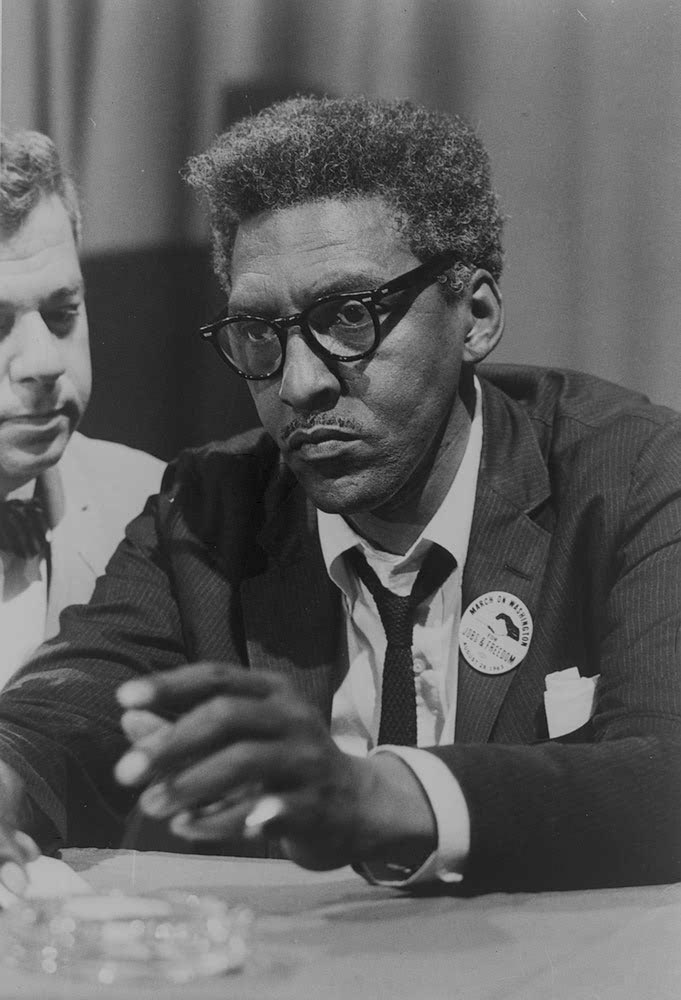 Recently, I was doing some research for a friend on Bayard Rustin. Rustin was a multi-talented man and one of the greatest grassroots organizers and advocates of nonviolent direct action in this country's history but he was a giant with feet of clay.
It seems to me that too often people are disheartened when they learn about the flaws of a personal hero but I think such knowledge should be reassuring. We don't have to be perfect to work in important struggles or try to do great things. Imperfect people can work for justice, too; indeed, we're the only ones who can.
So, I'm going to dish some dirt on Bayard Rustin because I think we can learn from both the powerful positive example of Rustin's life and from his negative example, too. Rustin was in the thick of many important social movement in the US in the last century and what he did or did not do tells us a lot not just about Rustin but about those movements. A final lesson is that we must be on guard for our own blind spots.
This isn't going to be an exhaustive list and it won't include some of the faults others find with him. To me, the three most outstanding flaws in Rustin were his sexism, his support for Zionism, and his internalized homophobia. He can hardly be faulted for the latter, except that it lasted so long—after Stonewall, even—and it was, in at least one instance, weaponized against someone else.
Rustin was the main organizer for the August 28, 1963, March on Washington but he sidelined women. The meeting mentioned below was the first major planning meeting after all the mainline civil rights organization had signed on. Daniel Levine writes:
[O]n July 2, at a luncheon at the Roosevelt Hotel in New York City, the "Big Six"—Randolph, King, John Lewis from SNCC, Whitney Young from the National Urban League, James Farmer, and Roy Wilkins—met. Dorothy Height of the National Council of Negro Women was not at that meeting. The NCNW was listed in the New York Times article as one of the original sponsoring organizations. The stationery of the march, however, did not list it. The addition of the National Council of Negro Women, as an afterthought, was typical of the whole march effort. It was as though the organizers came to the thought "Oh, we mustn't neglect the women." But they were not included as fellow planners or, as it turned out, as speakers at the march itself. ...[1]At that same meeting the men agreed "to add four white cochairmen to the march leadership" but black women were sent to the back of the bus.[3] Jervis Anderson writes:
A dozen days before the march, Randolph received letters from Anna Arnold Hedgeman, on the board of the SCLC and a member of the administrative committee of the March on Washington, pointing out that women were not being recognized. In response, Randolph, or maybe Bayard, suggested to the ten speakers that since they "were all men and since it is imperative that the role of women in the struggle be made clear, " important women should be invited to participate. Randolph suggested Rosa Parks, Mrs. Medgar Evers, Mrs. Daisy Bates, Mrs. Gloria Richardson, Mrs. Diane Nash Bevel. "The difficulty of finding a single woman to speak without causing serious problems vis-a-vis other women and woman's groups suggests ... that the chairman should introduce these women and tell of their role in the struggle and tracing their spiritual ancestry back to Sojourner Truth and Harriet Tubman," that they should be applauded, not speak, and then sit down. The male speakers and Rustin all agreed, and that is in fact what happened. Not one woman spoke from the platform.[emphasis added][2]
The program at the Lincoln Memorial was not as smooth in conception and execution as it seemed to the tens of thousands who applauded it. There had been, and probably still was, a brooding feminist rebellion behind the scenes. ... Only Daisy Bates (who had led the struggle to desegregate Little Rock's Central High School in 1957) was allowed a brief ceremonial turn on the platform, to introduce five "Negro Women Fighters for Freedom."Obviously, Rustin was not the only black male civil rights leader with a sexism problem but is it too much to ask a man who had repeatedly been pushed out of the limelight because of his sexual orientation to be more sensitive to issues of sexism? In the case of Rustin the answer may be yes.
Imperatively, those five included Rosa Parks, heroine of the 1955-56 Montgomery bus boycott. It was that event which not only produced the celebrated leadership of Martin Luther King, Jr., but also inaugurated the modern phase of black protest activism—a phase that had now reached its moral and popular zenith in the March on Washington. In fact, Anna Arnold Hedgeman, one of the newly disgruntled black women—she had been a passionate supporter of every mass initiative A. Philip Randolph had launched since 1941—now declared that the March on Washington would have been rightly called "Rosa Park's Day."
Perhaps, the strongest voice of feminist complaint was Pauli Murray's. Then studying at the Yale School of Divinity, she was among the black civil rights activists who had admired Randolph since the early 1940s. Seethingly displeased with particular arrangements for March on Washington, Pauli Murray wrote to Randolph a week before the event:I have been increasingly perturbed over the blatant disparity between the major role which Negro women have played and are playing in the crucial grass-roots levels of our struggle and the minor role of leadership they have been assigned in the national policy-making decisions. ... It is indefensible to call a national March on Washington and send out a Call which contains the name of not a single woman leader. Nor can this glaring omission be glossed over by inviting several Negro women to appear on the August 28 program.Perhaps such a letter would have been more appropriately addressed to Bayard Rustin; for it was he who organized the program and procedures of the March on Washington. [Murray's decision to write to Randolph is understandable since women were excluded from the March leadership and, thus, not privy to the behind-the-scenes decision to make Randolph the titular director while Rustin did the real organizing—VFPD] ... [Pauli Murray's] letter to Randolph echoed the earlier view of the feminist Ella Baker that black men did not want women to share the highest level of civil rights leadership.[4]
The time has come to say to you quite candidly, Mr. Randolph, that "tokenism" is as offensive when applied to women as when applied to Negroes, and that I have not devoted the greater part of my adult life to the implementation of human rights to [now] condone any policy which is not inclusive.
As Randall Kennedy notes in his review, "From Protest to Patronage:"
Before the late 1970s, Rustin spent little if any energy advancing the cause of equal treatment for lesbians and gays. ... [Lost Prophet: The Life and Times of Bayard Rustin author John] D'Emilio notes, however, that even with Rustin's forays into gay politics, he was never quite of it. The year before Rustin died in 1987, gay activist Joseph Beam invited Rustin to contribute to an anthology of writings by black gay men. "After much thought," Rustin responded, "I have decided that I must decline. ... I did not 'come out of the closet' voluntarily—circumstances forced me out. While I have no problem with being publicly identified as homosexual, it would be dishonest of me to present myself as one who was in the forefront of the struggle for gay rights. The credit for that belongs to others. ... While I support full equality, under law, for homosexuals, I fundamentally consider sexual orientation to be a private matter."This last remark by Rustin is an understatement. In fact, it seems that for most of his life Rustin accepted his own marginalization as a gay man as reasonable or even justified. Moreover, in 1971, when War Resisters League staffer David McReynolds " 'came out of the closet,' Bayard wanted him fired," according to McReynolds.[5] Levine writes that Rustin's "judgment was purely tactical" and Rustin wanted to protect the organization from the fallout over McReynold's admission. Ironically, after Rustin was sentenced to sixty days in jail in 1953 on a "morals charge"—he was arrested while having sex with two men in a car—McReynolds had been supportive and even visited him in jail. Rustin's internalization of homophobia may have led him to turn a blind eye to the marginalization of women, too.
In 1948, Jewish violence in Palestine killed thousands of Arabs. The creation of Israel also created 750,000 Palestinian refugees, driven from their homeland by Jewish terrorism and ethnic cleansing. Although Rustin was keenly sensitive, even self-conscious, about Jewish suffering in World War II he was callous about the suffering of Arabs at the hands of Jews just three years after the end of the WWII.[6] At one point, he even referred to Israel as "the opiate of the Arabs."[7]
In 1967, Israel launched a pre-emptive war on neighboring countries, killing thousands more, seizing additional Arab land and creating tens of thousands of additional Palestinian refugees. Although Rustin visited refugee camps in Thailand, Somalia, Pakistan and Puerto Rico as a representative of the International Rescue Committee, he pointedly refused to visit Palestinian refugees in the West Bank.[8] Just three years later, in 1970, Bayard Rustin betrayed his pacifist values and history and publicly lobbied for the United States to provide Israel with all the jet fighters and bombers it had requested.[9] Many of Rustin's old friends and colleagues were appalled.
After the United Nations General Assembly declared "zionism is a form of racism and racial discrimination" in 1975, Rustin started the Black Americans to Support Israel Committee.[10] He recruited an impressive list of national Black leaders but also attracted a number of Black critics, including one who wrote to a Jewish publication to say: "It is an insult to the collective intelligence of thirty-five million blacks that one hundred 'leaders' use their good name to support Zionism."[11] Psychologist Kenneth B. Clark was among those who refused to join BASIC. " 'I felt,' he explained later, 'that the Palestinians were human beings too; and that we could not have peace in the Middle East until the Palestinian problem was solved.' "[12]
In 1982, Israel invaded Lebanon killing nearly 20,000 Arabs, mostly civilians. Rustin helped whitewash Israel's atrocity as "an act of legitimate self-defense" and "not terribly destructive."[13]
Notes:
- Daniel Levine. Bayard Rustin and the Civil Rights Movement. (New Brunswick, NJ: Rutgers Univ. Pr, 2000) pp. 134.
- Levine, pp. 140-1.
- Jervis Anderson. Bayard Rustin: Troubles I've Seen. (New York: HarperCollins, 1997) p. 248.
- Anderson, pp. 258-9.
- Levine, p. 72.
- Anderson, p. 339.
- John D'Emilio. Lost Prophet: The Life and Times of Bayard Rustin. (New York: Free Pr., 2003) p. 483.
- Levine, p. 230.
- Anderson, p. 339; Levine, pp. 224-6.
- Levine, p. 226.
- Anderson, pp. 339-40.
- Anderson, p. 340.
- Levine, p. 231.
- http://www.wvu.edu/~lawfac/jelkins/lp-2001/murray.html
- http://www.pinn.net/~sunshine/whm2001/p_murray.html
Labels: Bayard Rustin, Black America, gender, history, Israel, LGBT, nonviolence, race, resistance, United States, Zionism


