Thursday, September 23, 2021
Orwell on Fascism, Language, & Writing
It will be seen that, as used, the word 'Fascism' is almost entirely meaningless ...
All one can do for the moment is to use the word with a certain amount of circumspection and not, as is usually done, degrade it to the level of a swearword.
Source: George Orwell, "What is Fascism?", Tribune, 1944.
The word Fascism has now no meaning except in so far as it signifies ‘something not desirable’. The words democracy, socialism, freedom, patriotic, realistic, justice, have each of them several different meanings which cannot be reconciled with one another. In the case of a word like democracy, not only is there no agreed definition, but the attempt to make one is resisted from all sides. It is almost universally felt that when we call a country democratic we are praising it: consequently the defenders of every kind of régime claim that it is a democracy, and fear that they might have to stop using that word if it were tied down to any one meaning. Words of this kind are often used in a consciously dishonest way. That is, the person who uses them has his own private definition, but allows his hearer to think he means something quite different.
~*~*~
In our time, political speech and writing are largely the defence of the indefensible. Things like the continuance of British rule in India, the Russian purges and deportations, the dropping of the atom bombs on Japan, can indeed be defended, but only by arguments which are too brutal for most people to face, and which do not square with the professed aims of political parties. Thus political language has to consist largely of euphemism, question-begging and sheer cloudy vagueness. Defenceless villages are bombarded from the air, the inhabitants driven out into the countryside, the cattle machine-gunned, the huts set on fire with incendiary bullets: this is called pacification. Millions of peasants are robbed of their farms and sent trudging along the roads with no more than they can carry: this is called transfer of population or rectification of frontiers. People are imprisoned for years without trial, or shot in the back of the neck or sent to die of scurvy in Arctic lumber camps: this is called elimination of unreliable elements. Such phraseology is needed if one wants to name things without calling up mental pictures of them. Consider for instance some comfortable English professor defending Russian totalitarianism. He cannot say outright, 'I believe in killing off your opponents when you can get good results by doing so'. Probably, therefore, he will say something like this:
While freely conceding that the Soviet régime exhibits certain features which the humanitarian may be inclined to deplore, we must, I think, agree that a certain curtailment of the right to political opposition is an unavoidable concomitant of transitional periods, and that the rigours which the Russian people have been called upon to undergo have been amply justified in the sphere of concrete achievement.The inflated style is itself a kind of euphemism. A mass of Latin words falls upon the facts like soft snow, blurring the outlines and covering up all the details. The great enemy of clear language is insincerity. When there is a gap between one’s real and one’s declared aims, one turns as it were instinctively to long words and exhausted idioms, like a cuttlefish spurting out ink. In our age there is no such thing as 'keeping out of politics'. All issues are political issues, and politics itself is a mass of lies, evasions, folly, hatred and schizophrenia. When the general atmosphere is bad, language must suffer.
~*~*~
But one can often be in doubt about the effect of a word or a phrase, and one needs rules that one can rely on when instinct fails. I think the following rules will cover most cases:
i. Never use a metaphor, simile or other figure of speech which you are used to seeing in print.
ii. Never use a long word where a short one will do.
iii. If it is possible to cut a word out, always cut it out.
iv. Never use the passive where you can use the active.
v. Never use a foreign phrase, a scientific word or a jargon word if you can think of an everyday English equivalent.
vi. Break any of these rules sooner than say anything outright barbarous.
These rules sound elementary, and so they are, but they demand a deep change of attitude in anyone who has grown used to writing in the style now fashionable.
~*~*~
Political language – and with variations this is true of all political parties, from Conservatives to Anarchists – is designed to make lies sound truthful and murder respectable, and to give an appearance of solidity to pure wind. One cannot change this all in a moment, but one can at least change one’s own habits, and from time to time one can even, if one jeers loudly enough, send some worn-out and useless phrase – some jackboot, Achilles’ heel, hotbed, melting pot, acid test, veritable inferno or other lump of verbal refuse – into the dustbin where it belongs.
Source: George Orwell, "Politics and the English Language", Horizon, April 1946.
Labels: Orwell, politics, quotations


Monday, June 15, 2020
Popper & Tolerance
Almost thirteen years ago, I wrote a post, citing Chris Hedges, that mentioned Karl Popper and his contrived "paradox of tolerance". I also invoked Popper again last year in a post quoting George Orwell.
In note 4 to chapter 7 of The Open Society and Its Enemies (1945) Popper writes:
Less well known is the paradox of tolerance: Unlimited tolerance must lead to the disappearance of tolerance. If we extend unlimited tolerance even to those who are intolerant, if we are not prepared to defend a tolerant society against the onslaught of the intolerant, then the tolerant will be destroyed, and tolerance with them.—In this formulation, I do not imply, for instance, that we should always suppress the utterance of intolerant philosophies; as long as we can counter them by rational argument and keep them in check by public opinion, suppression would certainly be most unwise. But we should claim the right to suppress them if necessary even by force; for it may easily turn out that they are not prepared to meet us on the level of rational argument, but begin by denouncing all argument; they may forbid their followers to listen to rational argument, because it is deceptive, and teach them to answer arguments by the use of their fists or pistols. We should therefore claim, in the name of tolerance, the right not to tolerate the intolerant.Here is a graphic representation of Popper's ideas:


If you doubt whether Popper's "paradox of tolerance" enjoys any currency on the Left then please consider that a slightly longer version of the text quoted above appears as the epigraph to the first chapter, "Faith", of Chris Hedges' 2006 book American Fascists. Consider, too, that billionaire George Soros considers himself a protégé of Karl Popper and derived the name of his Open Society Foundations from Popper's book title. Then please have a look at these articles in The Washington Post, Patheos, Quartz, Kottke.org, Big Think, The New York Times, Salon, Open Culture, and Hornet, for example.
The problem with Popper's supposed paradox should be obvious but it, apparently, is not. To illustrate, here is what Popper should have said:
But we should claim the right to suppress them if necessary even by force if they or their followers advance their ideas by the use of their fists, pistols, or other means of actual criminal violence. But even then we must be clear that is not their ideas we suppress but their violence in furtherance of those ideas, which would be criminal even if stripped of any ideology whatsoever.In other words, the problem is not with "intolerant" ideas (Who gets to decide that?) but with violent, coercive actions that are used to promote those or any other ideas. I don't mean to say that society has to wait until the "intolerant" carry out actual violence but, at a minimum, there should be solid evidence of an actual, imminent attack. Thus, there is no paradox of tolerance.
What cannot be tolerated is not intolerance but criminal activity in support of "tolerance", "intolerance", or no ideology whatsoever. Ironically, as has been made abundantly clear in the last two weeks of looting, arson, shootings, assaults, theft, and vandalism in the George Floyd riots, many on the Left have a high tolerance for criminality in advance of a favored ideology. In this case the favored ideology is "anti-racism" i.e. the intolerance of alleged "racism".
Popper is not the only figure associated with the Left who advocated a constrained view of "tolerance". As cited in Sculos and Walsh, Herbert Marcuse wrote in a 1965 essay titled "Repressive Tolerance" (later published in A Critique of Pure Tolerance) that "a liberating tolerance:"
[W]ould include the withdrawal of toleration of speech and assembly from groups and movements which promote aggressive policies, armament, chauvinism, discrimination on the grounds of race and religion, or which oppose the extension of public services, social security, medical care, etc. Moreover, the restoration of freedom of thought may necessitate new and rigid restrictions on teachings and practices in the educational institutions which, by their very methods and concepts, serve to enclose the mind within the established universe of discourse and behavior—thereby precluding a priori a rational evaluation of the alternatives. And to the degree to which freedom of thought involves the struggle against inhumanity, restoration of such freedom would also imply intolerance toward scientific research in the interest of deadly “deterrents,” of abnormal human endurance under inhuman conditions, etc.It may be that Marcuse is more influential these days than Popper but they are two birds of a feather in the procrustean arguments they use to constrict and distort the idea of tolerance. My primary objections to Popper's and Marcuse's ideas are to their distortion of the idea of tolerance and their advocacy for the use of state power to enforce orthodoxy. On the latter point, if a church, company, political party, club, etc. wants to expel someone because they do or do not support same-sex marriage, for example, then that is nothing to be celebrated. However, it is a qualitatively far different thing than the governmental coercion Popper, Marcuse, and their acolytes advocate.
Here are a couple of other thoughtful critiques of the "paradox of tolerance":
See also: "The Ideological-Conflict Hypothesis: Intolerance Among Both Liberals and Conservatives" (2014) by Brandt et al. in Current Directions in Psychological Science.
Labels: censorship, Chris Hedges, crime, critical thinking, Karl Popper, Orwell, philosophy, politics, race, thoughtcrime, violence
Tuesday, October 08, 2019
Orwell on "The Freedom of the Press"
... the chief danger to freedom of thought and speech at this moment is not the direct interference of the MOI [ministry of information—VFPD] or any official body. If publishers and editors exert themselves to keep certain topics out of print, it is not because they are frightened of prosecution but because they are frightened of public opinion. In this country intellectual cowardice is the worst enemy a writer or journalist has to face, and that fact does not seem to me to have had the discussion it deserves.Source: Orwell's Proposed Preface to Animal Farm. Animal Farm was first published in in England in 1945.
... The sinister fact about literary censorship in England is that it is largely voluntary.
Unpopular ideas can be silenced, and inconvenient facts kept dark, without the need for any official ban ... The British press is extremely centralised, and most of it is owned by wealthy men who have every motive to be dishonest on certain important topics. But the same kind of veiled censorship also operates in books and periodicals, as well as in plays, films and radio. At any given moment there is an orthodoxy, a body of ideas which it is assumed that all right-thinking people will accept without question ... Anyone who challenges the prevailing orthodoxy finds himself silenced with surprising effectiveness ...
At this moment what is demanded by the prevailing orthodoxy is an uncritical admiration of Soviet Russia. Everyone knows this, nearly everyone acts on it. Any serious criticism of the Soviet régime, any disclosure of facts which the Soviet government would prefer to keep hidden, is next door to unprintable. And this nation-wide conspiracy to flatter our ally takes place, curiously enough, against a background of genuine intellectual tolerance. For though you are not allowed to criticise the Soviet government, at least you are reasonably free to criticise our own ... [An American parallel would be the circumscribed nature of criticism of Israel in the US media—VFPD]
The servility with which the greater part of the English intelligentsia have swallowed and repeated Russian propaganda from 1941 onwards would be quite astounding if it were not that they have behaved similarly on several earlier occasions. On one controversial issue after another the Russian viewpoint has been accepted without examination and then publicised with complete disregard to historical truth or intellectual decency. To name only one instance, the BBC celebrated the twenty-fifth anniversary of the Red Army without mentioning Trotsky. This was about as accurate as commemorating the battle of Trafalgar without mentioning Nelson, but it evoked no protest from the English intelligentsia. In the internal struggles in the various occupied countries, the British press has in almost all cases sided with the faction favoured by the Russians and libelled the opposing faction, sometimes suppressing material evidence in order to do so ... Very similar things happened during the Spanish civil war. Then, too, the factions on the Republican side which the Russians were determined to crush were recklessly libelled in the English leftwing [sic] press, and any statement in their defence even in letter form, was refused publication. At present, not only is serious criticism of the USSR considered reprehensible, but even the fact of the existence of such criticism is kept secret in some cases ...
What is disquieting is that where the USSR and its policies are concerned one cannot expect intelligent criticism or even, in many cases, plain honesty from Liberal [sic — and throughout as typescript] writers and journalists who are under no direct pressure to falsify their opinions. Stalin is sacrosanct and certain aspects of his policy must not be seriously discussed. This rule has been almost universally observed since 1941, but it had operated, to a greater extent than is sometimes realised, for ten years earlier than that ... The English intelligentsia, or a great part of it, had developed a nationalistic loyalty towards the USSR, and in their hearts they felt that to cast any doubt on the wisdom of Stalin was a kind of blasphemy. Events in Russia and events elsewhere were to be judged by different standards. The endless executions in the purges of 1936-8 were applauded by life-long opponents of capital punishment, and it was considered equally proper to publicise famines when they happened in India and to conceal them when they happened in the Ukraine. And if this was true before the war, the intellectual atmosphere is certainly no better now.
But now to come back to this book [i.e. Animal Farm] of mine. The reaction towards it of most English intellectuals will be quite simple: 'It oughtn't to have been published.' Naturally, those reviewers who understand the art of denigration will not attack it on political grounds but on literary ones. They will say that it is a dull, silly book and a disgraceful waste of paper. This may well be true, but it is obviously not the whole of the story. One does not say that a book 'ought not to have been published' merely because it is a bad book. After all, acres of rubbish are printed daily and no one bothers. The English intelligentsia, or most of them, will object to this book because it traduces their Leader and (as they see it) does harm to the cause of progress. If it did the opposite they would have nothing to say against it, even if its literary faults were ten times as glaring as they are. The success of, for instance, the Left Book Club over a period of four or five years shows how willing they are to tolerate both scurrility and slipshod writing, provided that it tells them what they want to hear.
The issue involved here is quite a simple one: Is every opinion, however unpopular — however foolish, even — entitled to a hearing? Put it in that form and nearly any English intellectual will feel that he ought to say 'Yes'. But give it a concrete shape, and ask, 'How about an attack on Stalin? Is that entitled to a hearing?', and the answer more often than not will be 'No', In that case the current orthodoxy happens to be challenged, and so the principle of free speech lapses ... It is only, or at any rate it is chiefly, the literary and scientific intelligentsia, the very people who ought to be the guardians of liberty, who are beginning to despise it, in theory as well as in practice.
One of the peculiar phenomena of our time is the renegade Liberal. Over and above the familiar Marxist claim that 'bourgeois liberty' is an illusion, there is now a widespread tendency to argue that one can only defend democracy by totalitarian methods. [This calls to mind Karl Popper, the "totalitarian liberal"—VFPD] If one loves democracy, the argument runs, one must crush its enemies by no matter what means. And who are its enemies? It always appears that they are not only those who attack it openly and consciously, but those who 'objectively' endanger it by spreading mistaken doctrines. In other words, defending democracy involves destroying all independence of thought ...
These people don't see that if you encourage totalitarian methods, the time may come when they will be used against you instead of for you.
Labels: censorship, conspiracy, critical thinking, freedom, Karl Popper, media, Orwell, politics, quotations
Saturday, March 30, 2019
Facebook & Selective Censorship
 Enemies of freedom of thought and expression are hailing Facebook's recent reversal on banning "White nationalists" from its platform and from Instagram starting next week. Facebook's previous policy was as follows:
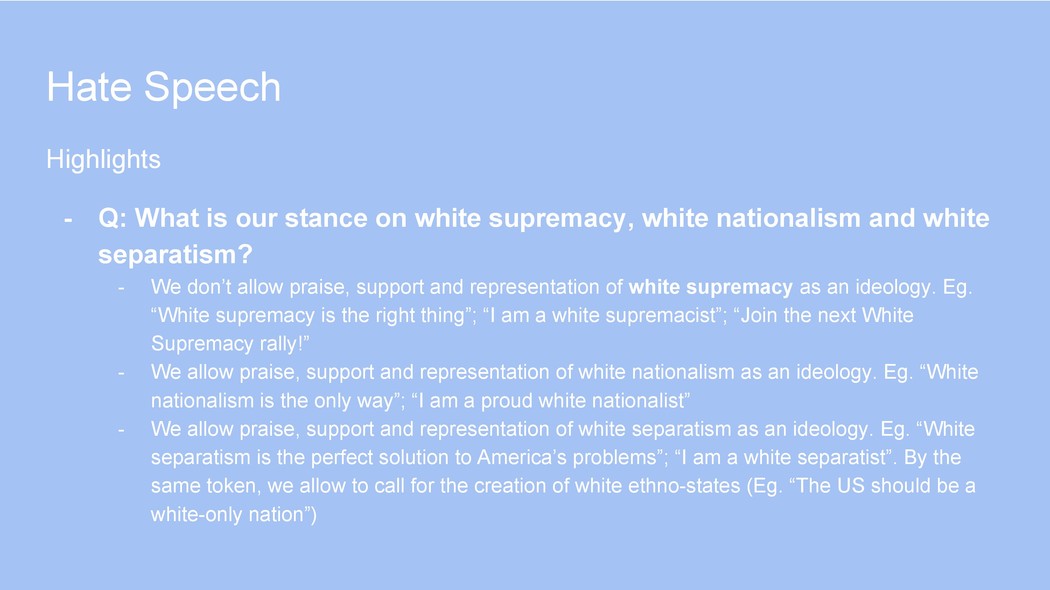
- Q: What is our stance on white supremacy, white nationalism and white separatism?
We don't allow praise, support and representation of white supremacy as an ideology. Eg. "White supremacy is the right thing"; "I am a white supremacist"; "Join the next White Supremacy rally!"
We allow praise, support and representation of white nationalism as an ideology. Eg. "White nationalism is the only way"; "I am a proud white nationalist"
We allow praise, support and representation of white separatism as an ideology. Eg. "White separatism is the perfect solution to America's problems"; "I am a white separatist". By the same token, we allow to call for the creation of white ethno-states (Eg. "The US should be a white-only nation")
Since then Facebook has been lobbied and attacked by the Humpty Dumpty brigade. Here's how the new policy arose according to Vice:
"We've had conversations with more than 20 members of civil society, academics, in some cases these were civil rights organizations, experts in race relations from around the world," Brian Fishman, policy director of counterterrorism at Facebook, told us in a phone call. "We decided that the overlap between white nationalism, [white] separatism, and white supremacy is so extensive we really can't make a meaningful distinction between them. And that's because the language and the rhetoric that is used and the ideology that it represents overlaps to a degree that it is not a meaningful distinction."Wow! "[M]ore than 20 members of civil society ..." That's surely representative of the full scope of views on the subjects of White nationalism and freedom of thought and expression. Of course, it is completely coincidental that Brian Fishman has been part of "regular consulting meetings" between Facebook execs and representatives of the Simon Wiesenthal Center's (SWC) Digital Terrorism and Hate Project, including Rabbi Abraham Cooper, SWC Associate Dean.

Also coincidental is that, apparently, only "White nationalism" will be banned by Facebook because no one ever died from violent Jewish nationalists (see here, here, and here) or violent Chinese nationalists or violent Black nationalists (see here, here, and here). On that subject The Deseret News reports:
As Motherboard [a Vice subdomain] reported, Facebook will still allow content relating to black separatist movements and the Basque separatist movement to be posted, due to experts' arguments that white separatism should be handled differently "because of the long history of white supremacism that has been used to subjugate and dehumanize people of color in the United States and around the world."To paraphrase Orwell, when it comes to Facebook Farm: All nationalisms are equal but some nationalisms are more equal than others. We'll see what happens when the new policy is implemented but as of today the Facebook page featured below was still live on Facebook:
However, Facebook does ban content centered on black nationalism, Motherboard reported. The Southern Poverty Law Center has characterized groups that espouse black nationalist ideology as hate groups, with the added proviso that "they should not be seen as equivalent to white supremacist groups — such as the Ku Klux Klan or neo-Nazis — in terms of their history of violence and terrorism."
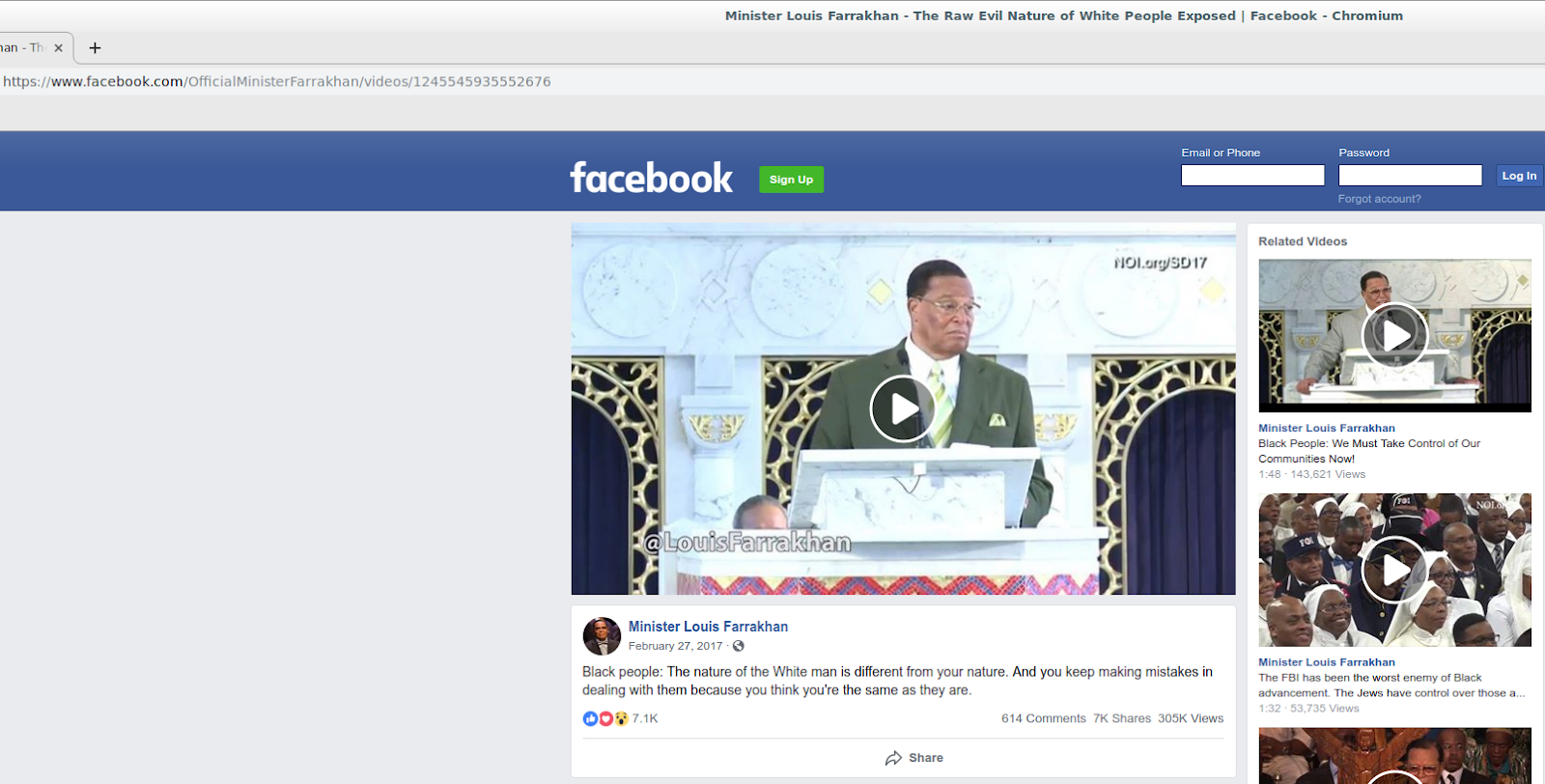
This seems to contradict the claim made in The Deseret News. You see, Louis Farrakhan is profiled as an "extremist", "antisemite", and a "Black Nationalist" by the SPLC and he is the head of the Nation of Islam (NOI), which is an "SPLC Designated Hate Group". The pictured video sub-page is entitled "Minister Louis Farrakhan - The Raw Evil Nature of White People Exposed" and Farrakhan's main page prominently features a link to the NOI main web site.
To be clear, I am no proponent of the SPLC and I don't support banning Farrakhan or the NOI from Facebook. Nor do I support banning White nationalists or supremacists. I do support banning people and entities advocating violence and related criminal activity although I don't think mere criminal advocacy or activity should be the threshold for censorship on Facebook.
For example, it was once a crime for Black people to, among other things, ride at the front of the bus or to dine in certain restaurants. Today, it is illegal, under Israeli law, for anyone anywhere in the world to advocate for a boycott of Israel; sedition is still, arguably, a crime in the United States; apostasy from Islam is punishable by death in some countries; and, a man in China was fined this year for using a VPN to access foreign web sites. Should Facebook censor speech reporting, supporting, or enabling those crimes?
While I have some sympathy with those who support regulating Facebook as a utility, I'm not fully convinced it would be a good idea. Moreover, I doubt that it will happen because that might open the door to treating Facebook as a common carrier and therefore intolerably impinge on the Left's ability to successfully pressure Facebook to censor crimethink.
In any case, my preferred approach to controversial speech is Millian:
But the peculiar evil of silencing the expression of an opinion is, that it is robbing the human race; posterity as well as the existing generation; those who dissent from the opinion, still more than those who hold it. If the opinion is right, they are deprived of the opportunity of exchanging error for truth: if wrong, they lose, what is almost as great a benefit, the clearer perception and livelier impression of truth, produced by its collision with error ...
Complete liberty of contradicting and disproving our opinion, is the very condition which justifies us in assuming its truth for purposes of action; and on no other terms can a being with human faculties have any rational assurance of being right ...
He who knows only his own side of the case, knows little of that. His reasons may be good, and no one may have been able to refute them. But if he is equally unable to refute the reasons on the opposite side; if he does not so much as know what they are, he has no ground for preferring either opinion.
Labels: censorship, freedom, J.S. Mill, media, Orwell, quotations, race, repression, technology, thoughtcrime, violence, White folks
Tuesday, January 29, 2019
The Covington Catholic Rorschach Test
For instance, Caitlin Flanagan's critique in The Atlantic is well worth reading but she just can't resist getting in some digs at the Covington students:
I have watched every bit of video I can find of the event, although more keep appearing. I have found several things that various of the boys did and said that are ugly, or rude, or racist. Some boys did a tomahawk chop when Phillips walked into their group. There is a short video of a group that seems to be from the high school verbally harassing two young women as the women walk past it. In terms of the school itself, Covington Catholic High School apparently has a game-day tradition of students painting their skin black for “black-out days,” but any attempt by the school to cast this as innocent fun is undercut by a photograph of a white kid in black body paint leering at a black player on an opposing team.Flanagan faults "various of the boys" for unspecified "ugly, or rude, or racist" behavior. She says, "Some boys did a tomahawk chop". I'm not going to watch the videos again but the other accounts I've read say that one boy did a "tomahawk chop". I didn't notice the gesture(s) and I won't say it didn't happen.
However, here are a few questions: Who decided that a "tomahawk chop" is indisputably ugly, rude, or racist? How do these critics know that the gesture in question in the video actually was a "tomahawk chop" and not something that just looked like one? Does the kid's state of mind or intent matter? If so, how do you know what that was?
Flanagan writes: "There is a short video of a group that seems to be from the high school verbally harassing two young women as the women walk past it." After everything that Flanagan agrees went wrong with this story you'd think she'd stay away from bashing the kids over video that merely "seems" to show bad behavior. I've seen that video, too, and it's not clear those kids were Covington Catholic students, the same kids filmed at the Lincoln Memorial, or that they were harassing anyone.
Finally, I've seen the "black-out days" video, too. To start with I don't think that practice is necessarily, or even likely, racist although it certainly could be. Given the times in which we live might it be stupid and/or insensitive? Sure, but not every act or statement that offends someone is racist or motivated by racism. Surely, intent ought to count for something but I realize we abandoned that kind of fairness long ago.
In any case, the bigger problem is that the "black-out days" video, like the video initially used to indict the Covington boys, is ripped out of context. Caitlin Flanagan have you learned nothing? And "leering" is strange choice of words but that aside Flanagan is reading an awful lot into that image. Several kids, most of whom are not painted, are visibly jeering the player from the opposing team. So what?
The final, glaring issue is that most accounts admit that the "blackface" video was taken in 2012. So, using it to impugn kids who were at most 12 years old for something other kids at their school may have done is simply deceitful.
In addition to Flanagan's piece, here are a few more articles worth reading:
- Megan McArdle in the Washington Post: "The Covington students failed to act like grownups. So did the adults"
- Robbie Soave in Reason: "If You Still Think Nick Sandmann's Smile Is Proof of Racism, You’re Seeing What You Want to See"
As an aside, I want to be clear: The agenda-pushing revealed by the Covington Catholic media witch hunt is nothing new. Narrative-driven—as opposed to careful, truth-driven—reporting is the order of the day in the mainstream media. What is new is that the media got caught and called out so strongly.
I've read George Orwell's 1984 at least three times and had forgotten about "facecrime" but not everyone has ...


Labels: culture, media, Orwell, politics, race, White folks
Thursday, July 27, 2006
Beyond Chutzpah: A Brief, 'Didactic' Review
Beyond Chutzpah is the much-awaited latest book by Norman G. Finkelstein. In his Introduction, Finkelstein tells us:
The purpose of Beyond Chutzpah is to lift the veil of contrived controversy shrouding the Israel-Palestine conflict. I am convinced that anyone confronting the undistorted record will recognize the injustice Palestinians have suffered. I hope this book will also provide impetus for readers to act on the basis of truth so that, together, we can achieve a just and lasting peace in Israel and Palestine.In the first part of the book—"The Not-So-New 'New Anti-Semitism' "—Finkelstein reveals how deserved criticism of Israel is periodically stymied by an outbreak of "new anti-Semitism" which just so happens to coincide "with renewed international pressures on Israel to withdraw from occupied Arab territories in exchange for recognition from neighboring Arab states." Among the current round of fear mongers he identifies are Abraham Foxman (Never Again? The Threat of the New Anti-Semitism (2003)) and Phyllis Chesler (The New Anti-Semitism (2003)). Finkelstein demonstrates that, "What's currently called the new anti-Semitism actually incorporates three main components: (1) exaggeration and fabrication, (2) mislabeling legitimate criticism of Israeli policy, and (3) the unjustified yet predictable spillover from criticism of Israel to Jews generally."
In the category of exaggeration and fabrication, Finkelstein notes that the reception of his earlier book, The Holocaust Industry, was cited as evidence of anti-Semitism. In its 2000-2001 survey, Antisemitism Worldwide, the Israeli Roth Institute for the Study of Contemporary Anti-Semitism and Racism ominously observed: "Finkelstein's book ... [was] enthusiastically welcomed, especially in Germany." Apparently, unobserved by the Roth Institute, is that, among others, the dean of Holocaust studies, Raul Hilberg, praised The Holocaust Industry as an important "breakthrough"—"carefully" researched and with "trustworthy" conclusions.
Echoing similar remarks from The Holocaust Industry, Finkelstein closes the first part of Beyond Chutzpah with a potent charge that, perhaps, only the son of Holocaust survivors would dare make:
As already noted, Jewish elites in the United States have enjoyed enormous prosperity. From this combination of economic and political power has sprung, unsurprisingly, a mindset of Jewish superiority. Wrapping themselves in the mantle of The Holocaust ["an ideological representation of the [actual] Nazi holocaust"], these Jewish elites pretend—and, in their own solipsistic universe, perhaps imagine themselves—to be victims, dismissing any and all criticism as manifestations of "anti-Semitism." And, from this lethal brew of formidable power, chauvinistic arrogance, feigned (or imagined) victimhood, and Holocaust-immunity to criticism has sprung a terrifying recklessness and ruthlessness on the part of American Jewish elites. Alongside Israel, they are the main fomenters of anti-Semitism in the world today.In the second, larger part of Beyond Chutzpah—"The Greatest Tale Ever Sold"—Finkelstein rebuts, in considerable detail, numerous claims made by Harvard law professor Alan Dershowitz in his best-selling book, The Case for Israel. Finkelstein exposes Dershowitz's reliance upon misinterpreted, non-existent, and discredited sources.
For instance, Dershowitz, citing a September 6, 1999, decision, claims, "the Israeli Supreme Court outlawed the use of all physical pressure in eliciting information from potential terrorists." Yet, as Finkelstein points out, a year before the publication of Case, Dershowitz, "referring to the same court decision ... acknowledged that it did not absolutely prohibit torture." After quoting the contradictory passage from Dershowitz, Finkelstein also quotes the opinion of the plaintiffs in the case—the Public Committee Against Torture in Israel (PCATI)—regarding the 1999 decision: "The Court avoided the position of international law that rejects torture ... and creat[ed] an opening both for the existence of torture in practice, and lending legal and ethical legitimacy to this deplorable crime." The title of PCATI's 2003 followup report speaks for itself: BACK TO A ROUTINE OF TORTURE Torture and Ill-treatment of Palestinian Detainees during Arrest, Detention and Interrogation September 2001–April 2003.
In 1948, Zionist paramilitary fighters from the Irgun and LEHI murdered over 100 unarmed Arab men, women, and children in the village of Deir Yassin. Later that year, in the New York Times prominent American Jews, including Hannah Arendt and Albert Einstein, cited the Deir Yassin massacre in a letter protesting the US visit of former Irgun commander and future Israeli Prime Minster Menachem Begin as evidence of his and his party's—the Freedom (Herut) party (forerunner to the Likud party)—"fascist" and "terrorist" politics and actions.
In Case, Dershowitz claims that "Deir Yassin stands out in the history of Arab-Jewish conflict in Palestine precisely because it was so unusual and so out of character for the Jews." He calls the massacre an "isolated although tragic and inexcusable blemish on Israeli paramilitary actions." Against this, Finkelstein quotes multiple passages from the noted Israeli historian and Zionist apologist Benny Morris—whom Dershowitz also quotes—to the effect that " 'Jewish atrocities' were 'far more widespread than the old histories have let on' " and " 'Jewish atrocities against Arabs . . . were generally unconnected to or lacked any previous direct, Arab provocation.' "Of course, Palestinians have long known about Zionist-perpetrated massacres and other atrocities—if we'd only listen.
Perhaps the best-known part of Finkelstein's attack on Case is Dershowitz's reliance upon and plagiarism of Joan Peters' now discredited book, From Time Immemorial. Not long after its publication in 1984, Peters' book received a scathing review in the New York Review of Books from Yehoshua Porath, professor of Middle East History at Hebrew University. Concluding, he wrote:
I am reluctant to bore the reader and myself with further examples of Mrs. Peters's highly tendentious use—or neglect—of the available source material. Much more important is her misunderstanding of basic historical processes ... Everyone familiar with the writing of the extreme nationalists of Zeev Jabotinsky's Revisionist party ... would immediately recognize the tired and discredited arguments in Mrs. Peters's book. I had mistakenly thought them long forgotten. It is a pity that they have been given new life.In any event, the book—endorsed on the dust jacket by a number of Jewish 'luminaries'—was generally well received in the U.S. and went to become a national bestseller. In his doctoral dissertation on Zionism, Finkelstein cut his scholarly teeth by exposing Peters' "colossal hoax"—a verdict later upheld by "Baruch Kimmerling (of the Hebrew University) and Joel S. Migdal, in their authoritative study, Palestinians: The Making of a People."
In a detailed appendix, including tables and facsimiles of the advance uncorrected proofs of Case, Finkelstein shows how Dershowitz "appropriates large swaths" from Peters' book. One interesting example, albeit minor in comparison to the others Finkelstein documents, was exposed on a nationally broadcast debate between the two antagonists. In two places in Case, Dershowitz uses the term "turnspeak," attributing it in the book solely to George Orwell's 1984. Yet, Orwell never used the clunky term, which was in fact coined by none other than Joan Peters. It is the charge of plagiarism that prompted Dershowitz's campaign to suppress the publication and promotion of Finkelstein's book. Dershowitz claims he has been libeled; yet, the famous trial lawyer refuses to file suit against Finkelstein. Ostensibly, he does not want to give Finkelstein undeserved attention.
All in all, Finkelstein's book is a powerful refutation of The Case for Israel and a powerful corrective to the distorted record of the Israel-Palestine conflict. People who've never known or believed anything but the dominant Zionist narrative would do well to read Beyond Chutzpah and then, as the author hopes, "act on the basis of truth."
Labels: holocaust, Norman Finkelstein, Orwell, Zionism