Monday, June 08, 2020
MLK on Riots and Violence
 |
| Arson in Minneapolis on May 28, 2020 |
It is doubtful that there has been any time in American history when more Black people occupied positions of prominence in the media and power in politics. Even Demon Trump has the same percentage of Black cabinet members as Obama did in his first term.
In Minneapolis, the police chief and the state attorney general are both Black men. The city's representative in Congress is a Somali-American woman. There are apparently four Black members on the city council, one of whom is the son of the state attorney general.
So, how is it that the Minneapolis rioters are supposedly "unheard"? What are they saying and who isn't listening? More importantly, why is it that when pundits, politicians, and other propagandists quote King about the "language of the unheard" they seldom quote the text below from his 1964 Nobel Peace Prize speech?
Violence as a way of achieving racial justice is both impractical and immoral. I am not unmindful of the fact that violence often brings about momentary results. Nations have frequently won their independence in battle. But in spite of temporary victories, violence never brings permanent peace. It solves no social problem: it merely creates new and more complicated ones. Violence is impractical because it is a descending spiral ending in destruction for all. It is immoral because it seeks to humiliate the opponent rather than win his understanding: it seeks to annihilate rather than convert. Violence is immoral because it thrives on hatred rather than love. It destroys community and makes brotherhood impossible. It leaves society in monologue rather than dialogue. Violence ends up defeating itself. It creates bitterness in the survivors and brutality in the destroyers.In 1968, shortly before his death, King reiterated his position on the "language of the unheard" while "condemn[ing] riots", saying: "... I am still committed to militant, powerful, massive, non-violence as the most potent weapon in grappling with the [race] problem from a direct action point of view ... And I feel that we must always work with an effective, powerful weapon and method that brings about tangible results."
In a real sense nonviolence seeks to redeem the spiritual and moral lag that I spoke of earlier as the chief dilemma of modern man. It seeks to secure moral ends through moral means. Nonviolence is a powerful and just weapon. Indeed, it is a weapon unique in history, which cuts without wounding and ennobles the man who wields it.
I believe in this method because I think it is the only way to reestablish a broken community. It is the method which seeks to implement the just law by appealing to the conscience of the great decent majority who through blindness, fear, pride, and irrationality have allowed their consciences to sleep.
Labels: Black America, Christianity, crime, critical thinking, Ilhan Omar, Martin Luther King, nonviolence, Obama, police, quotations, race, Trump, violence


Saturday, November 23, 2013
Quotable: The Law of Love and the Law of Violence
Below are some excerpts from "The Law of Love and the Law of Violence" by Leo Tolstoy as translated of Mary Koutouzow Tolstoy (Rudolph Field, 1948) and transcribed and edited by nonresistance.org. I think the translation by Jane Kentish in A Confession and Other Religious Writings (Penguin, 1987) is superior but I don't have access to an electronic version of that text.
Nothing should be more natural than that the working class should thus express itself [by rejecting government--VFPD]. But most of them continue their existence as martyrs in the police service, in financial offices, and in the regiments. Others, the minority, try to free themselves from oppression by revolt and by committing violence in their turn on those who oppress them, or, in other words, try to quench fire with fire and thus increase the violence from which they are suffering.
Why do men act so irrationally? It is because the long duration of the lie has caused them to lose all notion of the bond that exists between their servitude and their participation in violence.
Why do they not see this bond? Because they no longer have faith, and without faith, men are guided only by interest. In fact, he who is guided by interest alone cannot do otherwise than deceive or be deceived. [p. 16]
The Christian revelation was the doctrine of human equality, of the fatherhood of God, of the brotherhood of man. It struck at the very basis of that monstrous tyranny that then oppressed the civilized world; it struck at the fetters of the captive, at the bonds of the slave, at that monstrous injustice which allowed a class to revel on the proceeds of labor, while those who did the labor fared scantily. That is the reason why early Christianity was persecuted. And when they could no longer hold it down, then the privileged classes adopted and perverted the new faith, and it became, in its very triumph, not the pure Christianity of the early days, but a Christianity that, to a very great extent, was the servitor of the privileged classes. [This text appears in the epigraph to chap. 10 in the Kentish translation (although this is not the same version she uses); it does not appear at all in M. K. Tolstoy's translation. The text comes from "Thy Kingdom Come" (1889) by Henry George.]
Do not think that Church Christianity was an incomplete, one-sided, formal view of Christianity, but nevertheless Christianity. Do not think this: for Church Christianity is the enemy of true Christianity and stands in relation to true Christianity as a criminal caught in the act. It must either destroy itself, or continue to commit new crimes. [This text appears in the epigraph to chap. 10 in the Kentish translation; it does not appear at all in M. K. Tolstoy's translation. According to notes in the Kentish edition, Leo Tolstoy is quoting himself from another work.]
The social conditions of life can only be improved by people exercising self-restraint.
It is said that one swallow does not make a summer, but can it be that because one swallow does not make a summer another swallow, sensing and anticipating summer, must not fly? If every blade of grass waited similarly summer would never occur. And it is the same with establishing the Kingdom of God: we must not think about whether we are the first or the thousandth swallow. [This text appears in the epigraph to chap. 13 in the Kentish translation; it does not appear at all in M. K. Tolstoy's translation.]
The Christian can ignore the laws established by the State because he has no need of them for himself, or for others; he considers that human life is better assured by the law of love professed by him than by the law of violence that one wants to impose on him … Having recognized the efficacy of the law of love, he does not consider the law of violence obligatory, and he denounces the other as the most horrible of mistakes ...
The profession of true Christianity, which includes the precept of nonresistance to evil by violence, relieves those faithful to this doctrine from any external authority. Much better, it gives them the possibility of obtaining better conditions in life, those that men seek vainly by changing its external forms. In reality, these forms change only after the modifications that have arisen in men's consciences, and in the measure in which this conscience has evolved.
It was not the orders of a government that abolished the murder of children, tortures, or slavery, but the universal conscience that caused these orders. Since the evolution of conscience determines the changes in the modes of life, the contrary, as well, should happen (or so they say). As it is more agreeable and easier to modify external forms (because the results are more apparent), this activity is preferred to the one whose aim is to modify conscience. That is why one is more frequently occupied with the foundation, rather than with the form. [pp. 29-30]
A man who continues to live in error sees the incarnation of power in certain sacred institutions, which are the indispensable organs of the social body. The man who awakens to the truth sees this assumed by men sunk in error and who attribute to it a fantastic importance having no possible justification, and who accomplish their will by force.
For those with insight, these lost people, bribed as often as not, resemble brigands who hold up travelers on the high roads. For anyone who has awakened to the truth, the entity called the State does not exist, and therefore there is not the slightest justification, for him, for the acts of violence committed in the name of the State. And any participation in these acts is impossible for him.
To sum up, State violence will disappear, not with the aid of external means, but thanks only to the calls of conscience of men who have awakened to the truth. [From the epigraph to chap. 15]
We are quite accustomed to find ways of managing other people's lives, and these methods do not seem odd to us. They would be unnecessary, however, if men were religious and free. They are, in fact, the result of despotism and of the domination of one or a few over many. This error is harmful, not only because it causes suffering to those who feel the oppression of despots, but even more so because their consciences no longer warn them of the necessity of bettering their condition. But only this conscience can have an effect on one's fellow being.
Not only has one man not the right to dispose of a great number, but a great number have not the right to dispose of a single man. (V. Tchertkov, Daily Reading, November 22nd) [From the epigraph to chap. 16]
The superstition that causes one to think that he can tell in advance how society will be organized in the future has its origin in the desire of the transgressors to justify their conduct, and in the desire of the victims to explain and lighten the weight of the constraint. The former persuade themselves and others that they know the way to make life take the form that they consider the best. The latter, who undergo such constraint that they do not feel strong enough to free themselves, have the same conviction, for it permits them to give a certain excuse for their position.
The history of nations ought to destroy this superstition entirely. [p. 35]
... our idea of our social organization, founded on violence, is so impressed upon us that we do not perceive all the crimes that they commit each day in the name of the public good. We see only the rare violent attempts of those who are called murderers, burglars, or thieves.
"He is a murderer, he is a thief, he does not observe the rule of not doing to others what you would not have them do to you," say the same people who go on killing in war, who force nations to prepare for carnage, and who steal from and despoil their own as well as foreign nations. [p. 37]
Men already see the ignominy of the spy and executioner, and are beginning to see that of the police, detectives, and even to a certain degree, of military men. But they do not yet see it of the judge, the minister, the sovereign, chiefs of parties, or revolutionaries. And yet the work of the latter is as vile and as contrary to human nature, or even worse, than the work of the executioner or the spy, because it is more hypocritical.
Understand then, all of you, especially the young, that to want to impose an imaginary state of government on others by violence is not only a vulgar superstition, but even a criminal work. Understand that this work, far from assuring the good of men, is only a lie, a more or less unconscious hypocrisy, and is always hiding the lowest passions.
Understand it, you, men of tomorrow, and stop looking for an illusionary happiness by participating in the administration of the State by judicial institutions, by instruction, and by all kinds of parties that have the good of the masses as an aim. Pay attention to only one thing, that which you need the most, that which is the most accessible, and that which gives the most happiness to us and to everyone: the increase of love in us by the suppression of vices and passions that keep it from manifesting itself. [pp. 39-40]
Labels: Christianity, nonviolence, quotations, Tolstoy
Friday, May 24, 2013
Quotable: From Two Speeches of the Rev. Dr. Martin Luther King, Jr.
A true revolution of values will lay hand on the world order and say of war, "This way of settling differences is not just." This business of burning human beings with napalm, of filling our nation's homes with orphans and widows, of injecting poisonous drugs of hate into the veins of peoples normally humane, of sending men home from dark and bloody battlefields physically handicapped and psychologically deranged, cannot be reconciled with wisdom, justice, and love. A nation that continues year after year to spend more money on military defense than on programs of social uplift is approaching spiritual death.
America, the richest and most powerful nation in the world, can well lead the way in this revolution of values. There is nothing except a tragic death wish to prevent us from reordering our priorities so that the pursuit of peace will take precedence over the pursuit of war. There is nothing to keep us from molding a recalcitrant status quo with bruised hands until we have fashioned it into a brotherhood. -"Beyond Vietnam," April 4, 1967. Love is the ultimate force that makes for the saving choice of life and good against the damning choice of death and evil. Therefore the first hope in our inventory must be the hope that love is going to have the last word. -"Beyond Vietnam," April 4, 1967, quoting Arnold Toynbee.
Now a lot of us are preachers, and all of us have our moral convictions and concerns, and so often we have problems with power. But there is nothing wrong with power if power is used correctly
You see, what happened is that some of our philosophers got off base. And one of the great problems of history is that the concepts of love and power have usually been contrasted as opposites, polar opposites, so that love is identified with a resignation of power, and power with a denial of love. It was this misinterpretation that caused the philosopher Nietzsche, who was a philosopher of the will to power, to reject the Christian concept of love. It was this same misinterpretation which induced Christian theologians to reject Nietzsche's philosophy of the will to power in the name of the Christian idea of love.
Now, we got to get this thing right. What is needed is a realization that power without love is reckless and abusive, and that love without power is sentimental and anemic. (Yes) Power at its best [applause], power at its best is love (Yes) implementing the demands of justice, and justice at its best is love correcting everything that stands against love. (Speak) -"Where Do We Go From Here?," August 16, 1967.
... I'm concerned about a better world. I'm concerned about justice; I'm concerned about brotherhood; I'm concerned about truth. (That’s right) And when one is concerned about that, he can never advocate violence. For through violence you may murder a murderer, but you can't murder murder. (Yes) Through violence you may murder a liar, but you can't establish truth. (That's right) Through violence you may murder a hater, but you can't murder hate through violence. (All right, That’s right) Darkness cannot put out darkness; only light can do that. [applause] -"Where Do We Go From Here?," August 16, 1967.
Labels: Martin Luther King, nonviolence, philosophy, quotations
Friday, January 25, 2013
Lessons of Athens, TN
In "Some Lessons of 'Unintended Consequences' " I wrote:
I was reminded of this recently while reading some of the post-Newtown massacre gun rights discussions. Unintended Consequences is, of course, an ardently pro-gun novel and it is therefore no coincidence that the story of the Battle of Athens appears on a lot of pro-gun web sites. While I was unsuccessful in verifying the provenance of an op-ed concerning the Athens revolt attributed to Eleanor Roosevelt, I did find an article in the New York Times (Jan. 12, 1947; p. 6) entitled "Athens, Tenn., Regime Set Up by GI's Falls." It reports:
I also learned about the inspiring story of the Battle of Athens from Ross' book. In 1946, WW II vets and other locals successfully took up arms against a corrupt, local Democratic Party regime in Athens, TN, the county seat of McMinn County.In a world where so many people are passive and disengaged from the major questions of political and social life, I expect I will always find righteous resistance to be inspirational. Yet, I am also keenly aware, that violent resistance is almost always a blind alley, which typically empowers not necessarily the kindest or most just among us but rather those who are adept at inflicting or orchestrating violence.
I was reminded of this recently while reading some of the post-Newtown massacre gun rights discussions. Unintended Consequences is, of course, an ardently pro-gun novel and it is therefore no coincidence that the story of the Battle of Athens appears on a lot of pro-gun web sites. While I was unsuccessful in verifying the provenance of an op-ed concerning the Athens revolt attributed to Eleanor Roosevelt, I did find an article in the New York Times (Jan. 12, 1947; p. 6) entitled "Athens, Tenn., Regime Set Up by GI's Falls." It reports:
The unofficial organization of the veterans is torn by dissension.
Four of the five leaders of the veterans movement declared in an open letter yesterday:
"We abolished one machine only to replace it with another and more powerful one in the making."
Labels: guns, nonviolence, politics, resistance, violence
Monday, June 16, 2008
Folksinger, Storyteller, Railroad Tramp Utah Phillips Dead at 73
 I just recently learned that Utah Phillips died late last month. I met Utah Phillips on a couple of his visits to Ann Arbor in the mid-1990s and was fortunate to participate in some long discussions with him at the Industrial Workers of the World (IWW) national office when it was located in downtown Ypsilanti. Utah was a great storyteller who told great stories in song and word. He was a generous man who exemplified the best of the IWW's anarcho-syndicalist principles. You can read the "offical [sic] Obituary as provided by the family" here. Click here to hear Utah's "Moose Turd Pie" story. Below is a clip of Utah talking about how his stint in Korea with the US Army radicalized him.
In another clip he talks about his 'professional' ethics--"making a living, not a killing."
Labels: anarchism, nonviolence, politics, Utah Phillips
Wednesday, April 02, 2008
The Holy Name 6: The Young People Are Our Only Hope
Below is an e-mail message from Jeri L. Reed, mother of anti-war Iraq veteran Cody Camacho. She has some insightful things to say about the anti-war movement, the upcoming presidential elections, and she supports Holy Name 6. I wrote to Jeri and she confirmed that this was her work and gave me permission to repost it. To see my earlier post on the Holy Name 6 featuring photos of the Holy Name 6 and a video click here.
I stood out on the street Monday night with about fifteen others. Two members of the Oklahoma National Guard, one a member of Iraq Veterans Against the War, both about to deploy to Iraq. Another mother whose two sons have been in and out of Iraq and Afghanistan, one son is in the Green Zone right now. Safer? She worries that he is in the middle of Baghdad, in the middle of Iraq, surrounded by millions of Iraqis who could one day get sick and tired of the American occupation once and for all. A big supporter of IVAW who distributes their newsletter in his small Oklahoma town drove up from his farm to join us, his Marine son was killed in Iraq on September 6 last year, my birthday, he is my birthday soldier, which probably all of us have by now. We were supposed to be commemorating the death of the 4000th soldier in Iraq. But people weren't even honking any more like they used to. I'm sure a lot of people drove by thinking we were just foolish for even bothering. What’s another dead soldier in a sea of so many? What's another dead Iraqi?
We keep standing out there even though it really does not do much to end the occupations. I wouldn't know what else to do, when my son rolled across the Iraq border five years ago on March 21, 2003, it became my eternal responsibility to do something, even if it seemed hopeless, which it does. But maybe that is what a lot of people think—why bother? We are powerless to end this war, so why try? Better to just ignore it and keep our minds elsewhere. A lot of people have turned their attention to electoral politics, putting their faith into one of the dismal presidential candidates. At the same time, I have not talked to anyone who really believes that any of the candidates will actually end the war in Iraq, and of course, few people think to consider Afghanistan at all.
But some small events have given me hope, actions that have been criticized by others as rash and disruptive. Actions by young people guided by their passion and certainty that the occupation of Iraq is a crime against humanity that needs to stop immediately, by their youthful disbelief that such things could take place and no one would do anything to stop them. On Easter Sunday, six young people, members of a street theater group called Catholic Schoolgirls Against the War, entered the services at Holy Name Cathedral in Chicago and staged a die-in, they spread fake blood around, right in the aisle in the middle of respectable parishioners there to quietly hear the mass, not be reminded of the atrocities happening thousands of miles away. They yelled out "Even the Pope calls for peace!" and lay down in the aisles as if dead. They vocally objected to the priest, Cardinal George, meeting with a known war criminal, George W. Bush. They were arrested, and face felony charges for their actions, bail was set at $25,000 for five of them, $35,000 for Donte Smith allegedly due to a previous arrest at the School of the Americas, they are presently all free after putting up $16,000 of borrowed money. It made me so glad; it gave me so much hope. I was so proud of them.
Because if anyone thinks, after five years of this outrage, after one horrible year of my son invading another country and helping to wreak havoc and death and destruction, after a year of him being mortared almost daily, wading through depleted uranium which is like the ticking time bomb of our lives, after two years of trying to help him deal with the after effects to no avail, which of course we are supposed to keep to ourselves so as not to disturb others and simply smile and go about our normal lives which are not normal, after filing for bankruptcy the first year and continuing to sink money I don’t have into fighting this war, we all do, those of us affected, our cards if we still have them are maxed out, we don’t pay our bills. After sharing the pain of hundreds of other families and soldiers for five years, of all of those friends whose kids did not return from Iraq or Afghanistan, of all of those members of Iraq Veterans Against the War who despite the fact that they must deal with their own deep injuries physical and mental are courageously willing to put themselves on the line, even if they are active duty, even if they are in Iraq. Saying nothing of course about the tens of thousands of dead and wounded Iraqis and Afghanis or the lives they must lead in devastated nations, the fear that they live with daily, the sorrow and anguish they face daily. If anyone thinks that after all of this pain and death and disruption and destruction of our lives and the lives of all the people in Iraq and Afghanistan I care if Easter Mass at Mayor Daley’s church was disrupted by six young people with fake blood and cries for an end to this atrocity, they would be wrong. Good. I hope they do it some more. They are our hope.
I’m just saying that because I was looking for updates on the Holy Name 6, the name they have acquired, and ran across a message board, a generally anti-war message board made up of “progressive” Democrats, where opinion seems to be running against them, how dare they, on Easter Sunday yet, disrupt a church service. The innocent parishioners should have been allowed to enjoy their Easter in peace, to think of peace, perhaps to pray for it, then head to their homes for nice Easter dinners with their families. There were children present after all. They were scared.
There are children in Iraq. They are scared. They are wounded. They die. They have needed us to end this occupation for five years. They needed us to stop the invasion before it began. We failed. None of us are innocent. If our young people are willing to take risks to try to shock some compassion and concern into the American public who would rather look the other way and spend their time on football scores rather than thinking about the number of dead Americans and Iraqis and Afghanis, we need to support them. This is our hope, sedate crowds of marching old people have failed, devoted prayers of peace have failed, polite conversations with spineless and lying politicians have failed.
The action at Holy Name last Sunday is not the only sign of hope. Earlier this month at the University of Alabama, members of Iraq Veterans Against the War and Students for a Democratic Society were arrested for staging a mock incident between soldiers and Iraqis in one of the university’s buildings. Recreating the day-to-day behavior of soldiers in Iraq towards Iraqi citizens was simply too alarming for those nearby, or in the words of the dean of students, it was disruptive and wrong because it was “mimicking a true emergency.” This IS a true emergency.
Students at the University of Iowa recently made Karl Rove very unwelcome after he was paid $40, 000 to speak there. Not only did a couple hundred students disrupt the speaking event, they surrounded the restaurant where Rove ate dinner later, calling for him to “come out with his hands up” over a bullhorn, attempting to make a citizens' arrest of this notorious war criminal, causing him to delay his exit for quite a while.
At a “teach in” near the University of North Texas a few weeks ago, I listened to students talk about ideas for actions, much of it taken from the pages of history. Members of a new SDS chapter like those springing up on campuses around the country were present. I found myself wanting to interrupt; some of the ideas sounded too much like the ideas of 20-year-old college students for me, because they were. I stopped myself from criticizing. It is all right for us to share wisdom. It is not all right to stifle our young people in this hopeless situation. We cannot tell them what to do. We have no grounds. We have failed.
Two weeks ago, Tina Richards spent the evening waiting at the juvenile facility in Washington DC for the release of her fourteen year old daughter who had been arrested blocking a street while chanting "Arrest Bush, not kids!" as part of the Stop-Loss Congress actions, along with many young people who descended on our nation’s capitol for what they called Our Spring Break. This was Chrissy’s second arrest. With two other young women, she was held for hours in a cell smeared with human feces and male bodily fluids, while the arresting officer kept trying to intimidate them, trying to scare them. They sang instead, they emerged with shining eyes and smiling faces, these three girls. They were proud of themselves and they should have been. And Chrissy was ready to do it again. This is personal to Chrissy, along with her mother she has had to deal with the problems of her brother Cloy, a former Marine, now disabled with PTSD. She has had to stand by her mother as Cloy collapsed further and further after returning from Iraq, to the point where he called Tina and told her he was holding a gun to his mouth. Chrissy’s life is permanently disrupted; I don’t think she cares whether the rest of the country feels her pain.
I can remember how I felt when I was young, just realizing how the world really worked, I remember my shock and disbelief, my anger and my passion, and my belief that I could help change things. I think of things that I did that I would not do now, things that seem rash and dangerous. It is easy to look at the alleged excesses of the 60s and 70s with a critical eye, looking at the actions of so many young people then, the actions of ourselves. Some of them were misguided; some of them just did not work out the way they were planned. These were not things done by people who worried about their personal safety or the long-term repercussions of their actions. But then again, the Vietnam War ended and people of color in this country got more rights. None of this happened because people quietly prayed it away or went to the polls and elected the “right” people. Nothing has ever really changed in this country because people followed the rules and did the right thing and did not disturb others.
We live in the most powerful nation in the world with the biggest stockpile of weapons of mass destruction, run by people who are murderers and torturers and thieves. Most of us acknowledge that we are ruled by murderers and torturers and thieves, mainly because they don’t even bother to keep it from us. You could not bring enough buttons reading “Arrest Bush and Cheney” or the ever popular t-shirt “Arrest Cheney First” into the state of Oklahoma to satisfy demand. Yet no one seems willing to do anything about it. They don’t want to disrupt their lives. When the bombs started dropping on Baghdad on March 19, 2003, then my son drove into Iraq two days later, I knew we had failed. We had not been willing to disrupt our lives to stop this; I had not been willing to disrupt my own life enough even to prevent my own son from participating in these atrocities. I have always thought, what we should have done was shut down the whole country to stop it, no matter what.
None of the actions listed involved any kind of violence; they merely caused a lot of disruption and inconvenience for surrounding people, watch the video if you want to see what the Holy Name 6 actually did. None of these small incidents by themselves did much to end the war. But one can only hope that they are sparks. One can only hope. And if our young people decide that they simply do not want a future like this, that they do not want to give their silent assent to war crimes and war criminals as most of the country is doing, if they decide to disrupt the whole country to end this, to do what we have not been willing to do, we don’t need to criticize them, we need to support them. Or join them.
I stood out on the street Monday night with about fifteen others. Two members of the Oklahoma National Guard, one a member of Iraq Veterans Against the War, both about to deploy to Iraq. Another mother whose two sons have been in and out of Iraq and Afghanistan, one son is in the Green Zone right now. Safer? She worries that he is in the middle of Baghdad, in the middle of Iraq, surrounded by millions of Iraqis who could one day get sick and tired of the American occupation once and for all. A big supporter of IVAW who distributes their newsletter in his small Oklahoma town drove up from his farm to join us, his Marine son was killed in Iraq on September 6 last year, my birthday, he is my birthday soldier, which probably all of us have by now. We were supposed to be commemorating the death of the 4000th soldier in Iraq. But people weren't even honking any more like they used to. I'm sure a lot of people drove by thinking we were just foolish for even bothering. What’s another dead soldier in a sea of so many? What's another dead Iraqi?
We keep standing out there even though it really does not do much to end the occupations. I wouldn't know what else to do, when my son rolled across the Iraq border five years ago on March 21, 2003, it became my eternal responsibility to do something, even if it seemed hopeless, which it does. But maybe that is what a lot of people think—why bother? We are powerless to end this war, so why try? Better to just ignore it and keep our minds elsewhere. A lot of people have turned their attention to electoral politics, putting their faith into one of the dismal presidential candidates. At the same time, I have not talked to anyone who really believes that any of the candidates will actually end the war in Iraq, and of course, few people think to consider Afghanistan at all.
But some small events have given me hope, actions that have been criticized by others as rash and disruptive. Actions by young people guided by their passion and certainty that the occupation of Iraq is a crime against humanity that needs to stop immediately, by their youthful disbelief that such things could take place and no one would do anything to stop them. On Easter Sunday, six young people, members of a street theater group called Catholic Schoolgirls Against the War, entered the services at Holy Name Cathedral in Chicago and staged a die-in, they spread fake blood around, right in the aisle in the middle of respectable parishioners there to quietly hear the mass, not be reminded of the atrocities happening thousands of miles away. They yelled out "Even the Pope calls for peace!" and lay down in the aisles as if dead. They vocally objected to the priest, Cardinal George, meeting with a known war criminal, George W. Bush. They were arrested, and face felony charges for their actions, bail was set at $25,000 for five of them, $35,000 for Donte Smith allegedly due to a previous arrest at the School of the Americas, they are presently all free after putting up $16,000 of borrowed money. It made me so glad; it gave me so much hope. I was so proud of them.
Angela Haban
Mercedes Phiniah
Reagan Maher
Ryane Ziemba
Donte Smith
Ephron Ramirez, Jr.
Mercedes Phiniah
Reagan Maher
Ryane Ziemba
Donte Smith
Ephron Ramirez, Jr.
Because if anyone thinks, after five years of this outrage, after one horrible year of my son invading another country and helping to wreak havoc and death and destruction, after a year of him being mortared almost daily, wading through depleted uranium which is like the ticking time bomb of our lives, after two years of trying to help him deal with the after effects to no avail, which of course we are supposed to keep to ourselves so as not to disturb others and simply smile and go about our normal lives which are not normal, after filing for bankruptcy the first year and continuing to sink money I don’t have into fighting this war, we all do, those of us affected, our cards if we still have them are maxed out, we don’t pay our bills. After sharing the pain of hundreds of other families and soldiers for five years, of all of those friends whose kids did not return from Iraq or Afghanistan, of all of those members of Iraq Veterans Against the War who despite the fact that they must deal with their own deep injuries physical and mental are courageously willing to put themselves on the line, even if they are active duty, even if they are in Iraq. Saying nothing of course about the tens of thousands of dead and wounded Iraqis and Afghanis or the lives they must lead in devastated nations, the fear that they live with daily, the sorrow and anguish they face daily. If anyone thinks that after all of this pain and death and disruption and destruction of our lives and the lives of all the people in Iraq and Afghanistan I care if Easter Mass at Mayor Daley’s church was disrupted by six young people with fake blood and cries for an end to this atrocity, they would be wrong. Good. I hope they do it some more. They are our hope.
I’m just saying that because I was looking for updates on the Holy Name 6, the name they have acquired, and ran across a message board, a generally anti-war message board made up of “progressive” Democrats, where opinion seems to be running against them, how dare they, on Easter Sunday yet, disrupt a church service. The innocent parishioners should have been allowed to enjoy their Easter in peace, to think of peace, perhaps to pray for it, then head to their homes for nice Easter dinners with their families. There were children present after all. They were scared.
There are children in Iraq. They are scared. They are wounded. They die. They have needed us to end this occupation for five years. They needed us to stop the invasion before it began. We failed. None of us are innocent. If our young people are willing to take risks to try to shock some compassion and concern into the American public who would rather look the other way and spend their time on football scores rather than thinking about the number of dead Americans and Iraqis and Afghanis, we need to support them. This is our hope, sedate crowds of marching old people have failed, devoted prayers of peace have failed, polite conversations with spineless and lying politicians have failed.
The action at Holy Name last Sunday is not the only sign of hope. Earlier this month at the University of Alabama, members of Iraq Veterans Against the War and Students for a Democratic Society were arrested for staging a mock incident between soldiers and Iraqis in one of the university’s buildings. Recreating the day-to-day behavior of soldiers in Iraq towards Iraqi citizens was simply too alarming for those nearby, or in the words of the dean of students, it was disruptive and wrong because it was “mimicking a true emergency.” This IS a true emergency.
Students at the University of Iowa recently made Karl Rove very unwelcome after he was paid $40, 000 to speak there. Not only did a couple hundred students disrupt the speaking event, they surrounded the restaurant where Rove ate dinner later, calling for him to “come out with his hands up” over a bullhorn, attempting to make a citizens' arrest of this notorious war criminal, causing him to delay his exit for quite a while.
At a “teach in” near the University of North Texas a few weeks ago, I listened to students talk about ideas for actions, much of it taken from the pages of history. Members of a new SDS chapter like those springing up on campuses around the country were present. I found myself wanting to interrupt; some of the ideas sounded too much like the ideas of 20-year-old college students for me, because they were. I stopped myself from criticizing. It is all right for us to share wisdom. It is not all right to stifle our young people in this hopeless situation. We cannot tell them what to do. We have no grounds. We have failed.
Two weeks ago, Tina Richards spent the evening waiting at the juvenile facility in Washington DC for the release of her fourteen year old daughter who had been arrested blocking a street while chanting "Arrest Bush, not kids!" as part of the Stop-Loss Congress actions, along with many young people who descended on our nation’s capitol for what they called Our Spring Break. This was Chrissy’s second arrest. With two other young women, she was held for hours in a cell smeared with human feces and male bodily fluids, while the arresting officer kept trying to intimidate them, trying to scare them. They sang instead, they emerged with shining eyes and smiling faces, these three girls. They were proud of themselves and they should have been. And Chrissy was ready to do it again. This is personal to Chrissy, along with her mother she has had to deal with the problems of her brother Cloy, a former Marine, now disabled with PTSD. She has had to stand by her mother as Cloy collapsed further and further after returning from Iraq, to the point where he called Tina and told her he was holding a gun to his mouth. Chrissy’s life is permanently disrupted; I don’t think she cares whether the rest of the country feels her pain.
I can remember how I felt when I was young, just realizing how the world really worked, I remember my shock and disbelief, my anger and my passion, and my belief that I could help change things. I think of things that I did that I would not do now, things that seem rash and dangerous. It is easy to look at the alleged excesses of the 60s and 70s with a critical eye, looking at the actions of so many young people then, the actions of ourselves. Some of them were misguided; some of them just did not work out the way they were planned. These were not things done by people who worried about their personal safety or the long-term repercussions of their actions. But then again, the Vietnam War ended and people of color in this country got more rights. None of this happened because people quietly prayed it away or went to the polls and elected the “right” people. Nothing has ever really changed in this country because people followed the rules and did the right thing and did not disturb others.
We live in the most powerful nation in the world with the biggest stockpile of weapons of mass destruction, run by people who are murderers and torturers and thieves. Most of us acknowledge that we are ruled by murderers and torturers and thieves, mainly because they don’t even bother to keep it from us. You could not bring enough buttons reading “Arrest Bush and Cheney” or the ever popular t-shirt “Arrest Cheney First” into the state of Oklahoma to satisfy demand. Yet no one seems willing to do anything about it. They don’t want to disrupt their lives. When the bombs started dropping on Baghdad on March 19, 2003, then my son drove into Iraq two days later, I knew we had failed. We had not been willing to disrupt our lives to stop this; I had not been willing to disrupt my own life enough even to prevent my own son from participating in these atrocities. I have always thought, what we should have done was shut down the whole country to stop it, no matter what.
None of the actions listed involved any kind of violence; they merely caused a lot of disruption and inconvenience for surrounding people, watch the video if you want to see what the Holy Name 6 actually did. None of these small incidents by themselves did much to end the war. But one can only hope that they are sparks. One can only hope. And if our young people decide that they simply do not want a future like this, that they do not want to give their silent assent to war crimes and war criminals as most of the country is doing, if they decide to disrupt the whole country to end this, to do what we have not been willing to do, we don’t need to criticize them, we need to support them. Or join them.
Labels: anti-war movement, Holy Name 6, Iraq, nonviolence, politics, resistance, War
Tuesday, February 19, 2008
When Dialogue is NOT our Hope (text)
In October 2006, I posted a summary of the document that appears below. I am pleased to be able to post the full text today. You don't have to be a Christian to appreciate the value of some of Phelps' insights about when dialogue is inappropriate or counterproductive.
"When Dialogue is NOT our Hope" (PDF) by Joseph Phelps in the Mennonite Conciliation Service's journal Conciliation Quarterly (Spring 1996. p. 8).
I hesitate to discuss the limitations of dialogue because of the danger that people will use them as escape hatches whenever the work become too demanding or too threatening. Nevertheless, we must acknowledge that there are occasions when dialogue is not the appropriate action for people of faith. There are times to talk, and times to be silent. We cannot dialogue when:
Either side refuses to talk.
To continue to pursue dialogue in the face of an absolute rejection by the other side may be a counterproductive strategy.
There may be, however, a few folks on the other side who are willing to be in dialogue; you may be able to ask them to convey your positions to those on the extreme edges of their side--it may well be that persons on both extremes will only be able to dialogue with others on their particular side of the Divide but who are closer to the middle of the spectrum, instead of dialoguing with persons from the other side .
When the conversation is co-opted by persons in power.
This happens when dialogue is used by a group that is being oppressive with their power as a way to appease the group with the grievance. In this case, dialogue is no longer a genuine exchange, but simply a way to neutralize the cry to be heard by those without power. In this scenario, dialogue is converted from a tool for mutual understanding and transformation, into a salve to soothe the feelings of the grieved ones by giving them the illusion of being heard and taken seriously. This perversion of dialogue will eventually be exposed, as the offending party comes to recognize that, indeed, this "talk is cheap."
When dialogue is substituted for the work of counseling.
Disputes can be the result of something more complex than a misunderstanding or even competing world views.
When an issue of justice is involved.
This is the most complex reason for halting dialogue. Some conflicts are more than a difference of perspectives. As Martin Luther King reminded us, sometimes there are reasons "why we can't wait." People of God cannot be content to engage in dialogue with perpetrators of evil and injustice. We must be hesitant and cautious to place such strong labels on an individual or group, but sometimes we must.
There are times when action must take precedence over talk, when conflict should be pursued in place of a false peace. This what Jeremiah (6:14) accused the prophets of Jerusalem of doing: "They have treated the wound of my people carelessly, saying, 'Peace, Peace,' when there is no peace." A dialogue between Rosa Parks and the Montgomery bus company which tried to force her to give up her seat in the 1950s was not in order (MCS Training Manual, p 134). Clearly, the time for talking had passed. An act of resistance, a shifting of sentiment, and a redefinition of power was necessary before honest dialogue could resume.
Jesus reminded us that there would be issues worth (non-violently) fighting over: "Do you suppose that I am here to bring peace on earth? No, I tell you, but rather dissension" (Luke 12:51). His stance for justice and true holiness put Him in constant conflict with those who preferred the status quo. The conflict exposed the need for radical change. To have quelled the conflict through dialogue would have been to neglect the work for which He was sent. (Could this be why Jesus stood silent before Pilate when asked, "What is truth?"?) Jesus had real enemies; his command for us to love our enemies acknowledges their reality and requires a tough love that stands up to them, and through transforming initiatives, turns them into friends.
Thus for Jesus, there needed to be a transforming fight. Having said this, let us also remember that Jesus' form of fighting differed from the tactics of the world. And despite their vast differences, Jesus kept talking with His adversaries throughout His ministry. He never gave up.
See also On Propriety, Power, and Social Protest
Thanks to HC for tracking down the PDF of this article.
Labels: Christianity, critical thinking, nonviolence
Wednesday, January 23, 2008
Palestinians End Gaza Blockade
 To the joy and relief of people around the world, Palestinians in Gaza took nonviolent direct action early yesterday and, for the moment, ended Israel's crushing and criminal blockade of the territory by tearing down large sections of the Israeli-constructed wall separating Gaza and Egypt. The Israelis and their Fatah collaborators were not so happy.
Next year in al-Quds!
See also "Gaza" on No Snow Here.
Labels: freedom, nonviolence, Palestine, resistance
Tuesday, May 15, 2007
Anarchism & Violence
 Terrorism is tempting with its tremendous possibilities. It offers a mechanical solution, as it were, in hopeless situations.
... the principles of terrorism unavoidably rebound to the fatal injury of liberty and revolution. Absolute power corrupts and defeats its partisans no less than its opponents. A people that knows not liberty becomes accustomed to dictatorship: fighting despotism and counter-revolution, terrorism itself becomes their efficient school.
Once on the road of terrorism, the State necessarily becomes estranged from the people.
--The Bolshevik Myth by Alexander Berkman in Anarchism: A Documentary History of Libertarian Ideas (Vol. 1) by Robert Graham, ed. (Montreal: Black Rose Books, 2005) p. 312.
There is something radically wrong, [the anarchist] declares, in a system of society that functions and maintains its existence by the impetus of violence and force. [She] sees nothing praiseworthy in political society which has recourse to periodic wars, or need of jails, gallows and bludgeons--and it is because [she] is aware that these brutal weapons are the instruments of every government and State that [she] works for their destruction. ...
Unlike the politician, [she] does not regard dishonesty, brutality and avariciousness as natural characteristics of human nature, but as the inevitable consequences of coercion and frustration engendered by artificial law, [she] believes that these social evils are best eradicated not by greater penalties and further legislation, but by the free development of the latent forces of solidarity and sympathetic understanding which government and law so ruthlessly suppress.
Freedom will be possible when people understand and desire it--for [rulers] can only rule where others subserviently obey. Where none obey, none has power to rule.
--"The simplicity of anarchism" by George Nicholson in What Is Anarchism?: An
Introduction by Donald Rooum, ed. (London: Freedom Press, 1992, 1995) p. 40.
Introduction by Donald Rooum, ed. (London: Freedom Press, 1992, 1995) p. 40.
... the genuine Anarchist looks with sheer horror upon every destruction, every mutilation of a human being, physical or moral. He loathes wars, executions and imprisonments, the grinding down of the worker's whole nature in a dreary round of toil, the sexual and economic slavery of women, the oppression of children, the crippling and poisoning of human nature by the preventable cruelty and injustice of man to man in every shape and form.
Violence, contrary to popular belief, is not part of the anarchist philosophy. It has repeatedly been pointed out by anarchist thinkers that the revolution can neither be won, nor the anarchist society established and maintained, by armed violence. Recourse to violence then is an indication of weakness, not of strength, and the revolution with the greatest possibilities of a successful outcome will undoubtedly be the one in which there is no violence, or in which violence is reduced to a minimum, for such a revolution would indicate the near unanimity of the population in the objectives of the revolution. ...
Violence as a means breeds violence; the cult of personalities as a means breeds dictators--big and small--and servile masses; government--even with the collaboration of socialists and anarchists--breeds more government. Surely then, freedom as a means breeds more freedom, possibly even the Free Society! To Those who say this condemns one to political sterility and the Ivory Tower our reply is that "realism" and their "circumstantialism" invariably lead to disaster. We believe there is something more real, more positive and more revolutionary to resisting war than in participation in it; that it is more civilised and more revolutionary to defend the right of a fascist to live than to support the Tribunals which have the legal power to shoot him; that it is more realistic to talk to the people from the gutter than from government benches; that in the long run it is more rewarding to influence minds by discussion than to mould them by coercion.
--"Anarchism and violence" by Vernon
Richards in Rooum, op. cit., pp. 50-51.
Richards in Rooum, op. cit., pp. 50-51.
... violence is the whole essence of authoritarianism, just as the repudiation of violence is the whole essence of anarchism.
--"Anarchism, Authoritarian Socialism and Communism"
by Errico Malatesta in Rooum, op. cit., p. 59.
by Errico Malatesta in Rooum, op. cit., p. 59.
Labels: anarchism, nonviolence, terrorism, violence
Thursday, October 26, 2006
Bayard Rustin—Giant with Feet of Clay
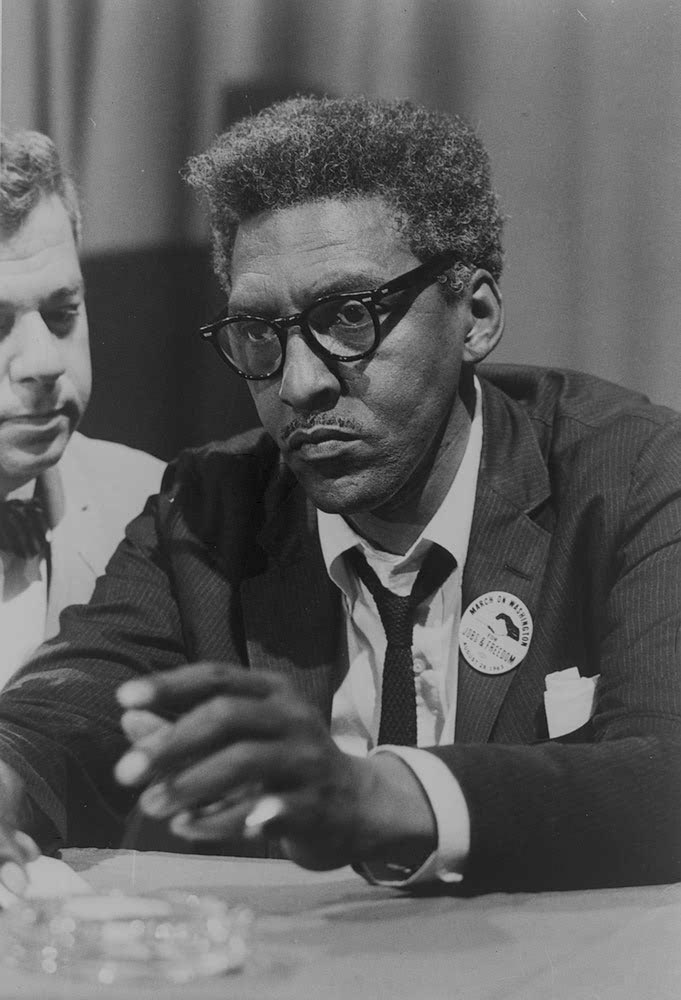 Recently, I was doing some research for a friend on Bayard Rustin. Rustin was a multi-talented man and one of the greatest grassroots organizers and advocates of nonviolent direct action in this country's history but he was a giant with feet of clay.
It seems to me that too often people are disheartened when they learn about the flaws of a personal hero but I think such knowledge should be reassuring. We don't have to be perfect to work in important struggles or try to do great things. Imperfect people can work for justice, too; indeed, we're the only ones who can.
So, I'm going to dish some dirt on Bayard Rustin because I think we can learn from both the powerful positive example of Rustin's life and from his negative example, too. Rustin was in the thick of many important social movement in the US in the last century and what he did or did not do tells us a lot not just about Rustin but about those movements. A final lesson is that we must be on guard for our own blind spots.
This isn't going to be an exhaustive list and it won't include some of the faults others find with him. To me, the three most outstanding flaws in Rustin were his sexism, his support for Zionism, and his internalized homophobia. He can hardly be faulted for the latter, except that it lasted so long—after Stonewall, even—and it was, in at least one instance, weaponized against someone else.
Rustin was the main organizer for the August 28, 1963, March on Washington but he sidelined women. The meeting mentioned below was the first major planning meeting after all the mainline civil rights organization had signed on. Daniel Levine writes:
[O]n July 2, at a luncheon at the Roosevelt Hotel in New York City, the "Big Six"—Randolph, King, John Lewis from SNCC, Whitney Young from the National Urban League, James Farmer, and Roy Wilkins—met. Dorothy Height of the National Council of Negro Women was not at that meeting. The NCNW was listed in the New York Times article as one of the original sponsoring organizations. The stationery of the march, however, did not list it. The addition of the National Council of Negro Women, as an afterthought, was typical of the whole march effort. It was as though the organizers came to the thought "Oh, we mustn't neglect the women." But they were not included as fellow planners or, as it turned out, as speakers at the march itself. ...[1]At that same meeting the men agreed "to add four white cochairmen to the march leadership" but black women were sent to the back of the bus.[3] Jervis Anderson writes:
A dozen days before the march, Randolph received letters from Anna Arnold Hedgeman, on the board of the SCLC and a member of the administrative committee of the March on Washington, pointing out that women were not being recognized. In response, Randolph, or maybe Bayard, suggested to the ten speakers that since they "were all men and since it is imperative that the role of women in the struggle be made clear, " important women should be invited to participate. Randolph suggested Rosa Parks, Mrs. Medgar Evers, Mrs. Daisy Bates, Mrs. Gloria Richardson, Mrs. Diane Nash Bevel. "The difficulty of finding a single woman to speak without causing serious problems vis-a-vis other women and woman's groups suggests ... that the chairman should introduce these women and tell of their role in the struggle and tracing their spiritual ancestry back to Sojourner Truth and Harriet Tubman," that they should be applauded, not speak, and then sit down. The male speakers and Rustin all agreed, and that is in fact what happened. Not one woman spoke from the platform.[emphasis added][2]
The program at the Lincoln Memorial was not as smooth in conception and execution as it seemed to the tens of thousands who applauded it. There had been, and probably still was, a brooding feminist rebellion behind the scenes. ... Only Daisy Bates (who had led the struggle to desegregate Little Rock's Central High School in 1957) was allowed a brief ceremonial turn on the platform, to introduce five "Negro Women Fighters for Freedom."Obviously, Rustin was not the only black male civil rights leader with a sexism problem but is it too much to ask a man who had repeatedly been pushed out of the limelight because of his sexual orientation to be more sensitive to issues of sexism? In the case of Rustin the answer may be yes.
Imperatively, those five included Rosa Parks, heroine of the 1955-56 Montgomery bus boycott. It was that event which not only produced the celebrated leadership of Martin Luther King, Jr., but also inaugurated the modern phase of black protest activism—a phase that had now reached its moral and popular zenith in the March on Washington. In fact, Anna Arnold Hedgeman, one of the newly disgruntled black women—she had been a passionate supporter of every mass initiative A. Philip Randolph had launched since 1941—now declared that the March on Washington would have been rightly called "Rosa Park's Day."
Perhaps, the strongest voice of feminist complaint was Pauli Murray's. Then studying at the Yale School of Divinity, she was among the black civil rights activists who had admired Randolph since the early 1940s. Seethingly displeased with particular arrangements for March on Washington, Pauli Murray wrote to Randolph a week before the event:I have been increasingly perturbed over the blatant disparity between the major role which Negro women have played and are playing in the crucial grass-roots levels of our struggle and the minor role of leadership they have been assigned in the national policy-making decisions. ... It is indefensible to call a national March on Washington and send out a Call which contains the name of not a single woman leader. Nor can this glaring omission be glossed over by inviting several Negro women to appear on the August 28 program.Perhaps such a letter would have been more appropriately addressed to Bayard Rustin; for it was he who organized the program and procedures of the March on Washington. [Murray's decision to write to Randolph is understandable since women were excluded from the March leadership and, thus, not privy to the behind-the-scenes decision to make Randolph the titular director while Rustin did the real organizing—VFPD] ... [Pauli Murray's] letter to Randolph echoed the earlier view of the feminist Ella Baker that black men did not want women to share the highest level of civil rights leadership.[4]
The time has come to say to you quite candidly, Mr. Randolph, that "tokenism" is as offensive when applied to women as when applied to Negroes, and that I have not devoted the greater part of my adult life to the implementation of human rights to [now] condone any policy which is not inclusive.
As Randall Kennedy notes in his review, "From Protest to Patronage:"
Before the late 1970s, Rustin spent little if any energy advancing the cause of equal treatment for lesbians and gays. ... [Lost Prophet: The Life and Times of Bayard Rustin author John] D'Emilio notes, however, that even with Rustin's forays into gay politics, he was never quite of it. The year before Rustin died in 1987, gay activist Joseph Beam invited Rustin to contribute to an anthology of writings by black gay men. "After much thought," Rustin responded, "I have decided that I must decline. ... I did not 'come out of the closet' voluntarily—circumstances forced me out. While I have no problem with being publicly identified as homosexual, it would be dishonest of me to present myself as one who was in the forefront of the struggle for gay rights. The credit for that belongs to others. ... While I support full equality, under law, for homosexuals, I fundamentally consider sexual orientation to be a private matter."This last remark by Rustin is an understatement. In fact, it seems that for most of his life Rustin accepted his own marginalization as a gay man as reasonable or even justified. Moreover, in 1971, when War Resisters League staffer David McReynolds " 'came out of the closet,' Bayard wanted him fired," according to McReynolds.[5] Levine writes that Rustin's "judgment was purely tactical" and Rustin wanted to protect the organization from the fallout over McReynold's admission. Ironically, after Rustin was sentenced to sixty days in jail in 1953 on a "morals charge"—he was arrested while having sex with two men in a car—McReynolds had been supportive and even visited him in jail. Rustin's internalization of homophobia may have led him to turn a blind eye to the marginalization of women, too.
In 1948, Jewish violence in Palestine killed thousands of Arabs. The creation of Israel also created 750,000 Palestinian refugees, driven from their homeland by Jewish terrorism and ethnic cleansing. Although Rustin was keenly sensitive, even self-conscious, about Jewish suffering in World War II he was callous about the suffering of Arabs at the hands of Jews just three years after the end of the WWII.[6] At one point, he even referred to Israel as "the opiate of the Arabs."[7]
In 1967, Israel launched a pre-emptive war on neighboring countries, killing thousands more, seizing additional Arab land and creating tens of thousands of additional Palestinian refugees. Although Rustin visited refugee camps in Thailand, Somalia, Pakistan and Puerto Rico as a representative of the International Rescue Committee, he pointedly refused to visit Palestinian refugees in the West Bank.[8] Just three years later, in 1970, Bayard Rustin betrayed his pacifist values and history and publicly lobbied for the United States to provide Israel with all the jet fighters and bombers it had requested.[9] Many of Rustin's old friends and colleagues were appalled.
After the United Nations General Assembly declared "zionism is a form of racism and racial discrimination" in 1975, Rustin started the Black Americans to Support Israel Committee.[10] He recruited an impressive list of national Black leaders but also attracted a number of Black critics, including one who wrote to a Jewish publication to say: "It is an insult to the collective intelligence of thirty-five million blacks that one hundred 'leaders' use their good name to support Zionism."[11] Psychologist Kenneth B. Clark was among those who refused to join BASIC. " 'I felt,' he explained later, 'that the Palestinians were human beings too; and that we could not have peace in the Middle East until the Palestinian problem was solved.' "[12]
In 1982, Israel invaded Lebanon killing nearly 20,000 Arabs, mostly civilians. Rustin helped whitewash Israel's atrocity as "an act of legitimate self-defense" and "not terribly destructive."[13]
Notes:
- Daniel Levine. Bayard Rustin and the Civil Rights Movement. (New Brunswick, NJ: Rutgers Univ. Pr, 2000) pp. 134.
- Levine, pp. 140-1.
- Jervis Anderson. Bayard Rustin: Troubles I've Seen. (New York: HarperCollins, 1997) p. 248.
- Anderson, pp. 258-9.
- Levine, p. 72.
- Anderson, p. 339.
- John D'Emilio. Lost Prophet: The Life and Times of Bayard Rustin. (New York: Free Pr., 2003) p. 483.
- Levine, p. 230.
- Anderson, p. 339; Levine, pp. 224-6.
- Levine, p. 226.
- Anderson, pp. 339-40.
- Anderson, p. 340.
- Levine, p. 231.
- http://www.wvu.edu/~lawfac/jelkins/lp-2001/murray.html
- http://www.pinn.net/~sunshine/whm2001/p_murray.html
Labels: Bayard Rustin, Black America, gender, history, Israel, LGBT, nonviolence, race, resistance, United States, Zionism


